
Wars in Ukraine and Iran Could Merge Into a Single Global Conflict – FT
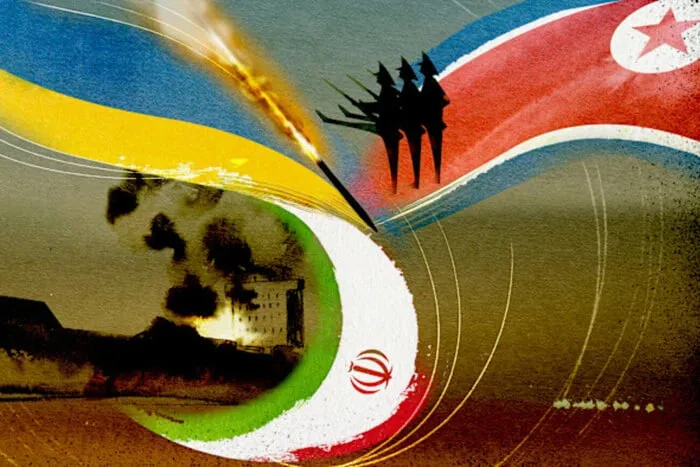
Russia’s war against Ukraine and the conflict in the Middle East are becoming increasingly intertwined and could become part of a broader global confrontation.
The publication’s columnist notes that deepening cooperation between Russia, China, Iran, and North Korea is changing the nature of modern warfare. In his view, such cooperation could lead to a larger-scale conflict that would engulf several regions of the world at once.
Signs of Interconnected Conflicts
Russia’s invasion of Ukraine has already become the bloodiest war in Europe since 1945, while the conflict between Iran, the U.S., and Israel has become the largest in the Middle East in recent decades. At the same time, in East Asia, China is stepping up its military activity around Taiwan, and North Korea is building up its military capabilities.
According to the author, these conflicts no longer exist in isolation from one another. “The current series of conflicts already meets some of the criteria for a world war. These overlapping wars now span two continents—Europe and Asia—and are influencing conflicts in Africa,” Rahman notes.
He emphasizes that the increasingly close cooperation between Russia, China, Iran, and North Korea has already prompted some American strategists to speak of the formation of a so-called “axis of adversaries.”
The author cites the participation of North Korean troops in the war against Ukraine as the first evidence of the convergence of these conflicts. The second, in his view, could be Ukraine’s strike on an Iranian vessel in the Caspian Sea that was heading toward Russia.
Rahman also suggests that Kyiv may seek to strengthen cooperation with the U.S. by highlighting Iran’s role in supporting Russia and Moscow’s involvement in assisting Tehran.
Risks of Further Escalation
The analyst notes that there is currently no official military alliance between Russia, China, Iran, and North Korea. However, according to him, these states share a common strategic goal: to weaken U.S. influence and strengthen their own positions in their respective regions.
At the same time, the author believes that China and the U.S., despite actively preparing for a possible confrontation, are still trying to prevent a direct war. However, this does not rule out the risk of a broader conflict, as history has repeatedly shown how regional wars and miscalculations by major powers have escalated into global conflicts.
This is the conclusion reached by Financial Times columnist Gideon Rahman.
Iran may attack Ukraine with ballistic missiles: the most dangerous one has been identified.
As a reminder, a pro-Iranian Telegram channel with nearly 400,000 subscribers is threatening ballistic missile strikes against Ukraine following Ukrainian President Volodymyr Zelenskyy’s latest statement regarding a strike on a vessel involved in transporting military cargo to Russia.
On July 25, Ukrainian President Volodymyr Zelenskyy instructed intelligence agencies to share information with international partners regarding possible new Russian support for the Iranian regime.
U.S. President Donald Trump, after 13 days of new military strikes against Iran, ordered a halt to the attacks.




