
Workers extract salt in the desert near Syria’s border with Iraq — Anadolu Agency
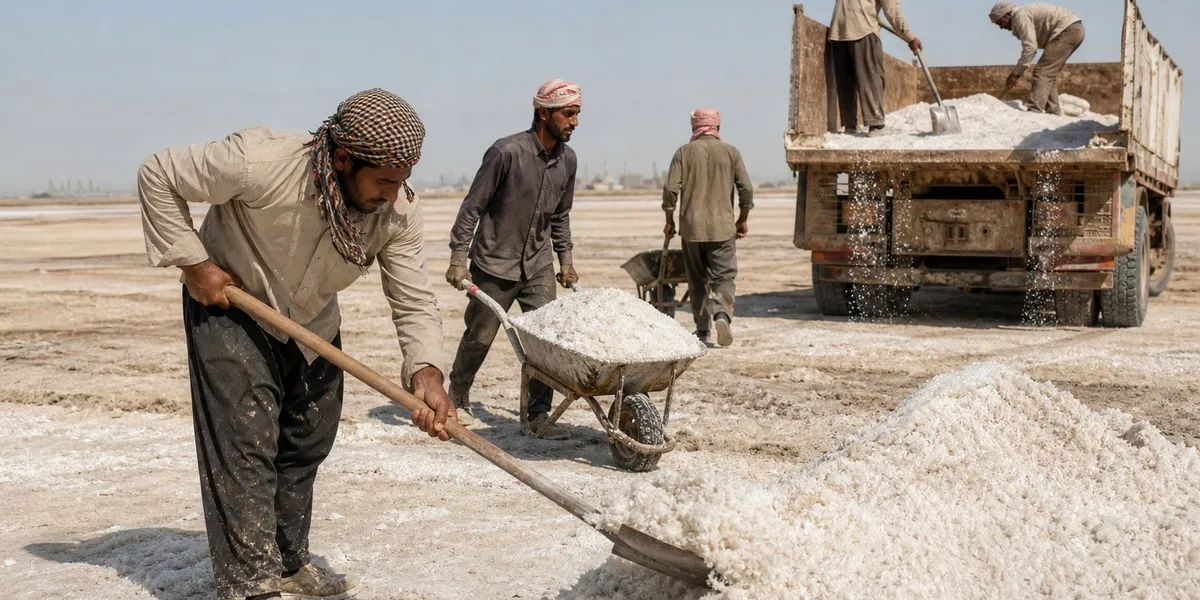
In the Deir ez-Zor desert in eastern Syria, near the border with Iraq, workers manually extract salt from beneath soil hardened by the heat. For many families, this seasonal work remains one of the few available sources of income due to a lack of other employment opportunities, Anadolu Agency reports.
Working under the sun and in dust
Workers use simple hand tools to loosen the dense soil and reach salt-bearing layers. The salt is then collected and transported. The work requires physical endurance, especially in conditions of intense heat and thick dust.
Worker Bilal Mustafa said that people remain under the sun throughout the working day and become very exhausted before the truck arrives. According to him, he and other workers tried to find jobs in other fields, but returned to salt extraction because there were no alternatives.
Mustafa noted that earnings depend on the amount of work completed: he receives $50 for a truck filled during the day, and $25 if the truck cannot be filled.
More current news is available on the UA.News Telegram channel Telegram.
How salt is extracted and sold
Extraction is only part of the process. According to Mustafa, the salt is also processed with water, and workers stir it with shovels in pools for hours.
Another worker, Osama Samer, explained that workers first dig a pit and fill it with water. After two to three days, a salt layer begins to form on the surface. It is collected in wheelbarrows, weighed, delivered to a loading ramp and loaded onto trucks.
The collected salt is transported by truck to Deir ez-Zor province, where it is packaged and sold. Samer said that a tonne of salt is sold for about $10. Extraction is seasonal: it begins at the end of winter and continues until the beginning of the following winter, although most work takes place in summer. Once the rains begin, work stops completely.
Samer added that workers work about five hours a day and receive a daily wage of 5,000 Syrian pounds, which, according to him, amounts to about 1,700 Turkish lira. Salt trader Muhammad Ali noted that operating and transportation costs consume a significant share of the income.


