
Udi Christians hold service at Gandzasar Monastery in Karabakh — Euronews
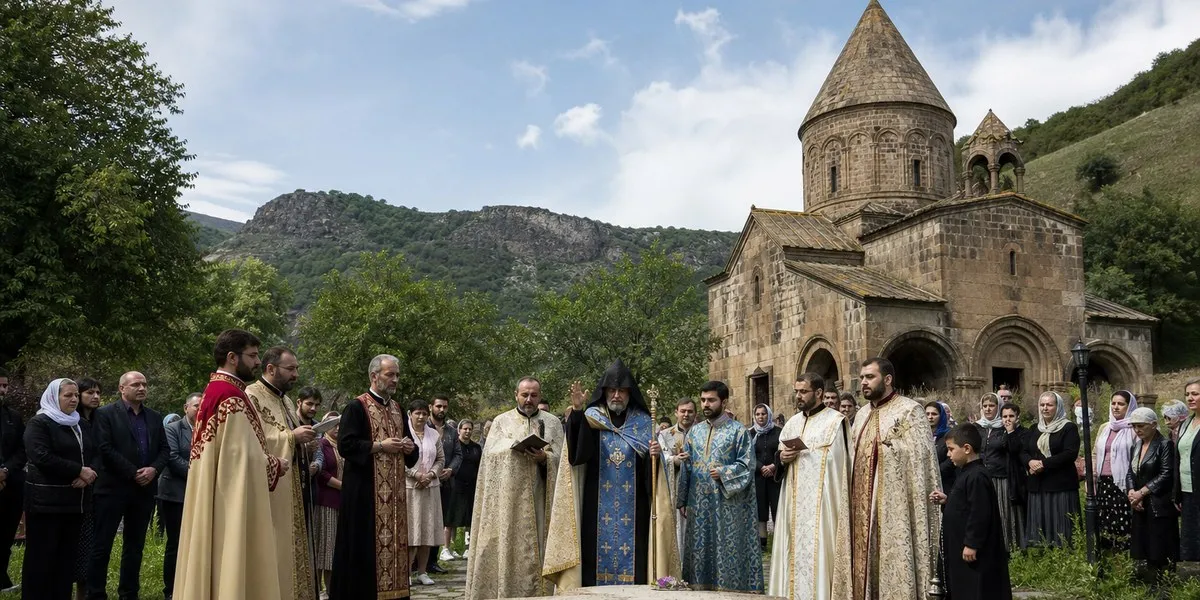
The Udi Christian community held a worship service at Gandzasar Monastery near the village of Vangli in Azerbaijan’s Aghdara District. The service took place on September 21 at the historic 13th-century monastery, which is one of Karabakh’s Christian landmarks.
As Euronews reports, the event was held as part of a government program dedicated to studying the region’s Christian heritage and religious traditions. Community representatives and clergy prayed in the church, including in the Udi language.
Pilgrimages of the Udi community
The Udis are an indigenous, predominantly Christian ethnic group of Azerbaijan, living mainly in the village of Nij in the Gabala District. Their community makes pilgrimages to Christian landmarks in Karabakh, including the monasteries of Khudavang, Agoglan and Amaras.
More current news is available on the UA.News Telegram channel Telegram.
Danakari Rafiq Arami, deputy chairman of the Alban-Udi Christian community, called holding the service at Gandzasar an important event for pilgrims. “Today, thanks to the achievement of independence, we are at a monastery built by our holy fathers. We are proud of our history,” he said.
Dispute over historical heritage
The monastery’s main church was built by Prince Hasan-Jalal Dawla between 1216 and 1238. Azerbaijan attributes Gandzasar to the Christian tradition of Caucasian Albania, while Armenia considers it a monument of the Armenian Apostolic Church. Differing interpretations of the church’s origin and historical affiliation remain a subject of disagreement between the two countries.
On September 12, Gandzasar and Khudavang were visited by a diplomatic delegation accredited in Azerbaijan. Its members were told about the history and architecture of the landmarks, as well as Azerbaijan’s claims regarding changes to these structures. EU Special Representative for the South Caucasus Magdalena Grono, who took part in the visit, said there were “deeply divergent views and narratives” regarding the origin of certain sites and stressed the need to resolve historical disputes as part of the reconciliation process.




