
U.S.-Iran Deal Sends Brent Crude Prices Plummeting to Lowest Level Since March — Reuters
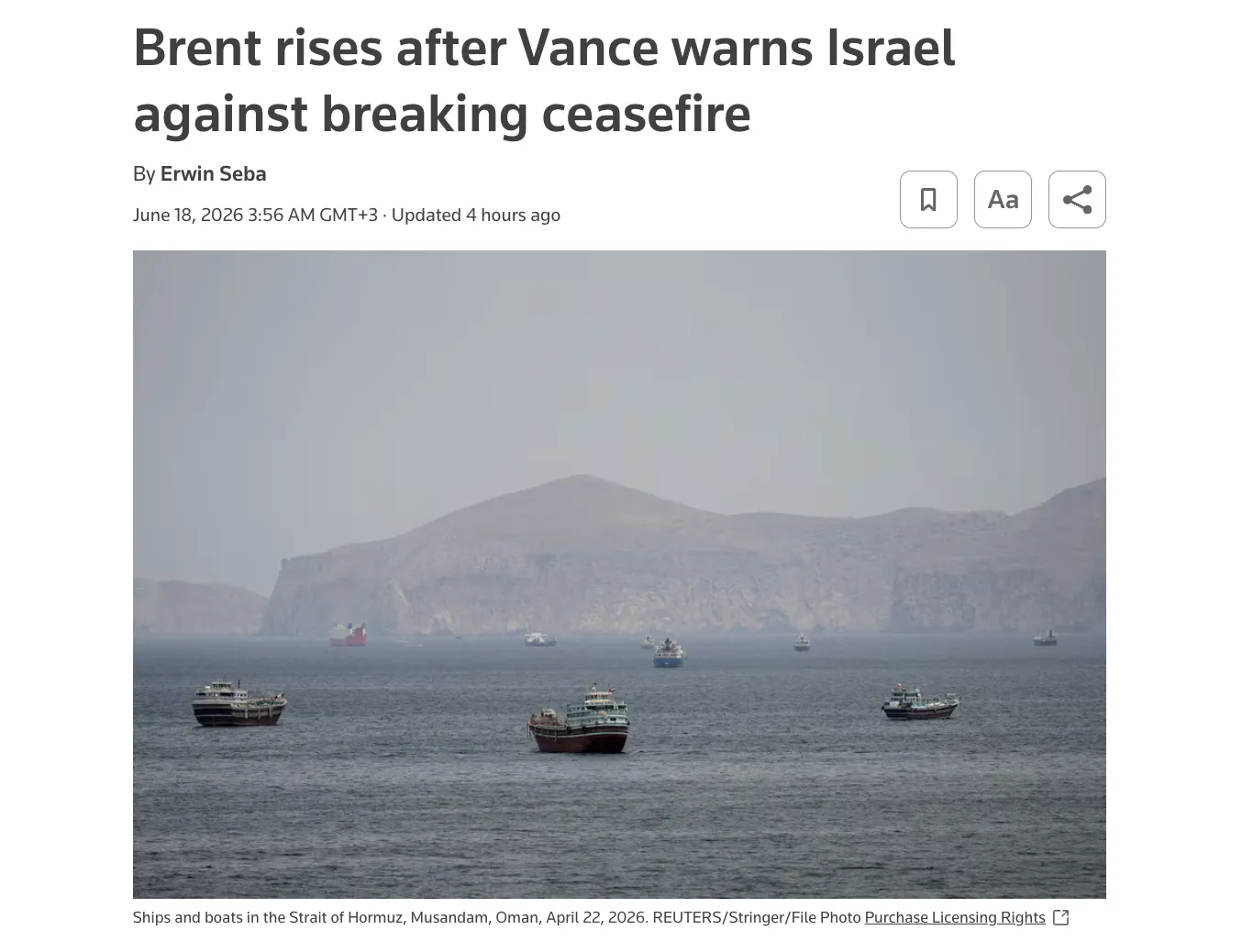
Global oil prices fell sharply on Thursday, June 19, amid reports of an agreement between the U.S. and Iran. Brent futures fell to $77.96 per barrel, while WTI futures dropped to $74.96, their lowest levels since late February.
The catalyst for the drop was the signing of a 14-point memorandum of understanding between the U.S. and Iran, which provides for the opening of the Strait of Hormuz to duty-free shipping. The document also extends the ceasefire for 60 days and applies to allies of both countries—in particular, Lebanon, where Israel had been conducting an operation against Hezbollah. Just a few hours after the signing, three Saudi supertankers passed through the strait.
Prior to the signing of the memorandum, approximately 20% of global oil exports passed through the Strait of Hormuz—a narrow maritime corridor between Iran and Oman. The agreement mandates the restoration of pre-war traffic volumes within 30 days.
The decline was halted by remarks from U.S. Vice President J.D. Vance, who warned Israel against further strikes on “Hezbollah” in Lebanon. The market reacted nervously.
“The vice president’s statements regarding Israel have brought the situation back to the brink,” said John Kilduff, a partner at Again Capital. According to him, even the slightest disturbance will be immediately reflected in the market.
At the close of trading, Brent settled at $79.85 per barrel (+0.38%), while WTI closed at $76.60 (-0.25%). Analysts at BNP Paribas do not expect a return to pre-war prices and consider $75 per barrel to be a stable floor for the near term—given the loss of inventories and the recovery in demand. Goldman Sachs forecasts that exports from the Persian Gulf will return to pre-war levels by the end of July, with production expected to recover by October.
While the Strait of Hormuz was blocked, Russia earned nearly twice its usual amount from oil in April—about $9 billion. The Russian Federation’s oil and gas budget revenues for April reached 855 billion rubles, compared to 617 billion in March—a 38% increase. This money directly financed the war against Ukraine.
Now the picture has changed. The drop in Brent prices below $80 per barrel is hitting the Kremlin’s tax revenues: the tax price of oil used to calculate payments is tied to market prices with a one-month lag. According to analysts’ estimates, June is already shaping up to be worse for the Russian Federation’s budget than May due to the decline in the tax price. If the Strait of Hormuz operates at full capacity, oil prices could drop even further—and the Kremlin will have to either cut war spending or dip deeper into its reserve funds.
The International Energy Agency forecasts a significant oil surplus in 2027 following the resumption of shipments through the strait. China—the largest buyer of Iranian oil—has meanwhile revised its consumption forecasts downward: PetroChina expects demand in China to fall by 4.9% this year due to the transition to renewable energy and the aftermath of last year’s price shocks, Reuters reports.
See also:
U.S. and Iran to Create $300 Billion Fund to Revive the Economy — Reuters
Peace on Tehran’s Terms: Why the Deal with Iran Resembles a U.S. Capitulation


