
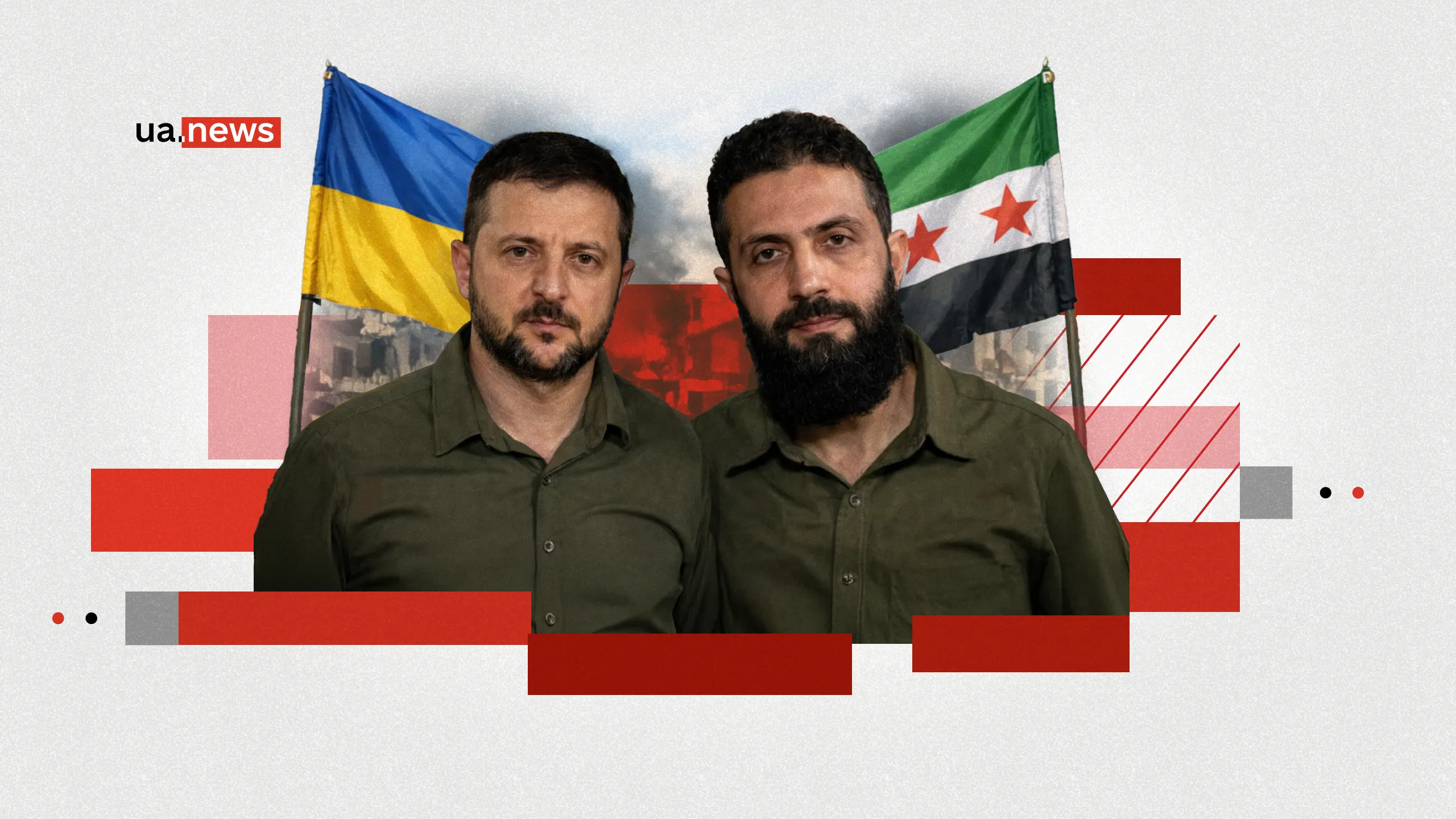
Volodymyr Zelenskyy regularly undertakes a wide range of international visits — more than all previous Ukrainian presidents combined. People have already grown accustomed to this, and visits to France, the United Kingdom, Canada, or the United States no longer surprise anyone. However, at times, the head of state still surprises Ukrainians and the expert community with rather unexpected, controversial, and non-obvious choices of destination.
On Sunday, 5 April, the Ukrainian leader arrived in the Syrian capital, Damascus. He arrived following a prior visit to Turkey, travelling on an official Turkish government aircraft together with that country’s foreign minister. Zelenskyy has already held a number of meetings, including with the new leader of the Syrian Republic, Ahmed al-Sharaa.
It should be recalled that since 2011, Syria has been engulfed in a brutal and bloody civil war. The country had been ruled for decades by the Assad family: first Hafez al-Assad, and then, from 2000, his son Bashar al-Assad. This ineffective, repressive, and corrupt Middle Eastern dictatorship eventually led to a social explosion, an attempt to overthrow the government, and a protracted and exhausting war in the literal sense of a war of all against all. Bashar al-Assad managed to retain power for 13 long years of conflict, not least thanks to military assistance from Russia.
However, everything came to an end in December 2024: the radical Islamist group Hayat Tahrir al-Sham launched an offensive against government forces, as a result of which the Assad regime collapsed, and the dictator himself fled to Moscow. Ahmed al-Sharaa became the new leader and began bringing the country out of long-standing diplomatic isolation.
However, one should not be under any illusions: the war in Syria has not ended, and the country has by no means embarked on a path towards peace, recovery, and democratisation. Assad was a brutal and corrupt dictator, but his regime was secular in nature, without signs of religious fundamentalism. The new head of state, however, is a former officially recognised terrorist and one of the leaders of the Syrian branch of Al-Qaeda (the organisation responsible for the 11 September attacks). He does not conceal his Islamist views, and before donning a presidential business suit, he spent many years wearing the uniform of a militant field commander. Under al-Sharaa’s leadership, systemic repression of opposition groups has continued, including at the level of entire ethnic and religious communities. In a literal sense, massacres of Christians and Alawites in so-called “unreliable” provinces marked the beginning of his rule.
And it is to this individual that the President of Ukraine — a country that declares its commitment to freedom, democracy, and European values in contrast to dictatorship — has paid an official visit. To say that Ahmed al-Sharaa is a highly controversial figure would be an understatement. The moral, ethical, and value-based aspects of such a policy leave considerable room for debate. It is also noteworthy that, according to many media reports, Rustem Umerov, Secretary of the National Security and Defence Council, played a key role in organising this trip, despite having been largely absent from the public sphere following the so-called “Mindich-gate”.
So why did Zelenskyy travel to Syria and meet with its leader? What are Kyiv’s interests in this country? What can be expected from the visit? UA.News put these questions to political experts.
“The Ukraine–Turkey–Syria triangle makes sense” — Yevhen Mahda
Ukraine is seeking opportunities to realise its potential as a contributor to security in the Middle East. Both the visit to Turkey and the visit to Syria are fairly consistent in this regard, as Turkey is our strategic partner. That said, the “quadriga” format — meetings of the foreign and defence ministers of Ukraine and Turkey — has not convened for quite some time.
Turkey has its own interest in acting as a mediator between Ukraine and Russia, while also attempting to position itself as a key intermediary for Middle Eastern countries. Turkish influence is clearly visible and significant in both Libya and Syria. This is no secret. Therefore, the formation of a conditional “Ukraine–Turkey–Syria triangle” makes sense. However, it must also be understood that achieving immediate results in the East — where Turkish, American, and Gulf state influences intersect — is, to put it mildly, not easy.
The fact that Mr Umerov was involved is logical for the Secretary of the National Security and Defence Council. It is also understandable given his background as a Crimean Tatar with strong connections in Turkey, where several million Crimean Tatars reside. However, this is not a situation where quick decisions or rapid successes should be expected. The East is a delicate matter, and this should not be forgotten.
Ukraine must undoubtedly knock on these doors — but finding the right key will require considerable effort.

“Zelenskyy’s visit to Syria is an attempt to counter Russian influence” — Volodymyr Fesenko
The fact that Zelenskyy arrived in Damascus on a Turkish aircraft together with Turkey’s foreign minister indicates that the Turkish side clearly facilitated this visit. Interestingly, presidential adviser Dmytro Lytvyn commented that it was a joint initiative of both Turkey and Ukraine. Whether it had been planned in advance or decided during the visit to Turkey remains unclear.
However, the situation indicates that Ukraine and Turkey share interests in this region. Ankara has considerable influence over the current Syrian leadership and is strengthening its position in the Middle East. Ukrainian and Turkish interests also align in other countries, such as Libya, where conflict continues and even a small Ukrainian military mission is present. Turkey is also providing assistance there.
At the same time, these are all countries with a significant Russian presence. Russia still maintains military bases in Syria, and Vladimir Putin is making significant efforts not only to preserve but also to restore Russian influence in the country. This runs counter to the interests of both Turkey and Ukraine.
It is important to understand that Ukraine is countering Moscow’s influence not only on the battlefield and not only within its own territory. It is also confronting the aggressor in other regions of the world wherever possible. Therefore, Zelenskyy’s visit to Syria represents an attempt to counter Russian influence in the region. There are also interests in developing cooperation in defence and security.
Another important point: previously, Ukraine primarily received assistance, but now it is also capable of providing services in the security sector. This is of interest to Syria, where military challenges remain relevant. In addition, Damascus is a potential buyer of Ukrainian agricultural products, offering promising prospects for cooperation in food supply.
Overall, Ukraine’s active policy in the Middle East demonstrates its geopolitical agency. This is a positive development. However, the region remains highly complex and contradictory, with major actors such as the United States and Israel also showing strong interest. Therefore, coordination is essential.
As for Umerov, he has long been actively engaged with the Middle East. Even before becoming Secretary of the National Security and Defence Council, he participated in negotiations with countries in the region and has extensive personal connections, including in Turkey and Saudi Arabia. He has been and remains Ukraine’s key communicator in this region.
Why Ukraine needs Syria — Ruslan Bortnyk
Zelenskyy’s visit to Syria will undoubtedly be perceived as part of a “Turkish track” within the Ukrainian leadership and as strengthening the position of Rustem Umerov, who is responsible for communication with Turkey and the broader Muslim world. However, the more important question is: why does Ukraine need Syria?
Ukraine sought engagement with Syria immediately after the change of power there. Kyiv wants Damascus to abandon Russian military presence. Ukraine views Russian military bases in Syria as part of Moscow’s logistics network for transporting grain and other resources from the Black Sea and Azov Sea regions — logistics that Ukraine is actively trying to disrupt.
Thus, Ukraine sees this as part of its broader effort to counter Russian logistics, military presence in the Middle East and Africa, and as a tool for exerting pressure on Russia.
Secondly, Syria, along with Egypt, has traditionally been seen as a destination for Ukrainian agricultural exports, particularly grain and oil. Ukraine is offering such supplies in exchange for political and military-political agreements.
Thirdly, Syria’s geopolitical importance remains extremely high, given its strategic location and its ability to influence the wider region, from Iraq to Israel.
Finally, there is the issue of manpower. A large number of trained fighters are currently present in Syria. Recruitment into the Armed Forces of Ukraine, including the Foreign Legion and potentially involving Syrian fighters, may also be among the government’s objectives. This is particularly relevant given that Ukraine already has units composed largely of Muslim fighters, including Chechen and Crimean Tatar formations.
Therefore, all these motivations likely play a role. For Ukraine, Syria represents both an opportunity to strengthen its geopolitical influence and another potential point of pressure on Russia.

“Zelenskyy did not go to Syria by chance” — Viktor Nebozhenko
The current Syrian president, who previously spent time in a US prison in Iraq and was once considered a terrorist, has nevertheless been received by Western leaders, including the King of the United Kingdom, Donald Trump, and European officials. Therefore, a meeting with him does not represent a diplomatic misstep.
More importantly, Nebozhenko points out that when armed groups led by the future Syrian president overthrew Assad and captured Russian bases, one of the key military tactics involved the large-scale use of drones, particularly on central roads — something Assad’s forces were completely unprepared for. This played a major role in the capture of Damascus.

At that time, only one country in the world had several years of experience using drones in combat and had an interest in the fall of Assad — Ukraine.
Therefore, Zelenskyy’s visit was not accidental. He is engaging with a leader who understands the importance of Ukrainian expertise in defence technologies and the potential for cooperation in this field.
