On February 24, 2022, Russian aircraft entered Ukrainian airspace with a sense of complete impunity. In Russian command centers, they expected that the first strikes by Kalibr and Iskander missiles would paralyze Ukrainian command and control, destroy air defenses, disable airfields, and pave the way for a rapid capture of Kyiv.
However, instead of the expected collapse, the enemy faced a mobile, cohesive, and resilient defense. The Ukrainian system did not break down; it quickly adapted and began to operate according to scenarios the Russian side had not anticipated.
This was reported bythe Ukrainian Air Force Command.
What was supposed to be a lightning-fast air blitzkrieg turned into one of the most intense air battles of the 21st century. Ukraine prevailed thanks to its flexibility, determination, and coordinated actions.
Every timely maneuver by the units saved lives in the capital, and every sortie by Ukrainian aircraft shattered Russian plans and the myth of its invincibility.
The First Strike: The Battle for Control
In the first hours of the invasion, the occupying forces launched massive missile strikes against command posts, radar stations, anti-aircraft units, and airfields. The goal was clear—to “blind” the Ukrainian defense and disrupt the resistance. Particular emphasis was placed on the Gostomel airfield as a staging ground for the airborne assault.
However, the system held firm. In just the first two days, the enemy lost 14 aircraft, 8 helicopters, and dozens of missiles. The expectation of an easy victory turned into grueling air battles, in which numerical superiority could not compensate for a lack of flexibility.
“The 300s”: The Art of Anticipation
The Russians fired dozens of missiles at stationary S-300 positions. Most landed in empty silos. The Air Force command executed a dispersal maneuver: heavy equipment had left the bases in advance of the attacks.
It was the “300s” that forced enemy aircraft to abandon high-altitude flights. They closed the sky at high altitudes, depriving the occupiers of the ability to bomb safely. Russian aircraft were forced to descend lower—right into the range of our tactical air defense.
“Buk-M1”: “Ambush” Tactics and Mobile Defense
While the S-300 battalions kept high altitudes under control, the “Buk-M1” systems employed “ambush” tactics. Mobile fire units did not keep their radars on constantly. They would “wake up” for a few minutes based on data from observation posts, launch a missile, and instantly disappear into the forests and woodlands. This tactic allowed them to effectively withstand a superior air force, combining the use of Ukrainian fighters and “Buk” systems in air combat against the Russians.
For Russian aviation, this meant one thing: there were no safe routes in the skies over the Kyiv region. These “nomadic hunters” shot down quite a few “invincible” Su-34s and Su-35s, turning the pride of the Russian aviation industry into charred wreckage in the fields near Makariv and Borodianka.
“The Ghost of Kyiv”: A Myth That Became a Weapon
When there were 5–6 enemy fighters for every Ukrainian pilot, the legend of the “Ghost of Kyiv” was born. It was a collective image of the pilots of the 40th Tactical Aviation Brigade and fighter pilots from other brigades who were fighting in the skies over the capital during those days.
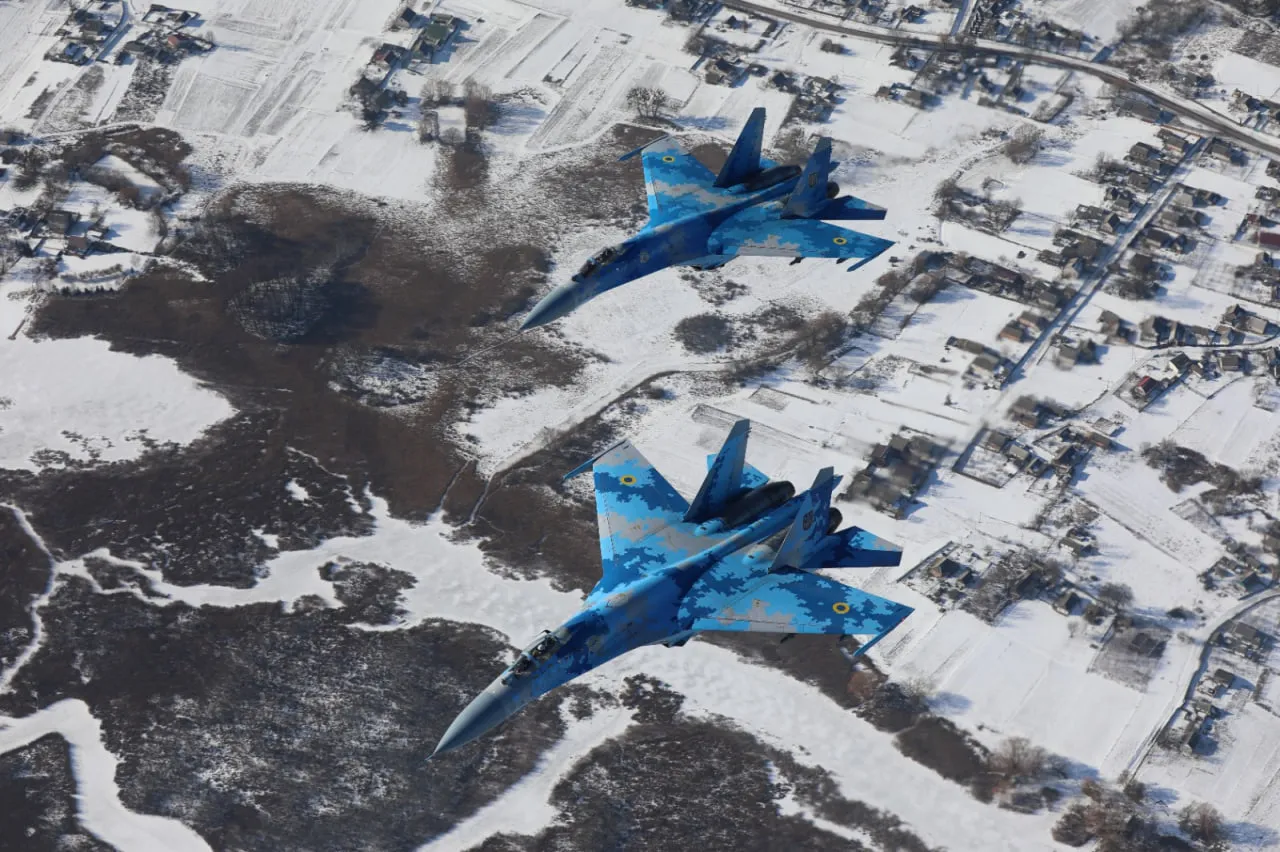
Flying old Soviet MiG-29s and Su-27s, and significantly outnumbered by the enemy in terms of aircraft, firepower, and radar range, our pilots forced the Russians into close-range dogfights. Using the terrain, they skimmed the ground to launch surprise attacks on the enemy, essentially driving the enemy into Buk missile ambushes.
Unfortunately, many heroic Ukrainian pilots did not return from their missions; at the cost of their own lives, they cleared the capital’s skies of the aggressor.
The legend of the “Ghost” demoralized the enemy more than any air defense system. Russian pilots, upon hearing reports on the radio about Ukrainian fighter jets in action, would often drop their bombs in an empty field and turn back before reaching their target.
Strike Power: Su-24M and Su-25 Against “Long Convoys”
While the fighters engaged in aerial duels, the Su-24M bombers and Su-25 attack aircraft became a key factor in destroying the occupiers’ logistics.
During those critical weeks, Ukrainian pilots flew at extremely low altitudes, breaking through dense enemy air defense fire. They methodically “cut through” multi-kilometer-long columns of Russian equipment near Hostomel, Bucha, and Makariv. It was these strikes, combined with the work of artillery and Bayraktar drones, that bled the offensive dry, turning the enemy’s logistics plan into chaos.
Each such sortie was an act of the highest professional courage—the attack aircraft pilots operated in the very heart of hell to give the infantry a chance for a successful counteroffensive.
Why did they lose control of the skies over the capital?
Exactly four years ago, on April 2, 2022, thanks to the coordinated actions of all branches of the military, the Kyiv region was completely liberated from Russian forces. This was a pivotal event in the first months of the full-scale war, one that shattered the occupiers’ plans. The Armed Forces of Ukraine defended the capital and delivered a powerful blow to the enemy. Putin’s plan—“to take Kyiv in three days”—failed.
In summary, the Russians lost the Kyiv region not due to a lack of equipment or manpower. They lost because of excessive overconfidence, an outdated doctrine, and rigid centralized command, which prevented them from adapting quickly.
The Ukrainians, on the other hand, acted in the opposite way—boldly and autonomously: field commanders made decisions in a matter of minutes, and air defense and aviation units constantly changed positions. And most importantly, every pilot, anti-aircraft gunner, and drone operator knew what they were fighting for.
The Foundation of Today’s Strength
The battle for Kyiv was won not only by missiles, but also by the titanic efforts of technicians, communications specialists, and tablet operators who worked around the clock to stitch the torn sky into a single network. Gaining combat experience and receiving additional weapons from partners, the air defense grew stronger with each passing day.
Today, as Patriot and IRIS-T systems operate over the capital, we must not forget: the path to modern air defense was paved precisely by those “old” S-300s, “Buk” systems, and weary MiG-29s that held the Ukrainian skies in the spring of 2022.
THE FORMULA FOR VICTORY: A COMMANDER’S WORDS
"Back then, we had neither Western fighters nor modern air defense systems like the Patriot. We worked with what we had. Everything was put to use: disinformation, show of force, and false radio communications. We deliberately ‘painted’ a distorted picture of the air situation for the enemy.
We knew the first strike would target command centers and airfields. That’s why, just hours before the attack, we carried out a dispersal maneuver. Radio-technical and anti-aircraft missile units moved to alternate positions, while aviation units went to reserve airfields. Our plan for deploying our assets changed instantly. By the time the first Russian missiles struck empty hangars, our resistance was already gaining momentum.
The first encounter in the sky took place just an hour and a half after the dispersal. The Russians were proceeding “by the book,” confident that our air defense had been neutralized. We proved them wrong. When our fighters went to intercept them, the enemy did not engage. They turned their aircraft around right over the Dnipro River.
The command staff—from brigade commanders down to squadron leaders—was granted the necessary autonomy. Everyone had the ability to act independently even with limited information. At the same time, we maintained constant communication: analyzing the enemy’s actions, identifying their weaknesses, and quickly implementing new decisions.
Conditions were extremely difficult: fog, freezing temperatures, precipitation, and limited visibility. But during all this time, not a single combat mission was disrupted.
It was precisely thanks to this systematic work, the pilots’ determination, and the anti-aircraft gunners’ resilience that the enemy’s air blitzkrieg failed.
"The sky over the capital is neither a coincidence nor a stroke of luck. It is the result of decisions, preparation, and responsibility. We didn’t just hold the sky—we shattered their belief in their own invincibility," emphasized Lieutenant General Anatoliy Kryvonozhko, Commander of the Ukrainian Air Force.