
Expanding Impact Through a Committee System: The NAAU Shared Its Experience with the NAAKU
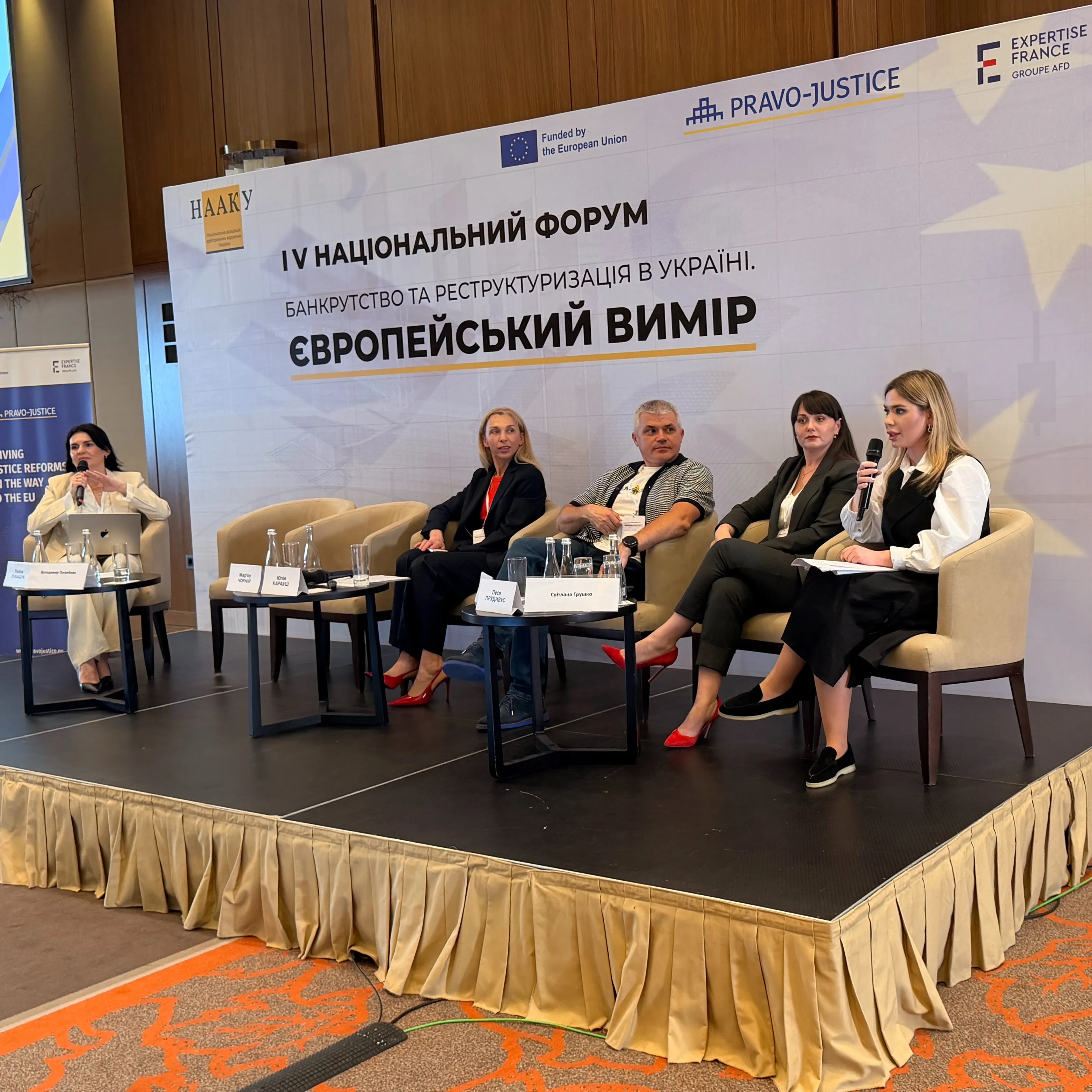
On May 22, 2026, the 4th National Forum of the National Association of Arbitration Administrators of Ukraine (NAAAU), titled “Bankruptcy and Restructuring in Ukraine: The European Dimension,” was held in Kyiv. One of the key events of the session dedicated to professional development and institutional capacity was a presentation by Svitlana Hrusko, coordinator of the committees of the National Bar Association of Ukraine (NBAU). She shared a practical case study—unique among Ukrainian self-regulatory organizations—on building a system of specialized committees as the primary expert and advocacy core.
During her presentation, Svitlana Hrusko reported that today the UNAU unites over 70,000 lawyers; over 14 years of development, the association has built an extensive system of committees that has evolved from nominal structures into a powerful working tool. As of 2026, 58 committees are active within the UNAA, bringing together 869 specialists. This experience generated significant interest among arbitration administrators, who are currently in the process of actively forming their own institutional structure.
In her speech, Svitlana Hrusko emphasized that although the law does not explicitly require the creation of committees, real-world experience has quickly demonstrated their necessity. Statutory governing bodies make strategic decisions, but a reliable expert foundation is needed to ensure their quality.
“The legal profession is divided into dozens of narrow specializations. A criminal defense attorney and an international arbitration attorney are, in fact, representatives of different worlds. No governing board is capable of covering the entire spectrum of this expertise on its own. The committees have become the bridge that allows us to engage the best narrow-profile specialists in the development of the profession without the need to elect them to governing bodies,” noted the coordinator of the UNBA committees.
The statistics presented on the activities of the UNAA committees clearly demonstrate the extent of their influence on the country’s legal landscape. Thus, during 2025, the committees prepared 115 expert opinions on draft laws. Among the major achievements are advocacy support for the law prohibiting the identification of a lawyer with a client (adopted in 2025), systematic participation in the recodification of the Civil Code, and work on draft law No. 12439 regarding security guarantees for business entities.
An important feature, according to Svitlana Hrusko, is that work in the committees is carried out exclusively on a voluntary basis. That is, the main driving forces for specialists are professional reputation, access to unique expert networking, the opportunity to directly influence the formation of legislation, and a sense of involvement in a common cause during wartime.
Addressing colleagues from the Association of Arbitration Administrators who plan to develop their own committee system, the NAAU representative advised against rushing and not attempting to immediately replicate cumbersome structures.
“It took us over twelve years to reach 58 committees. Don’t start with a large number. Create 3–5 strong committees focused on your most pressing needs and let them build their credibility. And most importantly—start not with the structure, but with the people. Find those who are truly passionate about the idea, and build the system around them. Everything else will fall into place,” concluded Svitlana Hrusko.
Also, during a discussion with representatives of the National Association of Ukrainian Bar Associations (NAAKU), the coordinator of the Ukrainian Bar Association (NAAU) committees reminded the audience that on May 1, 2026, the Council of Bar Associations of Ukraine considered an appeal from NAAKU Chairman Oleksandr Bondarchuk and adopted a resolution regarding amendments to the Procedure for Admission to the Qualification Exam. From now on, the work of an arbitration manager with a full higher legal education who operates in accordance with the Code of Ukraine on Bankruptcy Procedures is officially recognized as meeting the criteria for legal experience required to be admitted to the bar exam.


