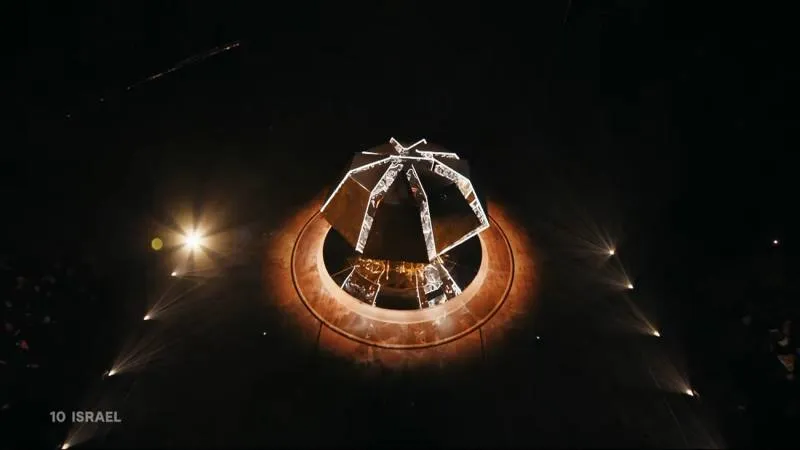
On the night of May 12–13, the first semifinal of the Eurovision Song Contest 2026 took place, with Israel’s representative, Noam Bettan, emerging as one of the most talked-about contestants. The artist impressed the audience with a grand production, an unusual stage design, and an emotional performance of the song “Michelle,” which allowed him to advance to the contest’s final.
Noam Bettan performed as number 10.
His contest entry, “Michelle,” tells of complex romantic relationships, inner turmoil, and the destructive power of love. A unique feature of the performance was that the singer performed the song in three languages at once—Hebrew, French, and English—which gave the performance an international flair and captured the attention of the European audience.
Israel’s production was one of the most spectacular in the first semifinal. The stage was designed using mirrored structures, intricate lighting, and visual effects. The centerpiece of the set was a large, sparkling diamond, around which the choreography unfolded. Joining Noam Bettan on stage were dancers who complemented the performance with synchronized movements and theatrical elements.
Viewers on social media actively discussed both the performance itself and the artist’s stage image. Many users called Israel’s performance one of the strongest in terms of visual appeal and emotional delivery.
At the same time, Israel’s participation in the contest was accompanied by heated debates and calls for a boycott. On the eve of the semifinals, a number of countries and individual representatives of the music community expressed dissatisfaction with the Israeli participant’s admission to the contest amid the war in the Gaza Strip.
The criticism was sparked, in particular, by reports of journalists being killed during Israeli shelling of Gaza. Some participants and activists claimed that Israel was allegedly using “Eurovision” as a political tool to improve its international image.
Representatives from Spain, the Netherlands, Slovenia, and Belgium openly spoke out against Israel’s participation. Some former contestants also joined the discussion. In particular, Austrian singer JJ and Swiss artists Nemo called on the organizers to be more attentive to the international context surrounding the contest.
Despite the wave of criticism and political controversy, the Israeli representative managed to garner enough support from viewers to advance to the final. After the results were announced, Noam Bettan thanked his fans for their support and noted that music should unite people regardless of political conflicts.
The Eurovision 2026 final will take place in the coming days, and the battle for victory promises to be one of the most intense in recent years.
In Vienna, during the first semi-final of Eurovision 2026, viewers noticed the stage design, which people on social media began comparing to the Ukrainian trident. Photos and videos quickly spread across the internet and sparked lively discussion among users.
The first semifinal of the 70th anniversary Eurovision Song Contest has kicked off in the Austrian capital. Fifteen countries are competing for a spot in the final tonight.
Moldovan artist Satoshi will be the first to take the stage in today’s Eurovision semifinal. In just a few years, he has gone from a young man from a small town to one of Moldova’s most prominent young musicians, and his name has been the subject of heated discussions on more than one occasion.
Swedish singer FELICIA will be the second to take the stage in the Eurovision semi-final today. The artist has long been known in Sweden, but previously performed under a different stage name—Fröken Snusk—which has sparked controversy and heated debate on more than one occasion.
The Croatian band LELEK will perform in the Eurovision semi-final today with their song “Andromeda.” The group has become a real sensation in Croatia thanks to their blend of folk motifs, electronic music, and modern pop sounds.
Greek singer Akylas has become one of the youngest and most talked-about participants in Eurovision 2026. The artist rose to fame thanks to TikTok and now represents Greece on Europe’s premier music stage. Today he will perform in the contest’s semifinals as the fourth act.
The Portuguese band Bandidos do Cante has become one of the most striking discoveries of Eurovision 2026. The group has combined traditional singing with modern pop music and quickly gained popularity in Portugal. Today, the band will perform in the second semifinal of the contest as the fifth act.
The Georgian group Bzikebi, which once won the Junior Eurovision Song Contest, has returned to the contest stage. The group, which many remember for their “bee” costumes and song in a made-up language, is now representing Georgia in the adult Eurovision Song Contest.
Finland is represented at Eurovision 2026 by an unusual duo—pop singer Pete Parkkonen and world-renowned violinist Linda Lampenius. The artists come from completely different musical worlds but have joined forces for a major performance at the contest.
Tamara Živković is one of the young artists who hasbeen the talk of the Balkans lately. The singer from Montenegro quickly gained popularity thanks to her powerful vocals, emotional performances, and distinctive style.
Vanilla Ninja is a band well-remembered by fans of 2000s music. The Estonian group was once a true sensation in Europe and has now returned to the spotlight thanks to Eurovision 2026.
Noah Bettan is one of the young artists who has been rapidly gaining popularity in Israel recently. He is called the new voice of a generation because of his emotional songs, sincere lyrics, and unique delivery.
ESSYLA is a young Belgian singer who has rapidly madea name for herself in recent years and has already become a recognizable figure on the music scene in French-speaking Belgium.
Lion Ceccah is an artist from Vilnius who has combined music, theater, and performance into his own unique stage style.
SENHIT is an artist who has already taken the Eurovision stage twice and left a lasting impression there. She blends pop, electronic music, and stage performance, collaborating with renowned international producers.
ALICJA is a Polish singer and songwriter who rose to fame after winning The Voice of Poland. Her style blends R&B and soul with deeply personal lyrics and an emotional delivery.
LAVINA is a Serbian metal band from Niš that formed in 2020 and quickly made its way onto European festival stages.
Sal Da Vinci — an Italian singer and actor from Naples who has been performing on stage since childhood and has become one of the most recognizable voices in Italian pop music.
Sarah Engels is a German singer who rose to fame after appearing on a TV talent show and has since become one of the country’s most prominent pop artists.