

Being late for a meeting with a famous writer is considered bad form. And that’s exactly what happened. However, a phone call simplified everything, because it turned out that the writer had also gotten lost. Without any fuss, Yulia Verba simply sat down at the first coffee shop she came across, shared her location, and waited calmly. As if it were just another meeting between old acquaintances.
From the very beginning, the interview didn’t go according to plan. The prepared list of thoughtful questions remained in my notes, because every answer Yulia gave sparked a new topic of conversation. She speaks just as she writes: easily, vividly, with humor, and with great attention to people.
Yulia Verba is nothing like someone who is “carried” above the ground by her own fame. It’s easy to imagine her in a neighborhood store, in the courtyard of old Odessa, or at a minibus stop. Perhaps that is exactly why her writing is so compelling: Yulia writes about the people around her—a little eccentric, a little tired, funny, and full of life. About those who deal with everyday hassles, argue, fall in love, and survive. But she does so with humor and great humanity. And she writes with rare compassion.
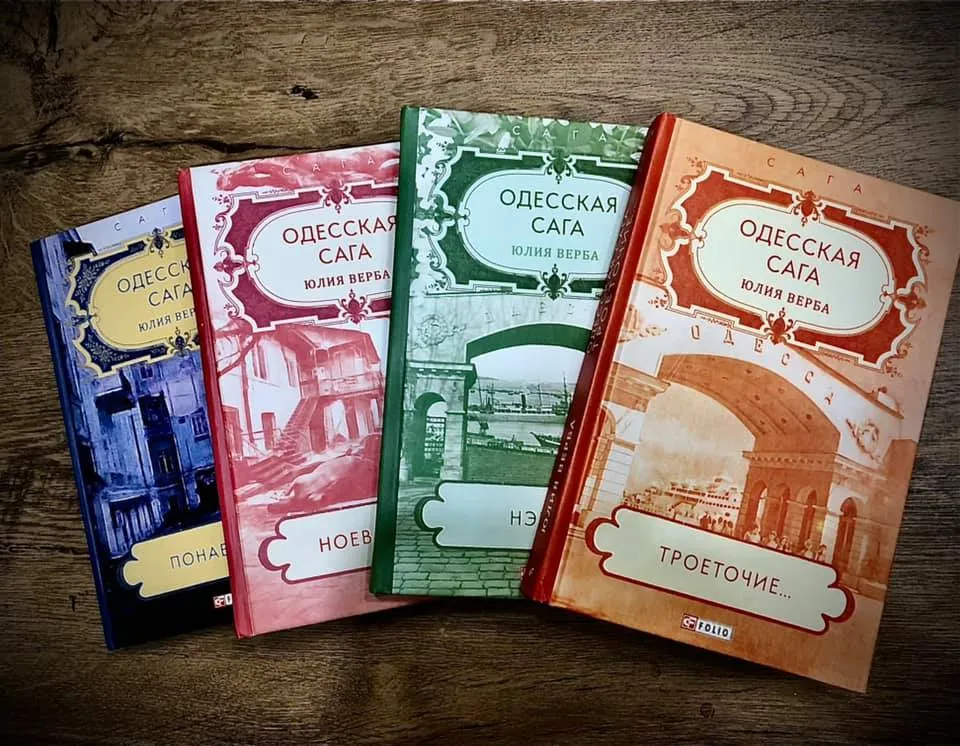
For reference: Yulia Verba is a wordsmith, copywriter, writer, and brand strategy specialist. She is the author of short stories and the four-volume novel *The Odessa Saga*, as well as the literary bestseller *The Moldavian Lineage*. The writer was born in Odessa, graduated from the Maritime University with a degree in “Port Construction,” and has worked in television, radio, advertising, nightclubs, and political parties; today, she collects not professions—but experiences.
That’s exactly why, if she were to invite you to her home in a few years, it would be a creative chaos—vintage items mixed with modern gadgets, just like Odessa itself. And the kitchen would smell of herbal tea that Yulia would have picked herself, having taken up such an unexpected hobby. She’d probably lose interest in gathering them quickly, but in that brief moment, she’d manage to brew a fragrant potion.
The one thing Yulia Verba never loses interest in is impressions. She collects them, lets them steep like tea, and then serves them to the reader—warm, bittersweet, funny, and very real.
On uninspired books and texts “sip by sip”
Yesterday my husband bought some seedlings and asked, “Can we plant the peppers yet?” And I look at those little leaves and say, “Where are the peppers here?” He replies, “Are you kidding?” Listen, I say, they’re always sold without leaves at the supermarket—how am I supposed to know? That’s how we live. Everything I know about gardening is very rough. But it’s also funny and interesting.
Now I walk around the “estate” with my phone and ask the AI—what is this and who’s eating it? I really want a new chapter in my life right now. It’s funny, but interesting.
I never made a transition from journalism to books. Because books were also “because I had to.” I’m more of an advertiser and a creative than a journalist. My whole life has been about commissions. And “The Odessa Saga” was also a commission, just on a larger scale. It was a contract and a request: “Write a book.”
Before that, I wrote columns—beautiful, complex, a bit “forced.” And then someone told me: “Everyone’s showing off so much. Write something lively and funny.” That was a commission, too. I started writing—and it just took off.
When you’ve worked in advertising for many years, you don’t have that “inspiration or no inspiration” story anymore. You just sit down and work. With experience, you can’t write anything truly bad. It might not be genius, but it will be a good, effective text.
Although I did write one novel purely “on inspiration.” It was a mystical thriller that I wrote in the U.S. No one commissioned it or was waiting for it. I just wrote what I myself found interesting. And I wrote it in six months.
You can also learn to write humor. There are very simple formulas. Any incongruity makes us laugh. When a child speaks like an adult—it’s funny. When an adult acts like a child—it’s funny too. Any incongruity elicits a reaction. This can be broken down into formulas.
And modern text has to work like a TV series. Cliffhangers, attention-grabbers, dynamics, rhythm. “Sit down, we need to talk”—and that’s it, the person is already on edge. Texts these days need to be served in bite-sized pieces. More white space between paragraphs, shorter blocks, strong subheadings. People don’t want a “full cup” right away. They read in sips.
Yulia’s Odessa
My view of Odessa isn’t rosy because I’m deliberately embellishing it. It’s simply a matter of focus. Just as a person in love looks at the one they love: everything seems beautiful. It’s the same with Odessa. If you look at it through the eyes of someone in love—you’ll see that beauty. It’s there.
The Odessa dialect, by the way, hasn’t completely disappeared. Yes, the language changes, the city changes, but the way of thinking remains. It’s a special sense of humor, answering a question with a question, strange retorts and intonations. Sometimes you catch yourself speaking just like a character in a joke.
Odessa locals, by the way, didn’t really like the TV series “Liquidation” because it was such a touristy version of Odessa. A bit of a souvenir. But at the same time, there was still something very recognizable there—that rhythm, that way of communicating, that inner irony.
The Right Not to Please Everyone
I’m very calm about criticism because I have very few people whose opinions truly influence me. You can count them on the fingers of one hand. If one of those people had said to me, “God, what kind of crap did you write?” I would have been really upset. Most of them are no longer alive. Well, for example, it could have been my parents. And if we’re talking about those whose opinions matter most to me, it’s my two great mentors.
One of them is Kim Kanevsky, a TV journalist from Odessa. He actually started teaching me back in 2000, when I had just joined Odessa TV. Back then, I was a completely fearless person; I wrote such terrible things... God, I’m so ashamed to think about it now! And he was constantly scolding me and asking where I’d picked up all those clichés from Soviet newspapers of the 1970s. He’d say, “What is this? God, what a disgrace!” He made me read all kinds of classics. Once he saw me with some tabloid detective novel and almost hit me over the head. He yelled, “You can’t read that if you want to be a journalist!”
He had this saying: “It’s like dipping a police dog’s nose into a can of kerosene. It will knock out its sense of smell and intuition, and it will no longer understand what is normal.” He would repeat: “First, read all the classics so you develop an immunity, and after that you can read anything. But for now, I forbid you!”
The second person is Mykhailo Mykhailovych Hrynchenko, a Kyiv native and renowned psychologist. He has appeared as a psychological expert on numerous TV shows. Before the war, he worked at the screenwriting school at Film.ua—I don’t know where he is now. He used to be the head of our advertising agency “Peremoha.” He was the one who taught me how to convey an idea, how to translate what’s in your head onto paper, and how the viewer or reader then perceives it.
The opinions of these two people are extremely influential to me. As for the rest... First, show me what you’ve written yourselves.
On books, the fear of writing, and texts without a living person
I read both Ukrainian and Western authors. I love Lyubko Deresh. I generally like literature that grabs you. It doesn’t have to be “pleasant.” If a book evokes strong emotions, if you’re still walking around and thinking about it for a few days afterward—that’s good literature.
Sometimes people ask: why write about the dark and scary, when there’s already enough of that in life? But if you don’t talk about it—it won’t go away. It’s like pulling fear out from under the bed into the light. It’s unpleasant to look at, but otherwise you won’t defeat it.
I can work in almost any conditions. I’m a mom of many kids, so background noise is normal for me. If someone’s banging things around at home, listening to music, or just walking around—that means everything’s fine. The only thing that really distracts me is music with lyrics I understand.
People who want to write are often afraid not even of the text itself. They think, “Who needs this?” But until you write it, you won’t know. And you don’t have to sit down and write a big novel right away. Start with short pieces. Social media is a great test these days. If a text resonates with people, they’ll let you know.
My writing journey also began on social media. People read, reposted, and then said, “Finally publish this as a book so we don’t have to search for individual posts.” And the first print run sold out in three days.
By the way, negative comments hardly bother me. If it’s just someone else’s opinion—that’s fine. But when someone comes to lecture me on how to live and write—I just block them. It’s like if someone came to your house and made a mess right in the middle of the room. You wouldn’t keep that, would you?
I teach writing courses and see one common problem: most people are very smart in their field, but they don’t know how to speak simply. We were taught to write complexly—with long sentences, in a pretentious way. But now you’re competing for attention with cat videos and memes. You have to write concisely, vividly, and with energy.
And, to be honest, AI-generated texts are already very noticeable. They’re beautiful, grammatically correct, but completely devoid of any human touch.
On people, prototypes, and the need to be alone
I’m not afraid that I’ll ever run out of topics. As long as you’re interested in people, the topics will never run out. Entire universes walk among us, each with their own stories, pains, love, and strange habits. It’s inexhaustible.
You can simply ask a person to recall their favorite childhood game—and stories, memories, and emotions will flow. And it will be fascinating to read.
In *Moldavian Lineage*, almost all the characters are real people from my childhood. I was even afraid to go back to my old neighborhood after the book came out. I thought they’d beat me up there. But everyone was actually happy: “Oh, they wrote about me!”
I’m an introvert. I feel very comfortable alone, somewhere in the garden where no one is around. But I love genuine conversation. After good conversations, you come away feeling full—of new stories, thoughts, and feelings. And then you want to return to yourself and “digest” it all. Or sit down right away and write while it’s still fresh.
On moving to Kyiv, old cities, and the sea in winter
Over the past six months, I’ve had some major life changes. We moved back to Odesa from New York, where we’d lived for four years—and decided to stay in Ukraine.
My husband has a house in Kyiv. We’ve been together for seven years, but all this time I’ve been dragging him to Odesa. And then we came here. He says, “A house, a garden. You’ve always wanted a garden.” And I realized: really, everything is already here. We can start a new chapter.
So just three days ago, I moved from Odesa to Kyiv. Right now, I’m getting to know the area and arranging for the city to grant me residency. I want Kyiv to accept me—like a daughter-in-law into the family. I never thought I’d ever leave Odesa. But life is interesting.
Kyiv is very different. And very big. I’d already tried living here—half a lifetime ago. I was 25 then; now I’m 52. I worked as the art director at the “Hollywood” club, which is now called Freedom. I lived in Kyiv for almost a year.
It was hard for me back then. I missed the sea. I hardly ever left Podil because it reminded me of Odessa: old buildings, vintage vibes, a bit of chaos, a bit of luxury—all mixed together.
I really don’t like new buildings. Even in New York, I would never live in Manhattan, even though it has such a wild energy. But those glass boxes aren’t my thing.
We were once in a panoramic apartment with a view of the city. Everyone was raving: “My God, it’s so beautiful.” But I looked at those windows, at the metal and concrete, and thought: no, never.
Kyiv feels very ancient and very powerful to me. It’s as if something vast and living lies beneath this entire city. We’re here with our houses and our lives, like tiny creatures on the surface, while beneath it all there’s some colossal force.
Of course, I’m drawn to the old city center. Not because it resembles Odesa—they’re as different as a man and a woman. Kyiv is very imposing. Intelligent. Friendly, but it doesn’t let you get close. Like the old intelligentsia, who are incredibly interesting to talk to.
What I’ll miss most about Odessa is the sea. Although the Dnipro is nearby now—that’s water too. By the way, we didn’t like going to the sea in the summer. We went in the winter or spring, when there are no tourists. I don’t really get sunbathing. For me, the sea is sitting on the shore and watching.
And if I had to choose between the sea and the mountains—it would be the forest. Just the forest. By the way, I’ve never actually seen the Carpathians. I really need to close that chapter. To be honest, I was never drawn to them. But I love the forest very much.
On dreams, a “normal job,” and life with magnets
I’m not very good at dreaming. I think over the last few years I’ve simply realized: you can achieve anything if you put your energy into it. Nothing happens on its own.
Everything I set out to do—not some abstract “it would be nice,” but something concrete—I’ve managed to achieve one way or another.
As a child, I dreamed of being a writer and a journalist. But my parents said, “That’s not a real job. You need a normal profession.” So I graduated from the Maritime University with a degree in “Port Construction,” went on to graduate school, and researched wave power plants.
But I’ve wanted to write my whole life. Eventually, I started, and I’m still writing. I also used to dream of living in another country—not as a tourist, but just living there. Well, I made that dream come true, as they say. I went, lived there, survived, and came back with some souvenirs.
On emigration, social death, and resilience
Because any migration, and especially refugee migration, isn’t a story about how you calmly got ready, packed a container of belongings, and went to the place you’d dreamed of. I never had a dream of living in another country.
I knew the history and geography of Odesa very well. When the enemy was at the gates of Mykolaiv, I understood clearly: one successful assault, and Odesa would once again find itself under occupation, as had happened before in history. A lot was happening at the time. We had just finished filming “The Moldavanka Torch”—a comedy project in support of the people and the Armed Forces of Ukraine. I personally didn’t receive any threats, but our girls were being written to: “You do realize that you’ll be the first ones hanging from the branches when we enter the city?”
I was scared. Not so much for myself as for the realization that if atrocities like those happening everywhere else began, I simply wouldn’t be physically able to save my children. So we packed up and left—just to get the children to a safe place.
It was incredibly hard. Even though refugees don’t really like this phrase, the first year there is what’s called “social death.” When you find yourself in another country where no one knows you and you have no name, you have no one to talk to and you have nothing. All your achievements, diplomas, and awards are worth absolutely nothing—just zero. All you can do is go work as a cashier, a cleaner, or a caregiver.
And the issue here isn’t about pride or showing off. The issue is that you’re packed with useful knowledge and skills, and it’s not just that nobody needs them—they’re completely rejected. They sort of treat you like a person, but your knowledge is devalued. Are the laws of physics or chemistry any different on the other side of the world? No, but nobody cares.
So you’re really experiencing social death. Your phone never rings because there’s no one to call, you have no friends on social media—it’s a complete vacuum all around you. On the one hand, you live in safety—nothing is flying or shooting over your head—but on the other, you’re starting from absolute zero. You know nothing, have nothing, and are constantly afraid of making a mistake that will get you fined. You’re under constant stress. You have to prove something to someone, but you don’t know the local rules because they’re completely different, and you don’t understand a thing about them.
Over time, of course, you get your bearings, look around, and gradually start taking action. If you start... Because back in the day, I worked at a social center and interacted with immigrants from all over the former USSR—that was the “sausage emigration” of the ’90s. Practically all their stories are the same: PhDs and engineers would arrive, start caring for the elderly, and that’s where they ended up. They never managed to break out of that cycle due to age, circumstances, or lack of language skills. It’s really a kind of trap that’s very hard to escape. But at some point, you think: “No, it won’t be like that for me.” And you start to claw your way out little by little. We made it out. It’s not so much a material issue as it is about being able to pull yourself together and reclaim—literally fight your way back to—your former life. To live the way you’re used to, to interact with the people you’re used to. That is, to rebuild your social circle and hone your skills so that you’re recognized. It’s a true samurai’s path.
And after that comes the realization that you can now survive anywhere and anyhow. It’s a great school. You return home with the same “magnetism,” but now with a completely new experience and understanding: you’re capable of rising not just from zero, but from a complete negative.
A strong woman—that’s not me. Because what’s strong can break. I’d say—flexible.
Like a willow branch: you can bend it, but it will straighten back out. And sometimes it will even strike back hard. When life bends you down—it’s not always a defeat. Sometimes it’s just the run-up before a jump.
On war and getting used to the abnormal
Odessa hasn’t changed at all for me in how it feels. I felt like a lost puzzle piece—it finally came back and just fell into the spot that had been waiting for it all this time. The people I used to talk to before the war and whom we’ve met now are still just as close to me. For me, Odessa is still the same.
Well, you know... it’s like a woman has gained a few wrinkles and gray hairs, but she’s still beautiful. Just as beautiful and a little neglected—like a disheveled woman who knows she’s pretty but doesn’t have much money to spend on herself. With the same beautiful pretensions, countless cafes, restaurants, and everything else. There are a lot of new faces around, but the city still welcomes everyone. Odessa is like a grandmother: she loves everyone, and those who love her in return stay and get everything. It’s a very comfortable place to live.
The only thing is that there’s this very strange, eerie feeling of a parallel reality. I haven’t lived here all these years, but when you come back... I’m not afraid of anxiety. I didn’t wake up at night out of fear. On the contrary, here I sleep through the sirens much better than I did in New York. In the U.S., I had constant insomnia, but here I sleep like a log because I’m finally home.
But there’s still a certain contrast. There’s a saying: “By day, Odessa is Monaco; by night, it’s Afghanistan.” To me, it’s more like a plot from a Stephen King novel. You arrive in some city, everything there is so beautiful, cool, wonderful people... But everyone around knows that at night, a dark evil comes, creeps in, grabs someone, and devours them. And in the morning, all the survivors wake up and rejoice that they’re alive, and start celebrating that life.
At the same time, you can leave the town, but no one does. And you catch yourself thinking that you’re starting to act exactly the same way. At first, you see it all from the outside, a bit detached, and then you don’t go anywhere either and just go to sleep. A kind of fatalism sets in. Some part of your brain understands that this is “not right,” that it’s not normal and shouldn’t be this way—you can’t live like this! But you keep living like this.
This is the terrible reality of war: an evil you cannot stop on your own. According to the rules of the genre, this evil must disappear; you must destroy it, but you don’t understand exactly what needs to be done for it to finally vanish.
On the garden, silence, and creativity forever
I get easily carried away by different things. New hobbies draw me in, and I can spend several years in a row doing just one thing, like making something with my hands or figuring something out. I’m one of those kids who took a doll apart to see how its eyes closed and how its hair was attached. It’s a kind of investigative thrill. I love seeing how things work from the inside, what can be improved there.
That’s why I’m constantly finding new, interesting topics that completely absorb me for years—whether it’s studying art or some other pursuit. Right now, I’ve come here, and I have a garden. And my goodness, so many new things! I’ve already learned so much, like how to prune bushes properly. I’m not writing right now—I’m just playing in the garden.
But despite all these waves of passion, writing has always run parallel to everything else. I suppose it’s not going anywhere. You know, there’s this question: “What would your ideal life be like if you had all the money in the world and were completely set for life? What would you do then?”
I’d sit in the garden and write books. So that no one would rush me and no one would expect anything from me. So, in the end, my whole life boils down to this—sitting in the garden and writing


