
In China, a perovskite solar system outperformed a silicon one in a field test
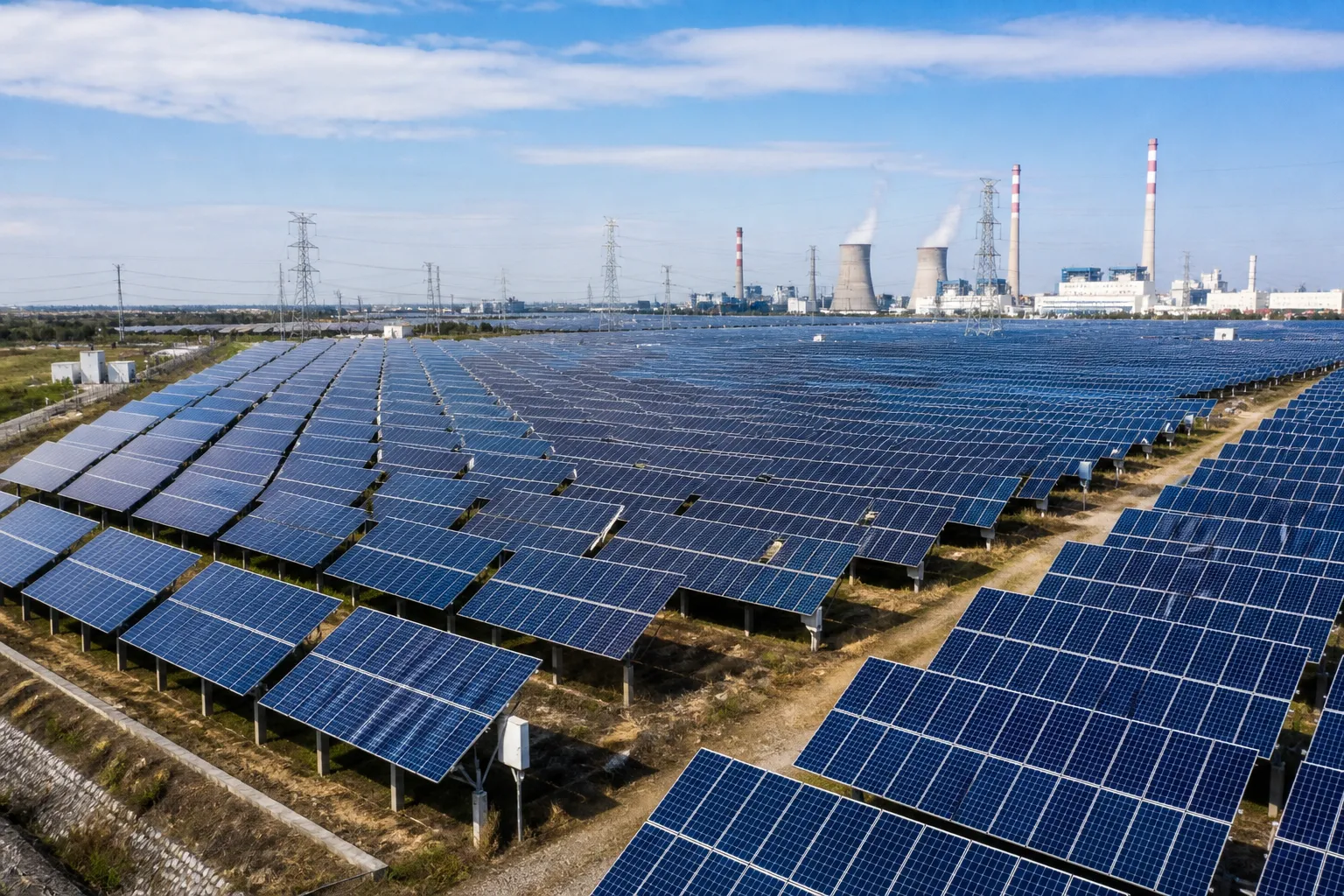
A Chinese-Canadian team of researchers led by Nanjing University tested a 1-megawatt perovskite solar system alongside a 3.5-megawatt silicon system. Over the course of three months, the perovskite system consistently generated more electricity than the silicon system at the same installed capacity, according to the South China Morning Post, citing a study in the journal Nature.
In March, the perovskite system outperformed the silicon system by 3.42%; in April, by 3.79%; and in May, by 5.81%. The study’s authors noted that the gap widened as temperature and sunlight intensity increased.
The team developed a new protective coating for perovskite—an ultra-thin and lightweight material that can be applied to large surfaces. The technology is designed to eliminate minor surface defects that cause some of the generated electricity to be lost. During the formation of the perovskite layer, an iodine-containing salt concentrates on the surface and creates a base for a second coating of lead carboxylates.
For more breaking news, follow the UA.News Telegram channel.
According to the researchers, the new treatment forms stable chemical bonds with the surface, eliminates defects more uniformly on large panels, and enhances the material’s protection against moisture, heat, and prolonged exposure to sunlight. After 1,300 hours of testing at a temperature of 85 degrees Celsius and 85% humidity, panels with a conventional coating lost 39% of their efficiency, while panels with the new coating lost only 2%.
The perovskite panel, roughly the size of a dining table, achieved an efficiency of 22% at an output power of 158.4 watts. It also passed tests involving temperature fluctuations ranging from minus 40 to 85 degrees Celsius: after 300 cycles, the researchers recorded virtually no loss of efficiency. The authors of the study stated that the panels passed a full suite of international reliability tests for commercial solar systems.
Perovskite cells are viewed as an alternative to traditional silicon panels. They can be manufactured by applying a thin layer of a liquid mixture, which potentially simplifies and reduces the cost of production. At the same time, durability and the maintenance of high efficiency in large modules have remained among the main challenges for the commercial application of this technology.


