
The U.S. has urged Europe to tighten restrictions due to Ebola risks ahead of the 2026 World Cup – Reuters
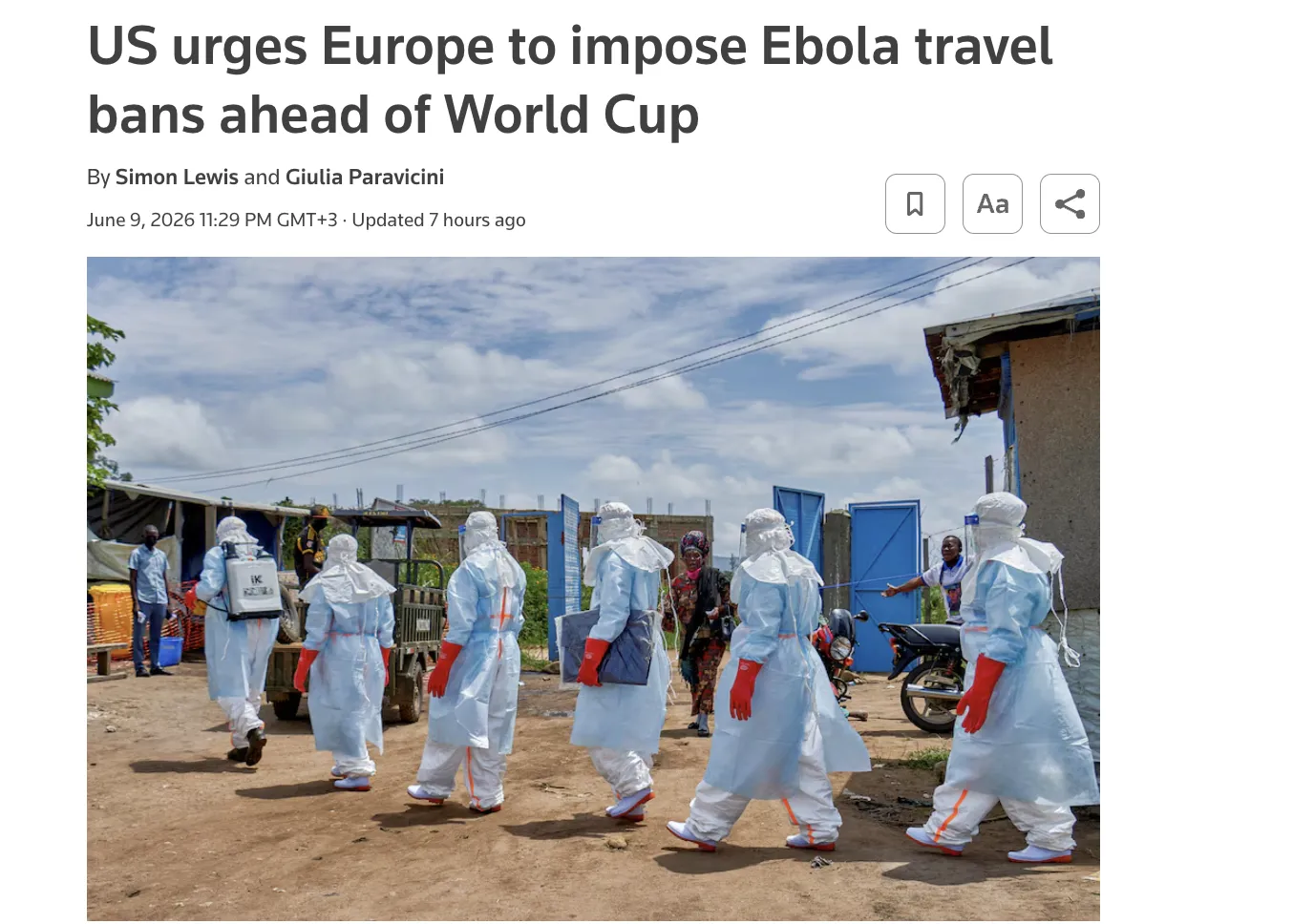
The U.S. government has sent an official request to European countries demanding that they impose additional entry restrictions on individuals who have recently been in regions of Central Africa where Ebola outbreaks have been reported.
On June 1, the U.S. State Department sent a memorandum to EU countries urging them to follow Washington’s lead and ban entry for citizens who have been in the Democratic Republic of the Congo, Uganda, or South Sudan within the past 21 days. According to Reuters, an EU diplomat in Africa confirmed receipt of the document but noted that the European Union had not responded to it. The European Commission did not provide any comments.
The U.S. has already imposed its own restrictions: the Centers for Disease Control and Prevention (CDC) has banned entry for foreigners from the three countries mentioned, and U.S. citizens are required to undergo screening at select airports. Secretary of State Marco Rubio has repeatedly stated that Ebola must not reach the U.S. On June 9, he discussed the situation with European Commission President Ursula von der Leyen.
A State Department spokesperson, commenting on a request to Europe, stated that other countries are obligated to do their part—both financially and practically.
“Other countries must do their part to prevent the outbreak from spreading further. Action is needed right now. This applies to both financial contributions and the implementation of sensible travel restrictions from the affected region,” the spokesperson emphasized.
He also noted that Washington is coordinating efforts with partners to protect the “millions of fans, athletes, and tourists” expected at the World Cup — which kicks off on June 11 in the U.S., Canada, and Mexico.
At the same time, riots broke out in Kenya. In the town of Nanyuki, near the Laikipia Air Base about 150 kilometers from Nairobi, local residents took to the streets to protest plans to build a U.S. quarantine center for people arriving from the DRC. The demonstration escalated into clashes with police: at least two participants were injured, and dozens were detained. Police used tear gas and water cannons. At the same time, there are currently no confirmed cases of Ebola in Kenya itself.
Meanwhile, the WHO acknowledges that the global medical community is currently losing the race against the virus. After the Bundibugyo strain outbreak was declared a public health emergency of international concern in mid-May, the number of confirmed cases in the DRC exceeded 344, and in Uganda, 15. The situation is complicated by constant attacks by armed groups in the epidemic zone. At the same time, WHO Director-General Tedros Adhanom Ghebreyesus urged against resorting to a total border closure: in his words, this would only block the delivery of medicines and medical equipment to affected regions. The organization insists on screening passengers at airports and border crossings instead of imposing complete entry bans.
This is reported in a Reuters article.
Earlier, World Health Organization (WHO) Director-General Tedros Adhanom Ghebreyesus announced his intention to urgently visit the city of Bunia in the Congolese province of Ituri. This region has become the epicenter of another dangerous Ebola outbreak.
The Democratic Republic of the Congo has recorded its 17th Ebola outbreak, which has already claimed the lives of 80 people. This time, the disease was likely caused by the little-studied Bundibugyo ebolavirus strain, rather than the more common Zaire ebolavirus.
Ethiopia has recorded its first outbreak of the Marburg virus, which is clinically similar to Ebola. The pathogen is capable of spreading rapidly, but there are no vaccines against it.


