
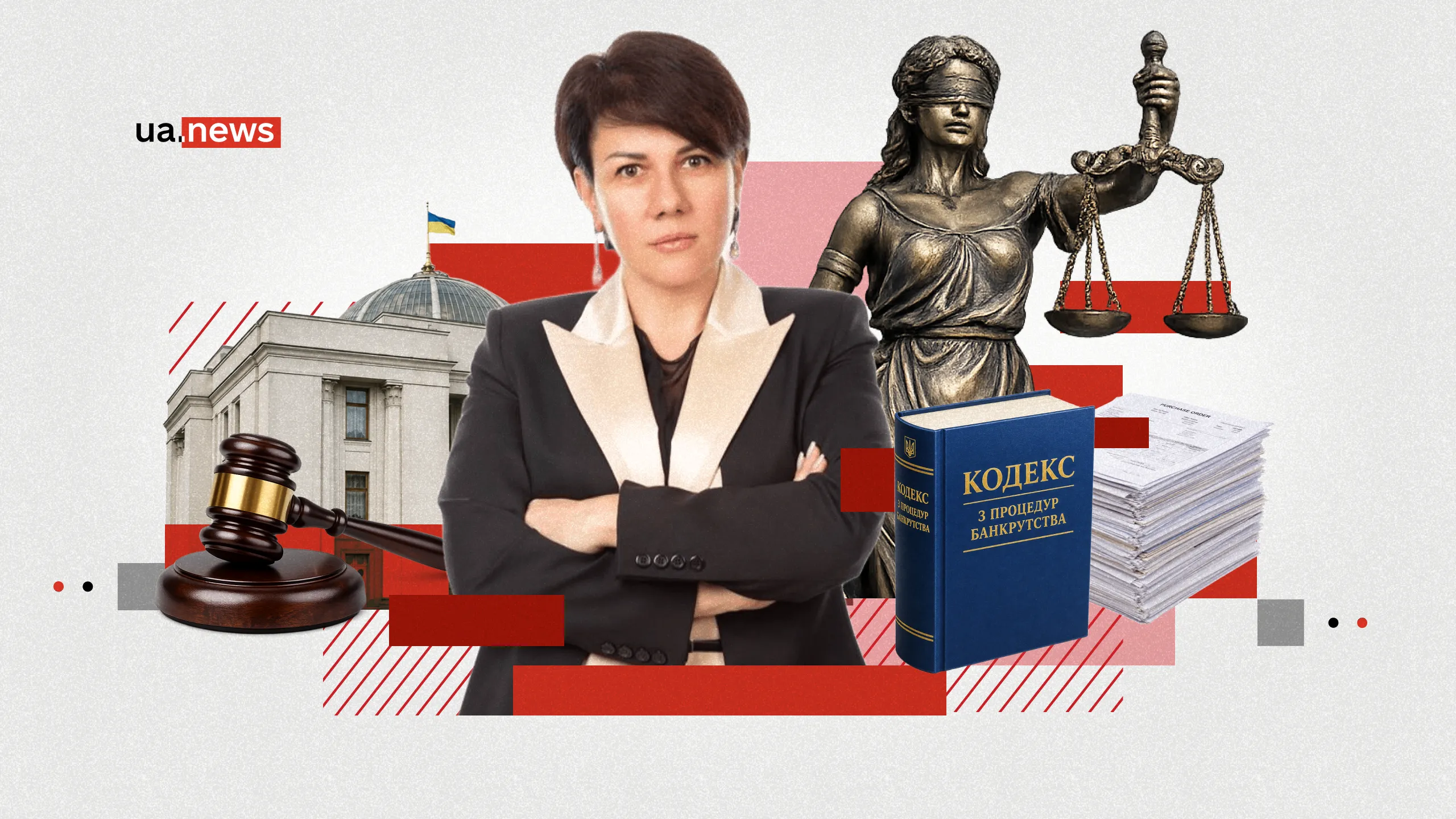
War, economic fragility, and the evolution of business culture are forcing Ukrainian companies to take a fresh look at bankruptcy. The bankruptcy process in Ukraine is gradually becoming a civilized mechanism for saving businesses. Today, an arbitration manager is a crisis manager, not merely a “liquidator” in the traditional sense.
We asked Natalia Tishchenko, managing partner at the law firm NOBILI, about all of this. Over the course of her 23-year career, she has handled over 150 bankruptcy cases worth hundreds of millions of dollars and has become one of the most renowned experts in this field. She has provided consulting services for over 2,000 cases, including those involving foreign investors and creditors (UniCredit Group, Olympic Casino, Ceragem). She is involved in projects that regularly make it onto the list of “The 50 Largest Court and Arbitration Cases in Ukraine.”
In an interview with UA.News, Natalia Tishchenko discussed how the war has transformed the Ukrainian bankruptcy market, why individuals are increasingly having their debts discharged, and why there are few women among arbitration administrators.
Businesses are more likely to declare bankruptcy
This trend is quite natural and reflects the reaction to economic processes in Ukraine. The prolonged war is, after all, leading to the closure of many businesses.
Previously, a business that wanted to cease operations would simply shut down. Debts were transferred to an unknown person whom the creditor could not find. Therefore, these obligations had to be written off. There was no liability. Now this approach is changing—we are seeing a trend toward liquidation through bankruptcy proceedings. This indicates that the market is maturing.
Even before the 2019 Bankruptcy Code came into effect, I emphasized that there is a widespread belief in Ukraine that “only cowards pay their debts.” Today, I can no longer say that. We have subsidiary and joint liability for business owners and managers. This is important. We have the tools to “catch up” with debtors. If a company has assets and they are being siphoned off—someone must be held accountable.
Apart from the war, there is another reason companies close: poor management decisions. Mistakes must also be accounted for, as the entire supply chain suffers. This mechanism began functioning after the adoption of the Bankruptcy Code. A successful judicial practice regarding subsidiary and joint liability has emerged.
Arbitration administrators have gained another tool—the ability to declare transactions fraudulent, i.e., invalid. When a company, despite its obligations to a creditor, enters into an agreement to sell or transfer assets and property at a lower price to “insiders” in order to avoid paying debts, we can challenge such agreements by declaring them fraudulent. This tool offers a fairly wide range of options for returning the transferred assets to the liquidation estate.
The rise in bankruptcies among individuals is also very common. Two factors are at play here.
First, the delayed impact of losing property, jobs, and sources of income. This is linked to the war.
Second, the breaking down of psychological barriers and the improvement of legal literacy. Today, people are no longer afraid of the topic of bankruptcy. Many stakeholders are actively explaining all the details of this process. I also promote these issues. Our team organizes many events and explains why this is necessary and how to implement it.
A person is living in debt and realizes: something needs to be done about this. They are no longer trusted when they turn to a bank or large institutions. And bankruptcy is, first and foremost, a legal way to get rid of debt.
Let me explain how this happened. A situation arose where the debtor could not repay the loan due to poor income planning or unforeseen circumstances, such as the war. Additionally, during difficult times, banks began to lose stability en masse. As a result, other companies, such as debt collection firms, began buying up loans.
My client couldn’t even figure out who to pay. Her debt had been resold several times. We took many procedural steps and consolidated all the claims into a single case. We assessed the full extent of her debt, evaluated the options, and sold the collateralized property. We had enough funds to settle with the creditors and still leave some money for the debtor. Before this, my client had lived under stress for many years.

The Effectiveness of Bankruptcy Procedures
Bankruptcy procedures work as effectively as possible during wartime: constant force majeure events, interruptions and postponements of hearings due to security risks, and blackouts. Some assets remain in occupied or frontline territories. There are properties where it is impossible to even conduct an inventory. Additionally, holding auctions to sell assets is significantly complicated by a decline in investment demand. Large properties cannot always be sold for their fair value. However, the judicial system is functioning as effectively as possible.
The e-court significantly simplifies our work. There is no need to travel to other cities for every hearing—we can join online via video conference and receive all documents. Moreover, the Verkhovna Rada has already amended the Code regarding the conduct of creditors’ meetings and other tools necessary for an arbitration manager. We can conduct almost all procedures online. The only exception is that the inventory is actually conducted on-site.
Regarding timelines. It is worth noting that the general bankruptcy procedure consists of several elements: asset disposition, reorganization, and liquidation. The Code sets deadlines, but each procedure is unique and depends on the size of the enterprise and the number of creditors. Their involvement and actions regarding appeals are the key factors determining the timelines.
For example, a clear 170-day deadline is set for asset disposition. But I have examples where a large enterprise has been in the asset disposition process for four years. This depends on the number of employees and the volume of assets. In particular, at one company, the inventory took a whole year because the assets were “scattered” all over Ukraine. If the company is small and there aren’t many creditors, then it’s possible to stay within the deadlines. Businesses that go through such lengthy procedures understand that this isn’t a matter of just one or two years.
The course of the process is also influenced by the behavior of creditors. Usually, when I find out the name of the bank, I already know how it will act. Not every creditor is willing to forgive debts and will file an appeal. That is, we can speak of a duration of one and a half to two years for an individual in an ideal scenario.
Bankruptcy Models and Preventive Restructuring
The liquidation model of bankruptcy still dominates in Ukraine. We lack a culture of preventing financial insolvency. Usually, businesses seek help too late, by the time an arbitration manager—essentially a crisis manager—arrives to assist.
But there are noticeable changes related to Ukraine’s rapprochement with Europe. Preventive restructuring is being actively implemented. The next step is to develop the habit of turning to an arbitration manager as an expert capable of helping to save the business.
At this stage, it is difficult for an arbitration manager to bring such a company into rehabilitation. This is possible if there is an attractive asset and an interested rehabilitator. Then the company can be restored to solvency. Incidentally, the percentage of rehabilitation cases in Ukraine is very low compared to Western countries, because the philosophy there is different.
In accordance with EU Directive 2019/1023, preventive restructuring has been introduced in Ukraine. It can be initiated by a party related to the debtor, such as an audit or law firm serving the company. Their direct obligation, as set forth in the Code, is to report “warning signs” regarding problems at the company. The manager is required to respond to this. If they fail to respond, this becomes grounds that the court will later use to hold them liable under subsidiary and joint liability.
These small steps are taken so that creditors can obtain information about borrowers. This also applies to the Debtors’ Registry, where one can check whether a company has any issues.
Supporting Businesses During the War
European countries are moving toward supporting businesses. Unfortunately, our government does not help businesses that are failing. I see my mission as working in this direction. The government must provide support and establish investment funds—as is done, for example, in France. We must help honest businesses that have suffered from rocket strikes but remain vital to Ukraine’s economy. Because this means taxes and jobs. I often speak about this during public events. And we are moving in this direction.

The trigger word “bankruptcy”
This story stems from former President Leonid Kuchma, who spoke negatively about the bankruptcy of a steel plant. Commenting on the case, he said that “someone opened a hole through which things are being stolen.”
There is another issue with the perception of the bankruptcy procedure. Typically, owners of large companies have their own legal departments. These lawyers are highly competent, but bankruptcy is a rather specialized process. Specialization is required. One must know the procedure not just from the Code, but in practice. The very system of this law is structured differently. For example, a criminal defense attorney gains a decent understanding of cases within a year—they typically handle 10–20 cases annually. But for me, a single corporate case lasts at least six years.
That’s why a lawyer who presents themselves as a “bankruptcy specialist” doesn’t always know what they’re talking about. This is exactly where arbitration managers come in handy. Because they’re the ones who know the ins and outs.
Bankruptcy—a new phase for business
A moratorium takes effect from the moment bankruptcy proceedings are initiated. This is a special procedure that prohibits creditors from enforcing collection. Sometimes the debtor has several enforcement proceedings. Enforcement agents file for collection and then receive payments in turn. When the debtor realizes they cannot repay the loans and all creditors are pressing at once, it is the moratorium that stops this pressure. This provides an opportunity to pause and think, to bring in specialists who can “work it out” and offer advice.
Moreover, in bankruptcy, everything is proportional: creditors are entered into the Register, and they receive their funds proportionally according to the order of priority. This is monitored by the court and the bankruptcy trustee. The interests of the debtor company’s employees are also taken into account, in contrast to enforcement proceedings, during which the rights of the workforce are ignored and problems arise.
The Role of the Arbitration Manager
When bankruptcy proceedings begin, an insolvency administrator is appointed. The first thing they do is send about 30 requests to various agencies, asking them to report on the debtor’s debts and assets. Then they request information from the company regarding wage arrears. This is also very critical, as the debtor may not always provide accurate information. The bankruptcy trustee must verify the data received.
He gathers all financial documentation, analyzes it, checks for possible instances of funds being siphoned off, or property or assets being sold at inflated or undervalued prices, and also investigates what assets were transferred to avoid paying debts.
If funds were siphoned off, the insolvency administrator begins to recover them. This can take years. We are now seeing a new trend—cross-border bankruptcies. This primarily concerns individuals. People have left, leaving debts in Ukraine, while setting up a wealthy life abroad: they own real estate and yachts. They live there, but here they cannot pay off their debts. Therefore, we face a new challenge—examining cross-border bankruptcies and locating debtors’ assets abroad.
Stressful Cases
Bankruptcy is a rather private matter. No debtor wants to talk about themselves. But sometimes there are high-profile and sensational cases. In my practice, there was a problematic case involving “Basis-Auto.” The company, aware of the debt, received a court ruling and transferred its assets on the very same day. It was a property in Kyiv’s Troieshchyna district worth $3 million, but it was sold for 100,000 UAH. With the court ruling in hand, I began the process of reclaiming the property to put it up for sale. And to sell it, I had to physically take possession of it.
In such cases, the arbitration manager has to enter the company’s premises with physical security. I’m prepared to handle such extreme situations, but it’s “cool” when everything goes smoothly. And when you go through critical moments, it’s exhausting and throws you off track. After such a “raid” on the property, I always have to get back to normal life and recover over the weekend. It’s mentally tough.
The arbitration manager plans the process of reclaiming the facility in advance, together with his security team. First of all, we need to figure out when there are fewer people there. We must avoid incidents so there are no fights or bloodshed—that’s my area of responsibility. I’ve learned from experience, and all my security guards enter the facility with video cameras.
We’re also always accompanied by a videographer who follows the guys and films everything to avoid trouble. Unfortunately, law enforcement doesn’t participate in this process at all, since they don’t understand our status. The police arrive only after everything has happened and file a report stating that the arbitration manager did not cause physical harm to anyone.
I am currently writing a book titled “The Liquidator.” This title is also a trigger. We are called “liquidators” at the final stage of bankruptcy. We have a professional joke: when the patrol police stop an arbitration manager, he can say that he is a “liquidator”—and immediately everyone scatters.
I had one such comical incident on Olena Teliga Street in Kyiv. There was an unfinished building there under the protection of a debtor who didn’t want to give it up. According to the Code, under the procedure, I fully perform the functions of a director and am obligated to take possession of this property. Therefore, I am forced to enter the site if the debtor does not hand it over voluntarily. We entered the unfinished building’s grounds and posted our own security guards.
Then I received a call from the neighboring housing office asking, “Is this Natalia?” I replied, “Yes.” And they told me, “You agreed with us that electricity would be ‘fed’ from the neighboring building to the site. Now pay us 80,000 UAH.” It turned out that a woman had come from the debtor, identified herself by my first and last name, and promised them a bribe.
Can you imagine how much electricity they stole from the residents of the high-rise? They ran a cable to this unfinished building and used it, probably for quite a long time. Of course, they didn’t have any documents. They just gave my first and last name.

On the reputation of an arbitration manager
Reputation is the most important element of our profession. Unfortunately, anything can happen. And if you’re known as a decent, law-abiding, and honest person, the reputational risks are lower.
I had an incident related to my reputation when “tabloids” started writing that I was supposedly a corporate raider. They spread fake news in associations and groups on social media. Bots started commenting. Then a lawyer sent me a chat log with a bot, saying, “Look what’s happening in the group.” Members started standing up for me and refuting the bots’ slander. In other words, people knew me and began defending me. And I wasn’t even in that group. That’s how reputation works.
It’s very important to be a public figure. Public visibility is my protection. At some point, I realized that thanks to my public profile, I can influence the community’s opinion. I have the opportunity to tell the truth. In addition, I have a mission to help the Association of Insolvency Administrators navigate its path to maturity, since our Association is still young—it was established in 2019.
Plus, we have a great profession that needs to be promoted. I’m currently involved in many projects, including collaborations with European partners. And being in the public eye helps me.
Transparency and Improving Bankruptcy Procedures
Bankruptcy has become more complex but also more transparent. We have safeguarded ourselves against sham proceedings, as was common in the 2000s, when cases were filed and closed in just three months. We now have a draft law on simplifying the bankruptcy procedure, which is to be submitted to the Verkhovna Rada for consideration in the near future. After all, the Code remains unsuitable for small businesses. The procedure, unfortunately, has become quite expensive and continues to get more expensive.
Since the start of the full-scale invasion, there have been at least two attempts in parliament to impose a moratorium on bankruptcy. Essentially, this would mean banning the bankruptcy of debtor companies. To the average citizen, this might seem like a positive thing—after all, bankruptcy is bad, and it’s better to avoid it. But what are people and companies supposed to do then? Sit on their debts and let them pile up?
In the end, this did not happen. I partly attribute this achievement to myself. We began actively organizing various roundtables and publicly discussing this issue. And the members of parliament heard the position of our Association and my personal stance.
Our company, NOBILI, specializes exclusively in bankruptcy and has been operating in this market for 18 years. During our latest rebranding, I set out to change the perception of this concept—to redesign our website so that people would visit and see opportunities in bankruptcy, not just problems. That’s when we came up with this slogan: bankruptcy is a European free-market tool. And that’s truly the case.


