
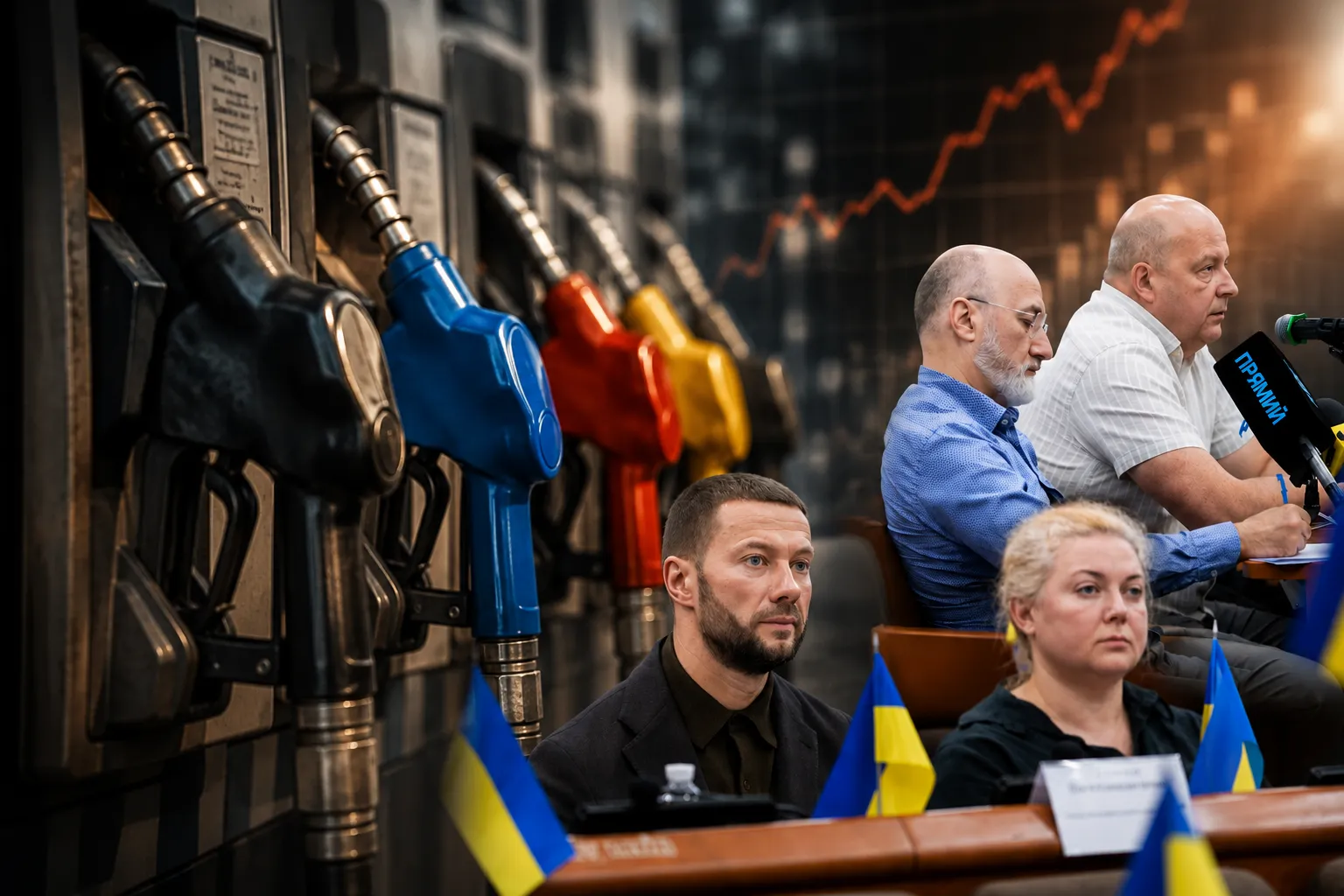
13 Hryvnias On Top: What Ukrainian Petrol Chains Are Hiding and Why They’re Under Parliamentary Scrutiny
09 July 2026 09:09«We Met All Demands and Cut Prices,» Petrol Station Owners Claim. «You Simply Brought Back Your Sky-High Profits and Hid Them in Mobile Apps,» Authorities Retort.
The Temporary Inquiry Commission, chaired by Member of Parliament Oleksiy Goncharenko, invited major oil traders for a straight-talking session. The meeting, which dissected prices at petrol stations, heavily resembled a conversation between the deaf and the blind. While global Brent crude was plunging toward its February levels of $71 per barrel, prices at major Ukrainian filling station chains remained frozen solid, locking in a mirror-image surge of a whopping 13 hryvnias per litre since the beginning of spring.
Excusing themselves with shelling at petrol stations and old stockpiles, the companies quietly brought their net profits back to pre-crisis levels. The Antimonopoly Committee asserts that filling stations possess every financial capability to lower prices today. Meanwhile, the Parliament hints: if the business does not understand kind words, massive fines will be deployed.
UPG’s Price Formula: Crude, Exchange Rate, and a Bit of Magic
Listening to the oil traders' explanations was fascinating. On paper, their pricing structure looks like advanced mathematics, accounting for everything from the general mood in the Middle East to exchange rates at currency booths.
«Speaking of pricing in general, a detailed analysis of global oil prices is conducted, fluctuations in exchange rates (Euro and Dollar) are analyzed, and the remaining petroleum products currently held by the company are factored in. Additionally, logistics costs and product prime costs are integrated. Based on this comprehensive data, the decision regarding the retail price at the pump is made,» explained Volodymyr Moroz, Executive Director of PE «Ukrapallet System», the UPG filling station network.
However, as soon as the Commission Chairman voiced the actual figures, the business's beautiful retail logic crumbled before dry statistics: in February, A-95 petrol at UPG cost 61.90 UAH, but by July, it had already reached 73.90 UAH. Meanwhile, foreign currency rates remained virtually unchanged during this period, and global crude oil had even become cheaper. The chain’s representative could not immediately explain where the «extra» 12 hryvnias from every fill-up went, instantly recalling some unaccounted-for old purchases on the fly.
«Since we did not have a prior agenda with these specific figures, it is difficult for me to operate with them in detail without preparation. I must note: the data you provided does not account for the volumes and cost price of those fuel remnants... A batch could have been bought, hypothetically, at 50 UAH or at 100 UAH. These remnants play a significant role in pricing on the totem board.»
The Commission labeled this response an outright «evasion» of the topic. The MPs reminded the Executive Director of a striking anomaly in the Ukrainian fuel market: in early March, when crude oil went up amid the Middle East crisis, pump prices jumped instantly—within 3 to 4 days. Back then, for some reason, the company did not wait for the cheap remnants to clear out and revalued the fuel that physically had not even reached the border. Yet, when the global market calmed down and trended downward, the system glitched.
«The concepts of “fast” or “slow” are quite subjective. When the global price drops, we still need time to sell off those petroleum product remnants that we already purchased at the old, high price. We evaluate the volume of these remnants and only adjust the price on the totem board based on that.»
The MPs' attempt to ascertain how much the company actually earns in «net» profit per litre of fuel (even without being tied to the pre-war margin cap of 5 to 7 hryvnias) predictably hit a brick wall. The network’s Executive Director barricaded himself behind the phrasing of «commercial secret» and advised sending official inquiries, claiming it would be incorrect to disclose internal markups to the general public without the chief accountant.
When financial excuses were completely exhausted, the oil traders pulled out their ultimate, rock-solid trump card—Russian shelling and damages from infrastructure destruction, which the business is forced to cover entirely on its own.
11 Hryvnias per Litre: MPs Calculate the Margin Right in the Hall
However, blaming high fuel prices on bombed stations failed: MP Yulia Yatsyk voiced the real statistics. Out of the chain's 444 petrol stations, only 8 facilities sustained damage. The head of UPG then found another excuse.
«If we put aside the capital expenditures for liquidating the consequences of enemy strikes and restoring destroyed filling complexes, there are no other large-scale force majeures as such. Among objective factors in the overall cost structure, there was only a certain planned increase in the employees' salary fund. I cannot name any other significant factors.»
Following that, the Inquiry Commission Chairman forced Moroz to state small-wholesale prices—meaning the price at which UPG sells diesel in large batches straight from fuel tankers, already factoring in their primary profit. The director resisted for a long time but eventually named the figure—around 64 hryvnias per litre. Comparing it with the price on the totem board, the MPs calculated the network's actual earnings themselves.
«At the same time, the maximum retail price for diesel on your station boards is 74.90 UAH per litre. So, you and I have visually calculated the current margin right here. Given that UPG has already baked its primary commercial profit into the wholesale price and is definitely not trading at a loss, the net difference between small-wholesale and retail sales at the gas station stands at nearly 11 hryvnias per single litre. This figure significantly exceeds the limits of 5 and 7 hryvnias that were once set by the state,» explained Commission Chairman Goncharenko.
After this, the top manager switched into full amnesia mode: he could not name the net profit percentage, the markup dynamics since the start of spring, or even the company's revenue volume over the last six months. A separate topic of debate was the report on the oil trader's operations prior to 2022. Before the full-scale invasion, the UPG brand actively promoted the interests of the «Belarusian Oil Company» in Ukraine and sourced more than half of its imports from Minsk fuel.
According to Moroz, on February 24, 2022, all contracts with the Belarusians were terminated immediately. However, the MPs recorded an important fact: the remnants of Belarusian fuel that were in UPG's reservoirs at the moment of the invasion were subsequently sold to Ukrainian drivers for a long time during the height of the fuel crisis. Cutting off this supply channel had paralyzed the network at the time, and now the company appears to be trying to catch up on lost ground at the expense of buyers. The Commission is preparing an official request to the Antimonopoly Committee to thoroughly investigate where these 11 hryvnias of markup from each litre of fuel are going.
UPG’s Lawyer and the Governor: A Coincidental Family Overlap or Just a Coincidence?
As soon as the MPs finished calculating the 11 hryvnias of net margin per litre, they called UPG's lawyers to testify. Attorney Vyacheslav Bunechko, who arrived to defend the brand, tried right from the threshold to entangle the MPs in legal schemes. He claimed that the firms «UPG» and «Nemyriv Oil» do not trade in fuel but simply own property and lease it to a single operator—«Ukrapallet System». The Commission Chairman, in turn, countered that the Antimonopoly Committee has long viewed them as one large family.
But the main surprise lay ahead when the conversation turned to the lawyer's surname. Right during the session, the MPs discovered that the oil trader's defender is the biological brother of Vitaliy Bunechko—the current Head of the Zhytomyr Regional Military Administration (Ova).
The coincidence turned out to be too prominent to ignore, as the lawyer himself immediately confirmed that it is precisely in the Zhytomyr region where the UPG fuel group has its central office registered, operates a massive oil depot, and deploys a powerful network of filling complexes. Commission members tried to smooth over the rough edges, noting that the company was born in Korosten long before the governor's appointment, and lawyer Bunechko himself had previously spent 20 years working at «Ukrnafta» heading its legal claims department, only joining the UPG team about a year ago. Nonetheless, a triggering aftertaste remained in the room.
Toward the end of the first part of the session, the fuel barons from UPG were asked not to disperse and to sit in the back rows—awaiting face-to-face confrontations with the Antimonopoly Committee. Notably, the Commission exposed a bizarre selectivity in the market: out of four fuel giants summoned «to the carpet,» only UPG showed up at the Verkhovna Rada. The other oil traders simply ignored the meeting. They were immediately warned that in the event of a repeated no-show, the Commission would act strictly in accordance with the Criminal Procedure Code—up to enforcing a compulsory turnout of the oil traders with the involvement of law enforcement agencies.
The Commission Secretariat is already packing «letters of happiness» for the entire fuel market. The MPs promise: after the talk with the AMCU, the circle of suspects involved in artificial price inflation will expand substantially, and the gas station oligarchs will either have to show an honest margin or travel to the next session under escort.
AMCU Admits: It Cannot Direct Chains to Lower Prices
The Antimonopoly Committee of Ukraine (AMCU) assures that it is working tirelessly. Admittedly, the results of this work resemble a paper labyrinth. The speech by AMCU Chairman Pavlo Kyrylenko at the Inquiry Commission session began with a brisk report: it turned out that even before the March price explosion, 39 cases against oil traders were already sitting with the agency. Yet, society gains absolutely nothing from these proceedings.
The head of the agency immediately rushed to deflect responsibility and directly explained why the AMCU is not planning to forcefully beat down the prices on the totem boards.
«Society often demonstrates a misunderstanding of our functions: direct control over the establishment, regulation, or capping of retail fuel prices does not fall under the purview of the AMCU. Today, the retail fuel market in Ukraine is free; state price regulation is absent. Prices are formed based on market mechanisms.»
To put it simpler: the market decided and continues to decide. Since the start of the crisis, the committee has bombarded filling station operators with paperwork—sending out a staggering 42 large-scale analytical demands. And as early as March 9, the AMCU launched an investigation into a potential cartel conspiracy. At the same time, Kyrylenko officially stated: classical monopolists who have seized over 35% of the market and dictate terms to everyone do not exist in Ukraine. The market is fragmented, meaning there is no single entity to punish for «abuse of a monopoly position.»
When the MPs began demanding specific names and market shares, the AMCU leadership, along with State Commissioner Olga Nechytaylo, laid their cards on the table. Tax reports clearly confirmed who actually holds the Ukrainian petrol pumps and splits the billion-hryvnia revenues.
Who Controls Ukrainian Petrol Stations: Figures Disclosed by the AMCU
| Petrol Station Chain Name | Estimated Market Share | Characteristics and Positioning |
|---|---|---|
| OKKO | around 20% | Historical leader in sales volumes, currently reclaiming the top spot. |
| WOG | around 17% | Consistently holds its ground in the premium segment for affluent drivers. |
| Ukrnafta | 10% + (growing) | State-owned company rapidly pushing to the top courtesy of new assets. |
| UPG | actively growing | From a modest 80 stations, it aggressively broke into Ukraine's top 4. |
| BRSM-Nafta | under 10% | A major player raking in revenue in the economy segment. |
| AMIC (Amic Energy) | under 5% | A systemic operator in the lower echelon of major networks. |
As the AMCU analysis showed, at the peak of the crisis, drivers began fleeing en masse to the stations of state-owned «Ukrnafta», where prices were at least somewhat more modest. However, a vacuum does not stay empty for long: according to the latest data, the private giant «OKKO» has once again reclaimed absolute leadership in sales volumes, and UPG is trying to keep pace.
The Commission Chairman ordered an expansion of the list of «suspects.» The Secretariat received a strict directive: add «BRSM-Nafta» and «AMIC» to the financial audits. The MPs mean business and intend to shake up the reports of every major player to find out whether their synchronous markups are just an ordinary collusion behind the backs of Ukrainians.
AMCU Investigates Whether the Strait of Hormuz Became a Universal Excuse
The investigation into the cartel conspiracy of the fuel giants, which the AMCU initiated on March 9, is gathering detective-like details. Committee Chairman Pavlo Kyrylenko spoke candidly about closed-door debriefings with top managers of the chains at the onset of the spring crisis. The core question the agency head posed to the oil traders sounds remarkably simple: why, between March 5 and March 10, amid the escalation in the Strait of Hormuz, did prices on the boards jump synchronously and instantaneously, even though the oil depots were crammed with old, cheap fuel?
According to Kyrylenko, instead of selling off old stockpiles at an honest price, the businessmen baked new risks into the current price tag. They explained this by claiming that European refineries (specifically, the Polish concern ORLEN) immediately restricted shipments. The networks urgently required billions in working capital to contract subsequent expensive batches.
But the most intriguing part was unearthed by the AMCU when they looked closer at actual sales.
The Totem Board—For Some, the True Price—For Others
According to verified data from the country's three largest private networks («OKKO», «WOG», «Ukrnafta»), the official pump price tag is designed for anyone but systemic buyers.
Random drivers (direct retail): account for a mere 1.8% for diesel and 3.6% for petrol. These are individuals without apps or loyalty cards who simply drove in and overpaid the full cost.
Mobile apps and loyalty programs: occupy 26.2% of diesel sales and a record 60.6% of petrol sales. Through individual discount systems, the real price of petrol for regular customers is usually 3 to 5 hryvnias lower than the official one.
Big business and the state (B2B / B2G): claim the lion's share of the market—72% of all diesel fuel and 35.8% of petrol.
«I directly asked the managers during meetings: "Does it turn out that you artificially inflate the price on the totem board for ordinary citizens to compensate for your losses on corporate and state contracts, which you failed to calculate, through an ultra-high retail margin?"» Pavlo Kyrylenko lamented.
As it turned out, before the crisis, the networks signed long-term contracts with farmers, logistics operators, and state entities at a fixed price (63–65 UAH/litre). When the global market skyrocketed, the station operators found themselves trapped: the law prohibits raising prices in public procurement by more than 15%. To avoid going bankrupt on wholesale deliveries, the traders simply shifted the financial burden onto the shoulders of ordinary Ukrainians, jacking up retail prices on the boards. Officially, the owners of the filling stations deny this, ensuring they are merely «balancing the average margin.» And when asked an awkward question by the AMCU head whether the business was ready during wartime to operate «at zero» to suppress the panic, the oil barons predictably remained silent.
When global oil prices finally turned downward in June, the oil traders «forgot» to rewrite the price tags once again. On June 19, Kyrylenko gathered the network executives for a tough talk. Metrics showed that pump prices should have instantly collapsed by at least 3.50–4.00 hryvnias. Yet, the drop progressed at a penny per week. The business’s explanation was boilerplate: «We must first sell off what we bought at the peak of May prices.»
The AMCU throws its hands up: they cannot direct private companies to lower prices by decree in a free market—even in the EU during crises, antimonopoly regulators do not meddle in price controls. However, Kyrylenko assured the Inquiry Commission MPs that the March 9 cartel conspiracy case would be brought to a finish. If the intentional stagnation of prices in June or their synchronous spike in March are documented, maximum financial sanctions await the companies.
AMCU: Fuel Could Have Already Been Cheapened by 3–4 Hryvnias
The MPs attempted to find out if it is lawful for fuel merchants to justify high costs by strikes on infrastructure. Kyrylenko confirmed: rebuilding a single modern complex from scratch costs colossal money, and the enemy hits them intentionally. Logistics also plays a part—the further a region is from the western border, the more expensive the delivery. Yet, blaming everything on the war failed. The head of the AMCU stated: even factoring in the destruction, major networks possess a solid cushion of safety and are obligated to lower prices right now.
In June, the AMCU proved to the fuel kings with hard data that they could painlessly shed 5 to 6 hryvnias from each litre, and as of July, this clean room for a markdown stands at least at 3 to 4 hryvnias. The businessmen refused to freeze marketing games and simply make the price on the boards honest. The traders talked again about needing to sell off expensive remnants purchased at the peak of the May crisis first.
At the same time, the AMCU acknowledges that fuel volumes in the country are currently balancing on the edge. While before 2022 oil depots maintained an untouchable reserve for 30 days, due to constant missile strikes, storing large volumes in one place has become dangerous. Currently, the operational remnants of the networks have shrunk to a critical 10 days of operation. Meaning, the business faces real risks, but the Commission strictly logged a point: Ukrainians should no longer overpay for convoluted bonuses and an artificially inflated margin. The next step rests on the conclusions of the cartel conspiracy investigation.
Penny for Penny: How OKKO and WOG Synchronously Rewrote Price Tags
The fuel segment of the Inquiry Commission session concluded with a complete demolition of the oil traders' official versions. When the Chairman brought the real figures from Ukrainian pumps onto the screen, all «economic justification» for the high prices evaporated. The MPs recorded an outright pricing absurdity: the «OKKO» and «WOG» networks raised prices absolutely synchronously, penny for penny.
The Magic of Identical Price Tags: February vs July 2026
| Petrol Station Chain | Price Tag as of February 27 | Price Tag as of July 6 | Net Surge per Litre |
|---|---|---|---|
| OKKO | A-95: 65.99 UAH
Diesel: 65.99 UAH | A-95: 78.90 UAH
Diesel: 79.90 UAH | + 13.00 UAH |
| WOG | A-95: 65.99 UAH
Diesel: 65.99 UAH | A-95: 78.90 UAH
Diesel: 79.90 UAH | + 13.00 UAH |
What outraged the Commission most was the fact that this 13-hryvnia leap persists against a stable Euro, while the global price of Brent crude has generally fallen below its late-February levels. While the global market rolls downward, Ukrainian premium filling stations simply «forgot» to update their totem boards.
The Main Secret of Oil Traders: A Margin of 10+ Hryvnias
Kyrylenko tried to vindicate the operators, stating that in March-April, due to the crisis in the Strait of Hormuz, their profits «dropped by half» compared to February.
But the Commission Chairman immediately multiplied the percentages and called a spade a spade. It turned out that even after this mythical «drop by half,» the net margin of the operators stands at significantly over 10.00 hryvnias on every single litre! This is several times higher than the pre-crisis state limit of 5–7 hryvnias that was in force until May 2022.
Furthermore, the head of the AMCU admitted that throughout May and June, their margin fully recovered and returned to the ultra-high pre-crisis level.
By Kind Word and a Fine: The Commission Proceeds to Defense Secrets
The finale of the fuel battle at the Commission session turned out to be harsh. The Chairman directly implied that the oil traders had lived in a cozy vacuum without serious sanctions for too long, causing their «social conscience» to completely atrophy. Instead of unquestioningly following the AMCU’s preventive recommendations and lowering prices, the businessmen reported: «We have executed everything,» even though the numbers on the totem boards screamed otherwise.
«You know, forgive me for such an allegory, but with a kind word and a gun, you can sometimes achieve significantly more than just with a kind word... 10 years without serious sanctions and loud cases is too long a period. The market simply relaxed,» Goncharenko summarized.
Immediately after this, the Commission moved to review the high-profile «Midas» case, where unexpected details regarding the trade of strategic technologies during wartime surfaced.
The FirePoint Case: Why the AMCU Paused Investments from the UAE
During one of the past Commission sessions, the chief designer of the defense company FirePoint, Denys Shtilerman, caused a stir. He accused the AMCU of artificially blocking a strategic investment agreement with the United Arab Emirates (UAE). He claimed the agency was intentionally running the company in circles. AMCU Chairman Pavlo Kyrylenko denied these accusations, revealing the actual chronology of the classified defense case.
It turned out that at the turn of 2025–2026, a massive package of documents arrived at the AMCU. FirePoint decided to buy out another domestic enterprise that manufactures unique engines for Ukrainian military hardware. Since this involves weapons for the front lines, the case was heard in a strictly closed regime. The Committee dug deep into Ministry of Defense reports, passed all in-depth review phases, and exactly two weeks ago officially granted the Ukrainians permission to purchase the plant.
AMCU Blocked UAE Capital Entry into Ukrainian Defense Industry
Kyrylenko explained that parallel to the Ukrainian deal, a completely separate application flew into the AMCU—from a foreign entity. And that is where it became dangerous. On one hand, a Ukrainian company is buying a strategic engine plant, while on the other, a foreign non-resident is attempting to instantly buy out this newly unified defense structure.
The regulator became genuinely concerned that unique technologies meant for the Armed Forces of Ukraine might be sold abroad tomorrow:
«I directly asked my subordinates: if a unique Ukrainian company and technologies that we are currently producing for the front line are entirely bought out by a foreign structure tomorrow—where are the guarantees that this product won't start being sold to other countries instead of securing the needs of the Armed Forces? We had no right to continue reviewing this combined case blindly,» Pavlo Kyrylenko commented.
In the end, the AMCU decoupled these processes. The Ukrainians were permitted to buy the factory, whereas the documents for the foreign investor were officially returned with a strict list of questions regarding Ukraine's national security. Instead of providing answers, the non-resident company simply vanished and did not submit a new application. Therefore, claims of a «long circle» are merely a business attempt to cover up its own inability to answer national security questions.


