
The BEB brought the case of an illegal casino to trial: the court imposed fines on those responsible
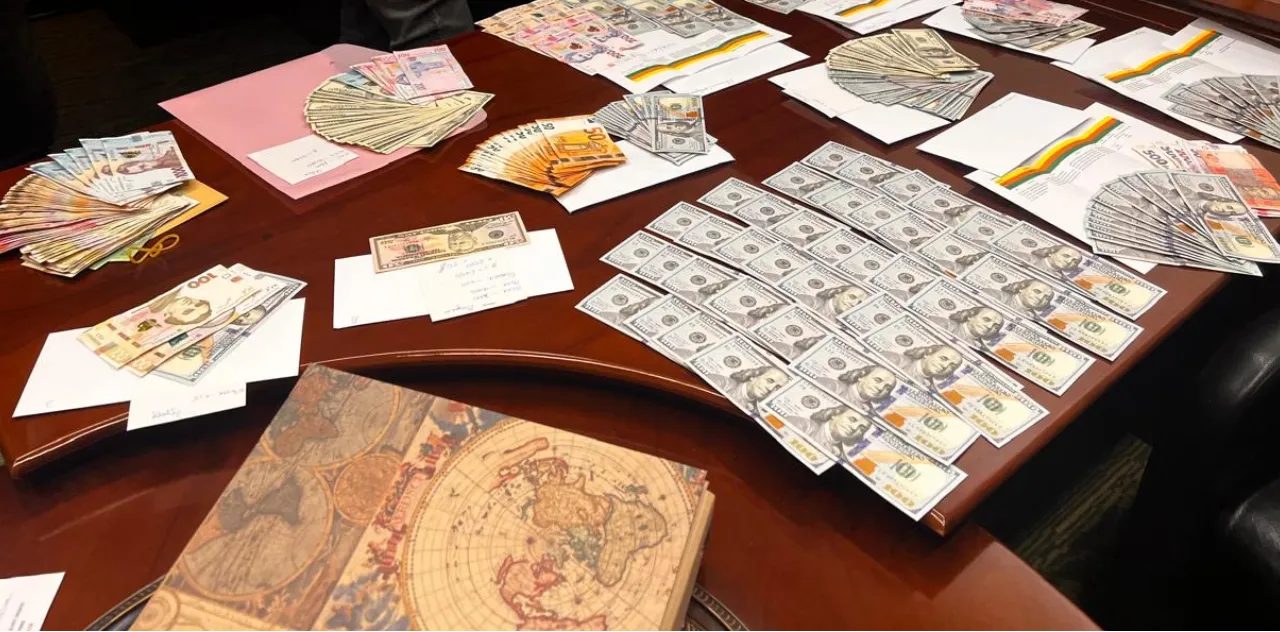
A Kyiv court found three members of an organized group guilty of setting up an underground casino in one of the city’s business centers. The suspects were charged with illegally organizing and conducting gambling activities. The case was investigated by detectives from the Kyiv Territorial Office of the Bureau of Economic Security (BES).
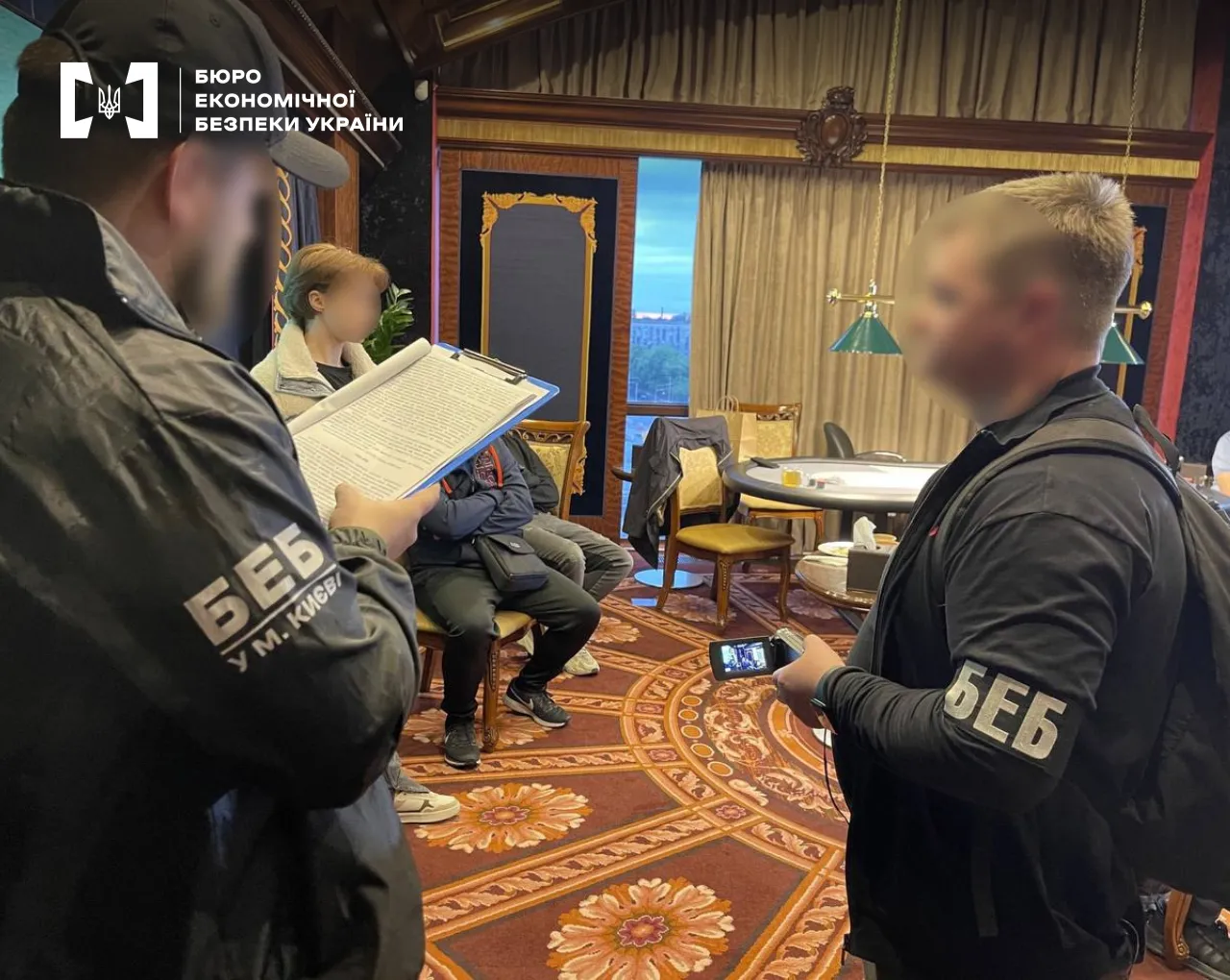
This was reported by the BEB press service.
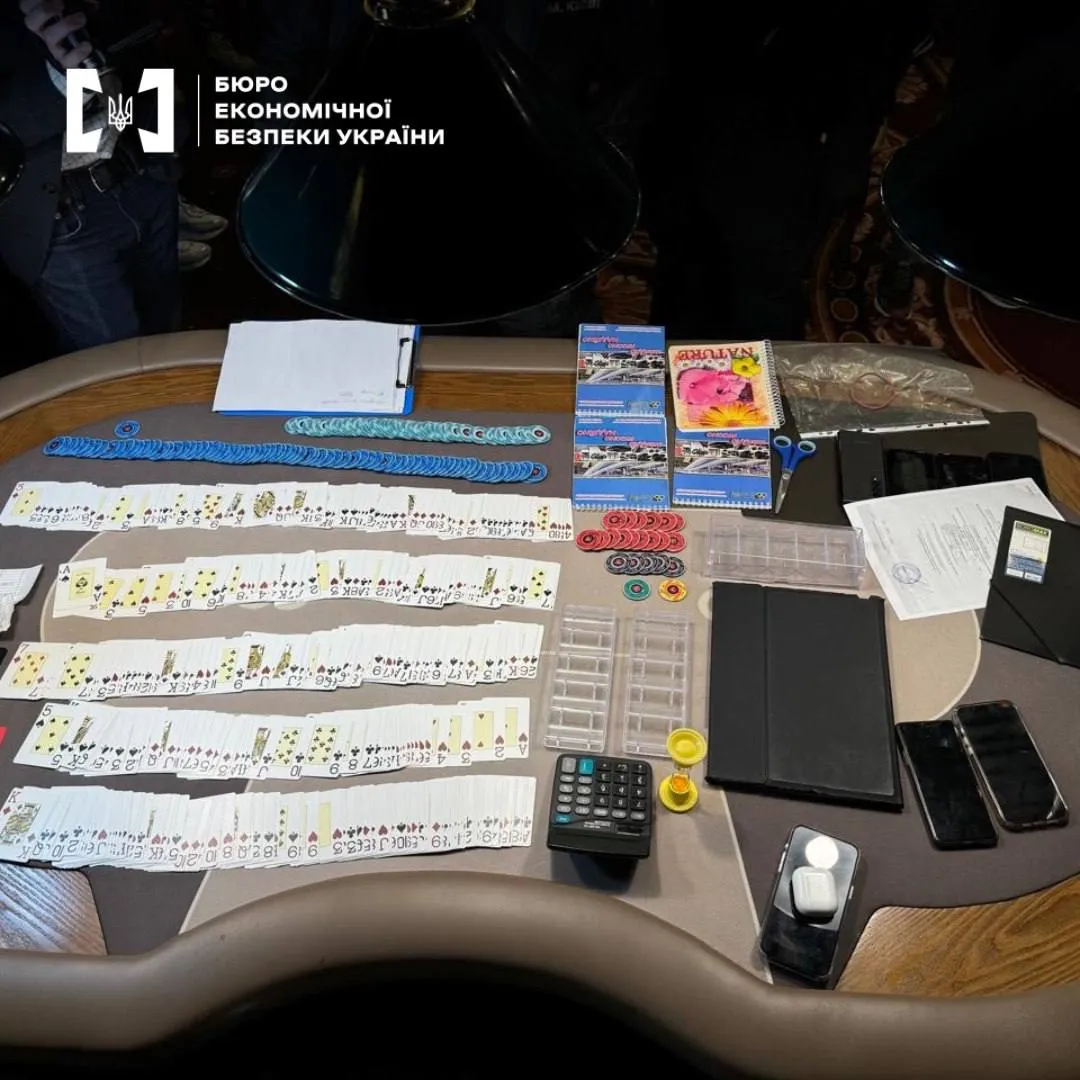
BEB detectives discovered that a Kyiv resident and two accomplices had opened an illegal gambling establishment on the ninth floor of the business center. A fraudulent call center was set up on the fourth floor of the same building.
“The suspects not only organized illegal gambling but also called citizens, offering to invest funds in a supposedly automated cryptocurrency trading system with a daily profit of up to 5%. After the money was transferred, contact with the victims ceased,” the statement reads.
Based on evidence gathered during the investigation, the court found the three defendants guilty of a criminal offense under Part 3 of Article 28 and Part 2 of Article 203-2 of the Criminal Code of Ukraine. The perpetrators were sentenced to fines.
The court imposed a fine of 799,000 UAH on the organizer of the illegal schemes and 765,000 UAH each on his two accomplices. Additionally, over $20,000 was confiscated from the perpetrators in favor of the state.
The criminal proceedings regarding the call center’s activities were transferred to the National Police of Ukraine based on jurisdiction. The case was prosecuted by the Kyiv City Prosecutor’s Office.
A similar case involving an underground casino is likely linked to the well-known businessman Vyacheslav Lysenko
Since 2024, the BEB has also been investigating a case involving an underground casino and a call center, which, according to Ukrainian media reports, were likely organized by Kyiv businessman Vyacheslav Lysenko, co-owner of “Meest China” and “CEO Club Ukraine.”
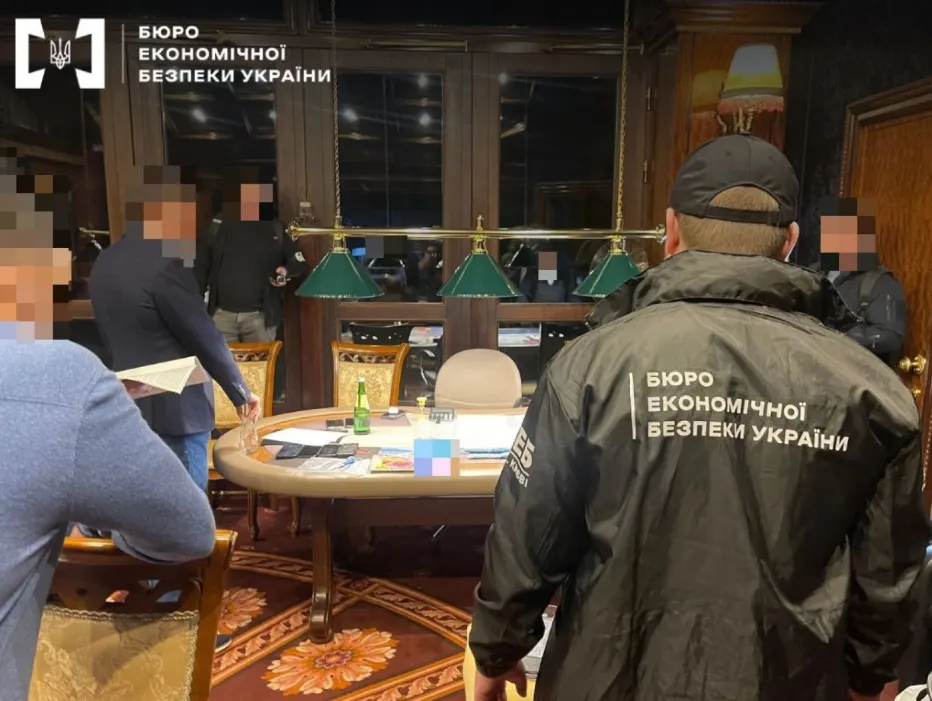
His name has been linked to this case since April 2024, when law enforcement officers raided the building where the underground casino operated. The CEO Club Ukraine office is also located there.
Law enforcement had been preparing the operation for about 8 months. At the call center, they seized computer equipment, phones, rough notes, and instructions on how to communicate with victims. In the home of one of the suspects, they seized nearly $135,000 and approximately €5,000 in cash.
In particular, according to Ukrainian media reports, Mykhailo Serhiiovych Slipukha, who served as director of two companies likely owned by Vyacheslav Lysenko, a member of the CEO Club Ukraine supervisory board, has been named a suspect in the case.
It was noted that the business center with the underground casino is located at 33B Degtyarivska Street. The searches were not limited to that location—more than 10 simultaneous raids were conducted at various addresses. In particular, at 23 Butysheva Lane, where Lysenko’s central office is located, and where Slipukha also worked.
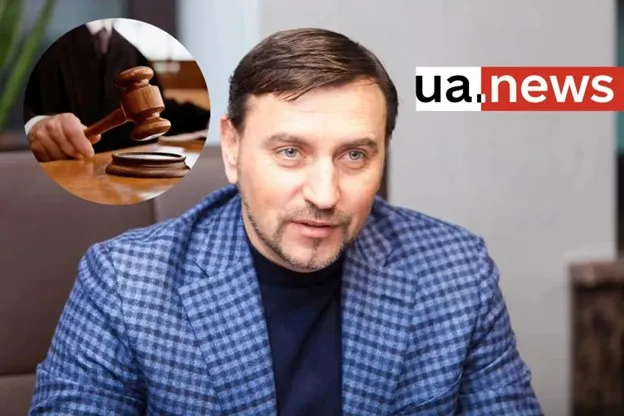
Businessman Vyacheslav Lysenko lost the court case to UA.News
Businessman Vyacheslav Lysenko categorically denied any connection to this case. The businessman attempted in various ways to remove all negative information related to his activities from the information space. This led to a legal battle with the publication UA.News, which, along with other Ukrainian media outlets, covered the details of the case involving an underground casino.
In December 2025, the Supreme Court denied the appeal filed by businessman Vyacheslav Lysenko. The co-owner of Meest China and CEO of Club Ukraine was unable to prove in court that the news published by UA.NEWS harmed his honor, dignity, and business reputation.
As a reminder, the plaintiff sought to have the information in our article regarding his alleged involvement in an underground casino and a fraudulent call center declared false, as well as to compel the publication to remove the article. Both the trial court and the appellate court dismissed the claim—and the Supreme Court upheld these rulings.
Key findings of the Supreme Court:
the disputed statements are evaluative judgments rather than assertions of established facts;
the use of phrases such as “may be,” “allegedly,” and “according to insider information” indicates conjecture rather than a statement of fact;
evaluative judgments are neither subject to proof nor refutation;
the negative nature of the statements in itself is not grounds for protecting reputation unless the dissemination of false facts is proven.
The Supreme Court also emphasized the balance between the right to respect for honor, dignity, and business reputation and freedom of expression.
It should be recalled that despite Lysenko’s attempts to use legal mechanisms to pressure the UA.NEWS editorial team into removing the publication from the news site, the Pechersky District Court of Kyiv, as early as March 2025, denied his request and left the news article on the media outlet’s website. In June, the Court of Appeals upheld this decision, emphasizing that the published and disputed information constitutes an “evaluative judgment” and does not contain statements that violate honor, dignity, or business reputation, nor are they subject to retraction.
Additionally, the court rulings noted that Lysenko failed to prove the negative impact of the news on his reputation and did not provide convincing evidence of a violation of his rights. Both courts explicitly emphasized that the media have the right to inform the public about important events and to disseminate information obtained from reliable sources, provided that such information does not constitute objective factual statements, and that the media have the right to subjectively assess certain events in the form of evaluative judgments. The appellate ruling emphasized that freedom of speech and the independence of journalism must be protected within the framework of the law.
This case is an important precedent that has shown Ukraine’s media that they have the opportunity to carry out independent, professional activities in Ukraine, but that they must fight for it.
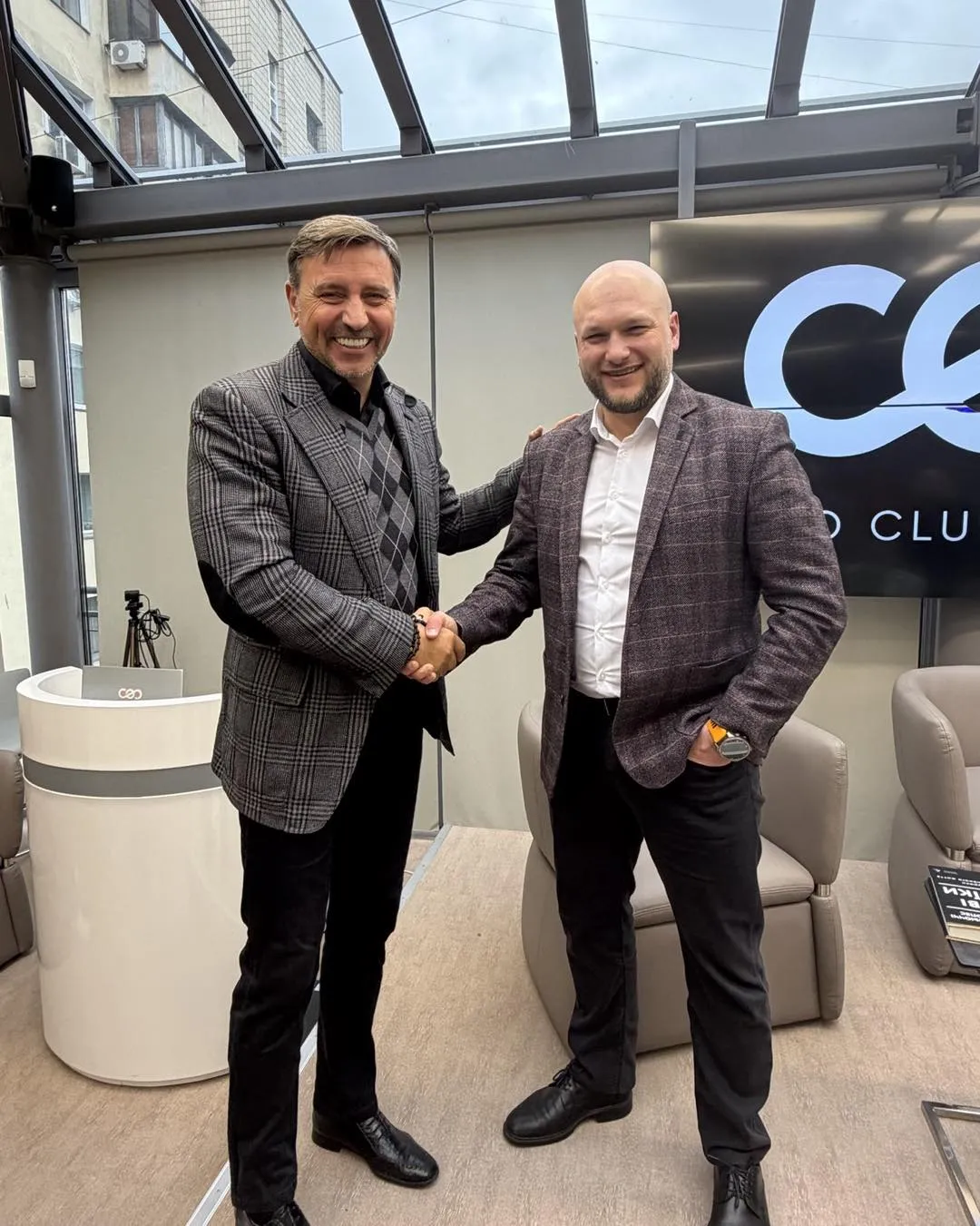
Vyacheslav Lysenko is in contact with the BEB and is “clearing” his reputation
Amid uncertainty surrounding the case of the underground casino and call center, an event took place that raised questions in the media: Economic Security Bureau Director Oleksandr Tsivinsky and his deputy Pavlo Buzdygan attended an event at the CEO Club Ukraine business club, where they met, among others, with Vyacheslav Lysenko—a shareholder of Meest China, whose offices had previously been searched by detectives from the same agency. The Bureau claims that the meeting was “public” and that no private conversations were held with the individual involved in the criminal proceedings.
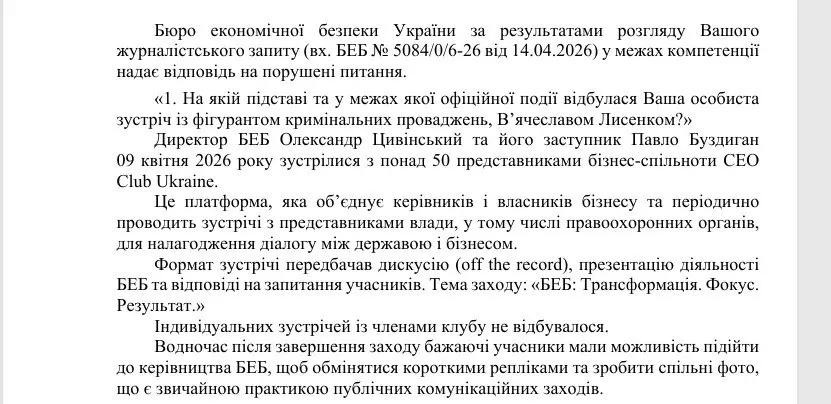
This was stated in the Bureau’s response to an official inquiry from the UA.NEWS editorial team.
In its official response, the agency attempted to distance itself from any personal contact with Lysenko, justifying the visit as “establishing a dialogue with the business community.” The meeting took place on April 9, 2026, in the format of a discussion on the topic “BEB: Transformation. Focus. Result.” In addition to Lysenko, about 50 other club members were present.

The Bureau insists that there were no individual meetings. However, they acknowledge that after the event, participants (including Lysenko) could approach Tsivinsky for “brief remarks and group photos.”
The agency’s leadership denies any risk of corruption, noting that “individual cases” were not discussed.
However, Vyacheslav Lysenko himself described the results of the meeting on social media in much greater detail than just “brief exchanges.” The businessman openly praised the new philosophy of the BEB head:
“I’m honestly surprised by the head’s approach and his philosophy: not to ‘tear apart’ businesses or shut down companies. Even if there are violations—first, an offer to correct them and voluntarily pay a fine, BUT without blocking the company’s operations... This approach could change the ‘rules of the game,’ and the BEB will no longer be a punitive body for legitimate businesses, but rather an ally. My conclusion: if this approach takes root... for legitimate businesses—no risks, only transparency and peace of mind,” Lysenko wrote on his Facebook page.
After losing his court cases, Vyacheslav Lysenko has been actively promoting himself in the public sphere as a social activist, philanthropist, and mentor. The businessman maintains his social media accounts in the best traditions of personal branding. His feed features only achievements and motivational quotes.
His interviews have also begun appearing in the media, where he is presented as an expert in various fields: from personal growth to geopolitics. In particular, Lysenko actively comments on the topic of doing business in China.
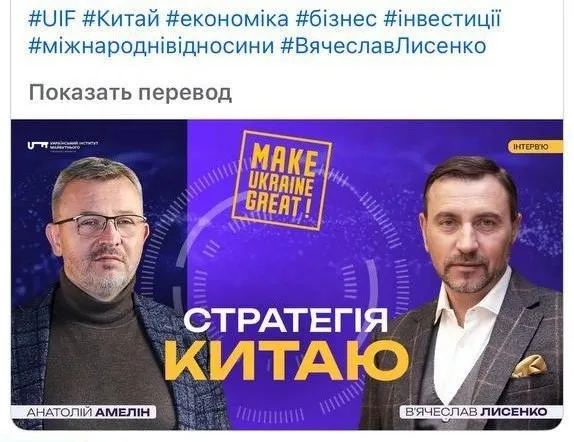
At the same time, behind the image of an effective and principled mentor-entrepreneur lies a background that suggests a willingness to compromise when it comes to profit and massive earnings—which, during wartime and under intense tax pressure, are unlikely to be generated by a transparent and honest business. These compromises are usually kept quiet to avoid damaging one’s personal brand. This is quite easy to do in the information space shaped by social media. The dark episodes are mostly highlighted by journalists from national media outlets, who once again raise the issue of establishing the institution of reputation.
Read also:
Communication or pressure on the investigation: the head of the BEB met with businessman Vyacheslav Lysenko, whose offices were previously searched by the Bureau
A photo to commemorate the searches: why did the BEB leadership meet with Vyacheslav Lysenko
Businessman Lysenko lost his appeal against UA.NEWS regarding the publication of information about his alleged organization of an underground casino in Kyiv


