
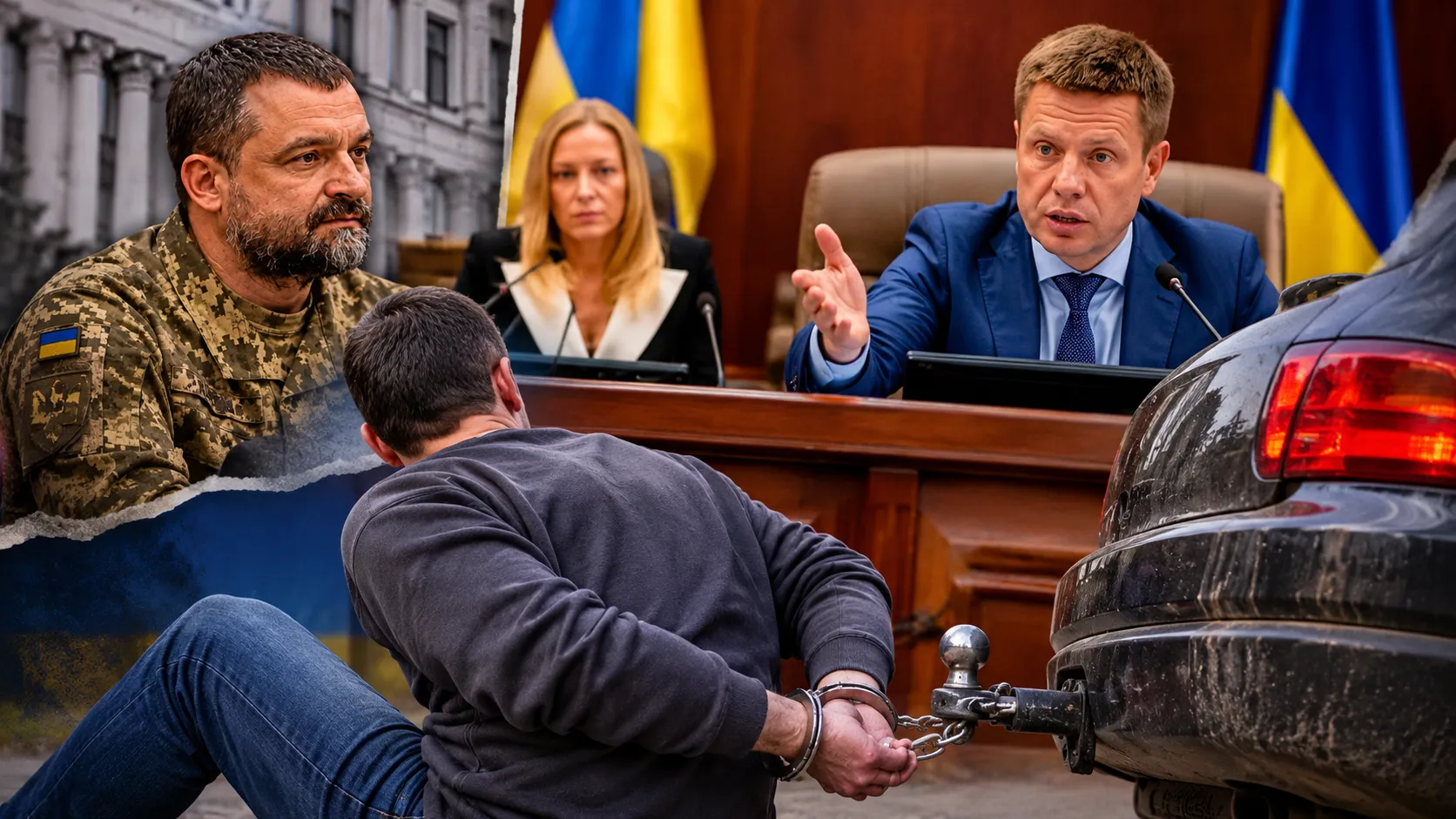
They lured people in through AUTO.RIA, tied them to a tow bar, and took bribes: what’s happening at the traffic police departments in Vinnytsia and Khmelnytskyi regions
26 November 2026 19:19Not a mobilization, but a list of reality thrillers: one man was handcuffed to a car’s tow hook; another wanted to sell his car, but instead of buyers, representatives from the Military Registration and Enlistment Office showed up. A father came to the military registration office “armed” with a baseball bat to free his son with a disability, and a 25-year-old coach was mobilized despite street protests by his students and parents.
And these are just some of the incidents discussed at a meeting of the Verkhovna Rada’s Temporary Investigative Commission, chaired by Oleksiy Honcharenko. At the regular session, the directors of NABU and the Specialized Anti-Corruption Prosecutor’s Office (SAPO), former SBU head Malyuk, Prosecutor General Kravchenko, and NABU detective Magamedrasulov were scheduled to testify, but none of the invited guests appeared in the hearing room for the second time, so the heads of the regional TCCs in Vinnytsia and Khmelnytskyi explained the actions of their subordinates to the investigative commission.
We’ve compiled the most notable stories from this session, along with comments from the TCC heads.
Chase Involving a Family with Children: National Guard Soldier Smashed a Window
Police officers and military personnel in the Vinnytsia region launched a pursuit of a passenger car. A family with two children was traveling in the car. The driver apparently did not stop when ordered to do so by the police, so they began the pursuit. After the car was stopped, a soldier approached it and smashed the window on the driver’s side; the frightened children screamed, and one of the girls crossed herself. In this shocking manner, the National Guard soldier was apparently “demonstrating” the benefits of military service.
“Military personnel did not participate in the pursuit,” explained Ilya Matviychuk, head of the Vinnytsia Regional Traffic Control Center. According to him, an internal investigation was conducted following the incident, as a result of which the chief of the second department of the Khmilnytskyi District Traffic Police and Special Forces was brought to disciplinary responsibility.
Police officers provided further clarification: the driver failed to stop when law enforcement officers lawfully ordered him to do so, after which they began pursuing him in a patrol car with its lights and sirens on. Ultimately, the car came to a stop in the Zhytomyr region (they had attempted to stop it earlier in the Vinnytsia region) due to damage to a rear tire. Administrative charges were filed against the driver for failing to comply with the order to stop and for failing to present a valid driver’s license.
The police department conducted an internal investigation into the incident and found no unlawful conduct on the part of its officers. Moreover, a National Guard soldier smashed a window in the car, greatly frightening the children. He was stationed at a mobile checkpoint alongside law enforcement officers and representatives of the Territorial Recruitment Center, which was set up for recruitment purposes, not to publicize mobilization measures. When a car with children inside drove through the checkpoint, ignoring orders to stop, the National Guard soldier got into a police car and joined the pursuit alongside law enforcement officers.
Neither Ilya Matviychuk nor National Police representatives Viktor Kovalchuk and Mykola Kurgan were able to explain exactly what benefits of serving in the National Guard the pursuit of the family was supposed to demonstrate. A report regarding the soldier’s actions was filed with the Zhytomyr Regional Police and subsequently transferred to the State Bureau of Investigations based on jurisdiction. The results of the investigation were not known to police representatives at the time of the TSC hearing.
Oleksiy Goncharenko instructed the secretariat to contact the State Bureau of Investigations to find out the outcome of the investigation into the National Guard soldier who broke the window.
How Many Disciplinary Actions Have Servicemembers Received: What’s Happening at the Vinnytsia TSK
Does the TSK punish its own employees for abuse of power, units operating without body cameras, the use of tear gas, possible “inflated” statistics, and bribes allegedly used to “get people off the draft list”? Instead, Ilya Matviychuk spoke about attacks on the military personnel themselves. Over the course of a year, 26 such incidents were recorded, in which military personnel sustained injuries, and one even died. He used this to explain why military personnel are permitted to use pepper spray.
“They have the right to do so. They are citizens of Ukraine first and foremost, and only then employees of the Military Registration and Enlistment Office,” stated the head of the Vinnytsia Regional Military Registration and Enlistment Office.
He then cited figures on personnel changes within the agency: over the course of the year, 868 military personnel were transferred to other positions or dismissed from the Vinnytsia TCC system. For comparison: the current authorized strength of personnel is approximately 1,670 people. In other words, personnel changes affected a significant portion of the staff, but for various reasons: health issues and transfers to other positions.
A total of 323 military personnel faced disciplinary action. Another nine were dismissed from their posts or discharged from military service. In addition, 66 official investigations and inspections were conducted at the Vinnytsia Territorial Military Commissariat over the course of the year. However, when explaining the reasons for the violations, Ilya Matviychuk mentioned the low level of qualification among some service members. He noted that not everyone is able to correctly assess a situation, which leads them to make erroneous decisions that subsequently result in negative consequences.
Corruption Cases: Six Cases in a Year and a Soldier Transferred to a Combat Unit
Seven military personnel have been implicated in corruption cases handled by the Vinnytsia Regional Territorial Control Center over the past two years. In 2025, there was one such case, classified under Articles 368 and 369 of the Criminal Code. In 2026, six cases were already registered under various articles: receiving and providing unlawful benefits, illegal interference with electronic systems, and drug possession.
Meanwhile, 452 out of a total of 1,653 military personnel at the regional TCC have combatant status. This represents approximately 27% of the personnel. The remaining personnel are fit for service in rear units.
Rally Outside the Military Registration and Enlistment Office: Police Focused Solely on Public Order
On October 8, parents, students, and others concerned about the future of 25-year-old Andriy Bryndak gathered near the assembly point of the Khmelnytskyi Regional Military Registration and Enlistment Office. The man worked as a gymnastics coach and was a full-time student. The day before, he had gone to the city’s Territorial Mobilization Center in response to a summons, intending to apply for a deferment due to his studies; however, after undergoing a medical examination, he was mobilized.
The protesters demanded that Bryndak be released and chanted that the mobilization was illegal, but in response they were warned: “Fire will be opened.” They claimed that the military threatened them with automatic weapons.
Serhiy Bren, the acting head of the Khmelnytskyi Regional Military Registration and Enlistment Office, offered a different account: Bryndak arrived at the city’s Military Registration and Enlistment Office voluntarily on October 7, underwent a medical examination, received a determination of fitness for service, and spoke with a recruiter from the military unit. He was then mobilized.
At the time of his conscription, the coach did not have a formal deferment. The mere fact of being a student, Bren explained, does not serve as a substitute for a deferment.
“He was supposed to apply for a deferment not at the Military Registration and Enlistment Office, but either through the Administrative Services Center for review by a commission or independently via the ‘Reserve+’ app, which he did not do,” stated the head of the regional Military Registration and Enlistment Office.
The protesters were not threatened with weapons either. Serhiy Bren explained that on the grounds of the assembly point, military personnel were guarding a military facility. Therefore, after the protesters attempted to break through the gates, the soldiers verbally warned that in the event of unlawful entry, they could use weapons, force, and special means in accordance with the law.
An internal investigation into Bryndak’s mobilization was ordered the day after the events. The result: no violations of the conscription procedure were found. Bryndak, who had been mobilized, did not file a complaint with the Territorial Military Commissariat alleging a violation of his rights.
A separate investigation was conducted into the rally itself, specifically to determine whether any military personnel subordinate to the TCC were among the participants and whether citizens’ rights might have been violated. The police, who were maintaining public order near the TCC building that day, did not record any violations during the gathering, and after speaking with journalists, the crowd dispersed peacefully.
A $1,000 Porsche Panamera: An Unusual Entry Found in a TCC Employee’s Declaration
Olena Koltsova, a leading specialist in the conscription department of the Khmelnytskyi Territorial Recruitment Center, declared two family vehicles: a 2018 Nissan Qashqai worth 50,000 hryvnias and a 2014 Porsche Panamera worth 46,000 hryvnias. In other words, the Porsche listed in the declaration turned out to be cheaper than the Nissan and cost approximately $1,000.
Instead of Koltsova, Yevhen Gorbachev, deputy head of the Khmelnytskyi Regional Military Registration and Enlistment Office, explained this curious arithmetic to the head of the Military Registration and Enlistment Committee: the Panamera belongs neither to Koltsova nor to her husband. A family friend, who moved abroad in 2022, had given the car to the family for their use. The Nissan Qashqai was purchased even before she began working at the TSK.
“An investigation was conducted into this matter to verify any allegations of illicit enrichment or corruption. Nothing was found. The National Agency for Corruption Prevention (NAZK) also conducted an investigation,” Gorbachev assured.
Koltsova continues to work at the TCC and, according to the official, drives the Nissan to work. The Porsche is used by her husband, who is a private entrepreneur and—in all sincerity, not just for show—provides significant and active support to the Armed Forces.
However, the TCC representative was unable to explain why the car was listed in the declaration at exactly 46,000 hryvnias. He speculated that this amount might have been specified in the purchase agreement, but did not provide a definitive answer.
Handcuffed to a tow bar: Two soldiers received reprimands
In Lehnivka, Khmelnytskyi Oblast, during a public alert, military personnel handcuffed a 61-year-old man to a tow bar after using force and a pepper spray canister against him. This incident was reported by Dmytro Lubinets, the Verkhovna Rada Commissioner for Human Rights.
The man is the father of a soldier. However, the Khmelnytskyi Regional Territorial Center for Recruitment and Social Support stated that they acted within the scope of their authority. A subsequent internal investigation did confirm the unlawful actions of the district TCC employees. Two soldiers were subjected to disciplinary action, and the case materials were forwarded to the territorial office of the State Bureau of Investigation.
The head of the Khmelnytskyi Regional TCC, Yevhen Gorbachev, called the incident regrettable and stated that he personally condemns the use of handcuffs, but in this case, the military personnel could not have reacted otherwise.
Law enforcement officials explained the details of the incident: “Military registration and enlistment office employees were speaking with an individual. At that moment, a 61-year-old man saw the military personnel’s vehicle. In a small village, everyone recognizes the military registration and enlistment office’s vehicles. So the man approached them on his own, provoked a conflict, damaged the vehicle, and assaulted the TCC employees—who later had their injuries documented at the hospital.”
This man has two sons—one is allegedly a draft dodger, and the other is serving in the Armed Forces. The conflict likely began due to the man’s personal animosity. Both sides have filed statements. Law enforcement is investigating two separate incidents: the actions of the civilian man and the actions of the TCC employees. The police are conducting proceedings under Article 350 of the Criminal Code (threats or violence against a public official or a citizen performing a public duty). The investigation into the actions of the military personnel falls under the jurisdiction of the State Bureau of Investigation (DBR). At the time of the hearing, neither investigation had been completed, and no preventive measure had been imposed on the 61-year-old man.
It later emerged that the body cameras were not recording during the incident. More precisely, as a representative of the TCC acknowledged, they had not even been turned on. And the conflict itself took place without police present. Therefore, Oleksiy Goncharenko promised that the commission would keep the case under review. He also asked the TCC management to pay special attention to the military officer who directly applied handcuffs to the elderly man.
Instead of a buyer—a TCC employee: a man was lured out via an ad on AUTO.RIA
According to media reports, a man in Khmelnytskyi listed his car for sale on AUTO.RIA. He received a call from supposed buyers, and they agreed to view the car, but instead of them, TCC employees arrived. The man was taken to the Territorial Recruitment Center.
The man’s daughter later complained that her father had health problems, and TCC employees initially refused to accept the medication that had been given to him. They did so only after repeated requests.
TCK representatives could not confirm the story regarding the ad, but acknowledged that the man’s daughter had contacted the police to complain that her father was not receiving medical care.
“It is true that she contacted the police, stating that her father was there and was not receiving medical care. An ambulance was called,” the official said.
The ambulance crew arrived, checked the man’s blood pressure, and administered medication. Afterward, he underwent a military medical examination, following which he was drafted into military service.
A veteran armed with a bat came to the Military Registration and Enlistment Office to demand the release of his son with a disability
A man in military uniform carrying a baseball bat arrived at the Khmelnytsky Military Enlistment Office and demanded that his son, who has a disability, be released. He claimed that the young man had been struck on the head.
“A response was dispatched via 102 regarding this incident. An investigative team arrived on the scene. There was no evidence to support this claim,” said Yevhen Gorbachev. Instead, he stated that the veteran had smashed the front door and the turnstile at the military registration and enlistment office.
Law enforcement officers reviewed footage from the building’s security cameras and body cameras. They found no evidence that force had been used against the conscript. The conflict was resolved at the scene. Neither the conscript nor his father filed any complaints with law enforcement regarding violations of their rights. No criminal case was opened against the father. His actions were classified as an administrative offense under Article 173 of the Code of Administrative Offenses—petty hooliganism. However, given his age and personal circumstances, the man was exempted from liability. Oleksiy Goncharenko called this the right decision.
$7,000 for service in the rear
A woman approached a 48-year-old soldier at the Shepetivka District Military Enlistment and Recruitment Office. She wanted to get an acquaintance assigned to a military unit that does not take direct part in combat operations. For $7,000, the soldier promised to arrange things with the Military Medical Commission, but was detained while receiving the money. The court ordered the soldier to be held in pretrial detention with the option of posting bail. He paid the bail and, according to a representative of the Military Enlistment and Recruitment Center, was at home at the time of the hearing.
Commenting on this incident, Gorbachev suggested that the soldier had knowingly deceived the woman, since it was unlikely that he actually had any influence over the members of the Military Medical Commission. To get to the bottom of the matter, the Shepetivka Regional Military Registration and Enlistment Office even conducted an investigation, but the information was not confirmed.
Two Renaults in Exchange for a Promise Not to Draft the Company’s Employees
According to the investigation, a former department head at one of the district military registration and enlistment offices in Khmelnytskyi Oblast—a lieutenant colonel—reached an agreement with the deputy director of a company not to draft its employees into military service. The price of the deal was two Renault cars. The lieutenant colonel received the cars in April 2024—a Renault Sandero with a book value of nearly 230,000 hryvnias. In August 2025, he received a Renault Duster worth over 587,000 hryvnias.
In the fall of 2025, the lieutenant colonel was transferred to serve in Zakarpattia, and the businessman, clearly realizing that he would have to renegotiate the deal, asked for the cars to be returned or donated to the Armed Forces. However, the lieutenant colonel decided to register the cars in the name of a close relative. For this, he was charged under Part 3 of Article 368 of the Criminal Code of Ukraine—receipt of an unlawful benefit by a public official.
A representative of the Khmelnytskyi Regional Territorial Control Center noted that he could not comment on personnel decisions in another region or on the course of criminal proceedings that no longer fall within his jurisdiction. However, a representative of the National Police clarified the circumstances of the case: it was the National Police who documented this crime. Law enforcement officials are aware that the lieutenant colonel was detained after being transferred to Zakarpattia. The court imposed a pretrial detention order on him, with the right to post bail of 260,000 hryvnias. He was subsequently suspended from his position at his new post, and the indictment was forwarded to the court.
“This is where the reward found this hero,” joked the TSC chairman, commenting on the lieutenant colonel’s arrest, and expressed hope for a fair verdict from the court.
Finally, Goncharenko reminded everyone that the next TSC hearing will take place on December 7. Former Defense Minister Mykhailo Fedorov is expected to attend—either voluntarily or with police assistance (which, of course, is preferable).
December 7 is also one of two dates on which the commission has invited NABU Director Semen Kryvonos, SAPO Head Oleksandr Klymenko, former SBU Head General Vasyl Malyuk, NABU detective Magamedrasul, and former Prosecutor General Ruslan Kravchenko.




