
History May Repeat Itself: Spain Tops the List of Favorites for the 2026 World Cup
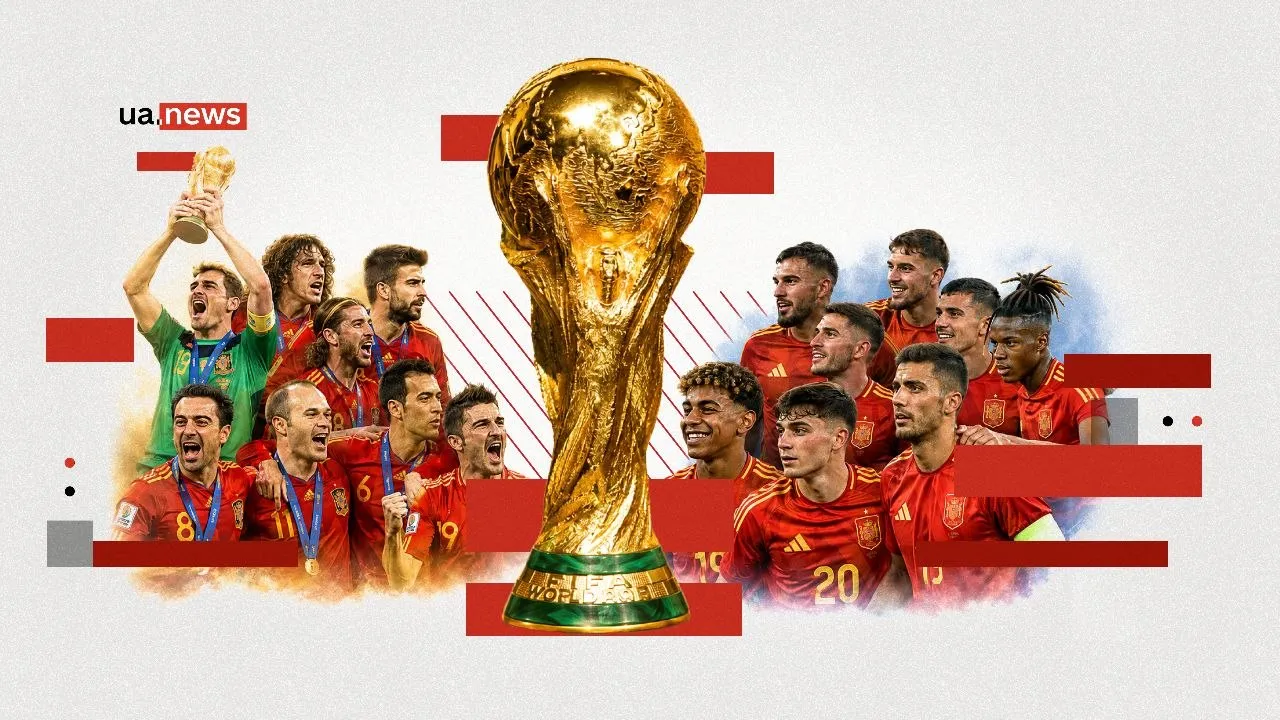
The Spanish national team has taken another step toward its ultimate soccer dream. Yesterday, the team confidently defeated France in the World Cup semifinals and became the first finalist of the tournament. For the Spaniards, this is a chance not only to win the World Cup for the second time in history, but also to reaffirm their status as one of the strongest national soccer teams of our time.
The victory over France has become one of the most talked-about events in world soccer. That is why, after the semifinal concluded, most bookmakers significantly revised their predictions regarding the future World Cup champion.
UA.News explains who analysts and bookmakers currently consider the top contender to win the World Cup, and also looks back at the Spanish national team’s path to its historic championship in 2010—the country’s only World Cup title to date.
Who Is Currently the Top Favorite to Win the World Cup
After defeating France, Spain took the top spot in the rankings of most leading bookmakers. While several teams were considered favorites before the start of the knockout stage, reaching the final has significantly changed the situation.
According to international bookmakers, the “Red Fury” has the best chance of lifting the World Cup trophy. At the same time, experts emphasize that World Cup finals are traditionally the most unpredictable matches, where a single mistake or a single lucky play can decide the fate of the title.
Several factors are working in Spain’s favor today. First, the team has one of the best possession rates among all tournament participants.
Second, the team has shown virtually no loss of organization, even against the strongest opponents. Furthermore, the coaching staff has managed to strike a balance between experienced players and young talents who have been the real revelation of this World Cup.
Analysts also point to the psychological factor. The victory over France boosted the team’s confidence, and their consistent performance throughout the tournament has made Spain one of the most stable teams in the competition.
Mathematical models also offer an optimistic assessment of the “Red Fury’s” chances. The Opta Analyst platform, which uses a supercomputer to model tournament results, gave France a 34% chance of winning the title and Spain a 23.4%chance even before the semifinals began.
After Spain’s victory over France, it was Luis de la Fuente’s team that moved into first place in the supercomputer’s predictions.
Prediction markets are showing a similar trend. On the Polymarket platform, where users trade contracts on the outcomes of sporting events, the probability of the Spanish national team winning the championship rose sharply immediately after the final whistle in the Spain–France match.
For many, the road to the final was reminiscent of 2010
For many soccer fans, Spain’s current performance brings to mind the 2010 World Cup in South Africa. Back then, the team was not considered the clear favorite to win the tournament either, but with each match, it demonstrated increasingly mature soccer.
That squad is considered one of the best in the history of world soccer. The national team featured Iker Casillas, Carles Puyol, Gerard Piqué, Sergio Ramos, Xavi, Andrés Iniesta, Xabi Alonso, David Villa, David Silva, Sergio Busquets, and Fernando Torres. Most of them were star players for Barcelona and Real Madrid, which at that time dominated European soccer.
However, the start of the tournament came as a real shock to the Spaniards.
The loss to Switzerland that could have changed everything
Spain suffered a sensational 0–1 loss to Switzerland in their first World Cup match.
Before kickoff, most experts had predicted an easy victory for the reigning European champions. The Spanish controlled the ball for nearly the entire match and created chances, but they were never able to capitalize on their dominance.
Instead, the Swiss capitalized on one of their few chances and scored the winning goal, which became one of the biggest upsets of that tournament.
After that defeat, many questioned the prospects of Vicente del Bosque’s team. Reports of a crisis began to appear in the media, and experts debated whether the famous “tiki-taka” style had become too predictable.
However, it was precisely after that match that the team seemed to hit the reset button.
A series of narrow but extremely important victories
In the second round of the group stage, Spain defeated Honduras 2–0 thanks to a brace by David Villa.
Then came a hard-fought 2–1 victory over Chile, which secured first place in the group and a spot in the knockout stage.
Starting with the Round of 16, every match turned into a real battle.
In the match against Portugal, David Villa scored the only goal.
In the quarterfinals, Spain narrowly defeated Paraguay. Villa was once again the hero of the match, although that game was also remembered for two missed penalty kicks and a brilliant performance by Iker Casillas.
In the semifinals, Spain faced Germany—one of the most impressive teams in the tournament. Joachim Löw’s young squad was striking in its effectiveness, but Spain barely allowed its opponent to create any dangerous chances.
The victory came courtesy of a header by Carles Puyol off a corner kick.
It was then that many experts finally acknowledged: Spain had rightfully become the top contender for the World Cup.
A Final That Went Down in History
On July 11, 2010, in Johannesburg, Spain faced the Netherlands in the final.
The match turned out to be extremely physical. The referee repeatedly handed out yellow cards, and one of the most memorable moments was a dangerous tackle by Nigel de Jong on Xabi Alonso’s chest.
Regular time ended scoreless.
It wasn’t until the 116th minute that Andrés Iniesta, after a pass from Cesc Fàbregas, shot past the Dutch goalkeeper and secured a historic 1–0 victory for Spain.
That goal has forever remained one of the most famous moments in World Cup history.
It was then that Spain became world champions for the first time.
After the final whistle, many called that team one of the strongest in soccer history. The national team won three major tournaments in a row—Euro 2008, the 2010 World Cup, and Euro 2012—setting a unique record that no other national team has yet managed to match.
What do the 2010 World Champion Spain team and the current team have in common?
Comparisons between the current Spanish national team and the legendary 2010 squad have already become a major topic in the global sports media. Although soccer has changed significantly since then—and with it, the demands placed on players—both teams share many similarities.
First and foremost is their confidence in their own style. Just as they did sixteen years ago, the Spaniards do not relinquish possession even under pressure from their opponents. While Vicente del Bosque’s team made history with its famous “tiki-taka,” the current national team has made this style more direct and fast-paced.
Luis de la Fuente’s team relies much more frequently on swift transitions from defense to attack, presses aggressively after losing possession, and isn’t afraid to take risks.
Another important similarity is the atmosphere within the team. In 2010, the national team’s core consisted of players from Barcelona and Real Madrid, who were locked in a fierce rivalry at the club level.
However, on the national team, they left all conflicts off the field and worked toward a common goal. A similar picture can be seen today, as players from different clubs quickly find common ground and demonstrate strong team discipline.
At the same time, today’s Spanish team has some significant differences. While in 2010, experienced world-class stars played a key role, today the team’s main strength lies in its young players. It is the young players who set the pace of the game, are not afraid to take the initiative, and are increasingly deciding the outcome of the most important matches.
Experts also point to the depth of the roster. While during the 2010 World Cup, Del Bosque made almost no changes to the starting lineup, the current coaching staff has significantly more opportunities for rotation without a significant loss in the quality of play. This is precisely what has allowed Spain to navigate a challenging tournament with minimal personnel issues.
Will Spain Become a Two-Time World Champion?
Ahead lies a match that could go down in the history of Spanish soccer. If the team wins the final, it will become world champion for the second time and join the elite club of national teams that have won the World Cup more than once.
However, regardless of the outcome of the final, this World Cup can already be called one of Spain’s most successful in recent years. The team has reclaimed its status as one of the world’s top soccer powers, demonstrated the effectiveness of a new generation of players, and once again confirmed that the Spanish soccer academy remains one of the strongest in the world.
Now there is just one step left. The final will determine whether the current generation can repeat the achievements of Casillas, Iniesta, Xavi, and their teammates, who etched their names into the history of world soccer sixteen years ago.
If that happens, the current team will also be remembered as one of the best national teams of its time, and the 2026 World Cup will become yet another golden chapter in the history of Spanish soccer.


