
White dwarfs can turn into neutron stars under certain conditions
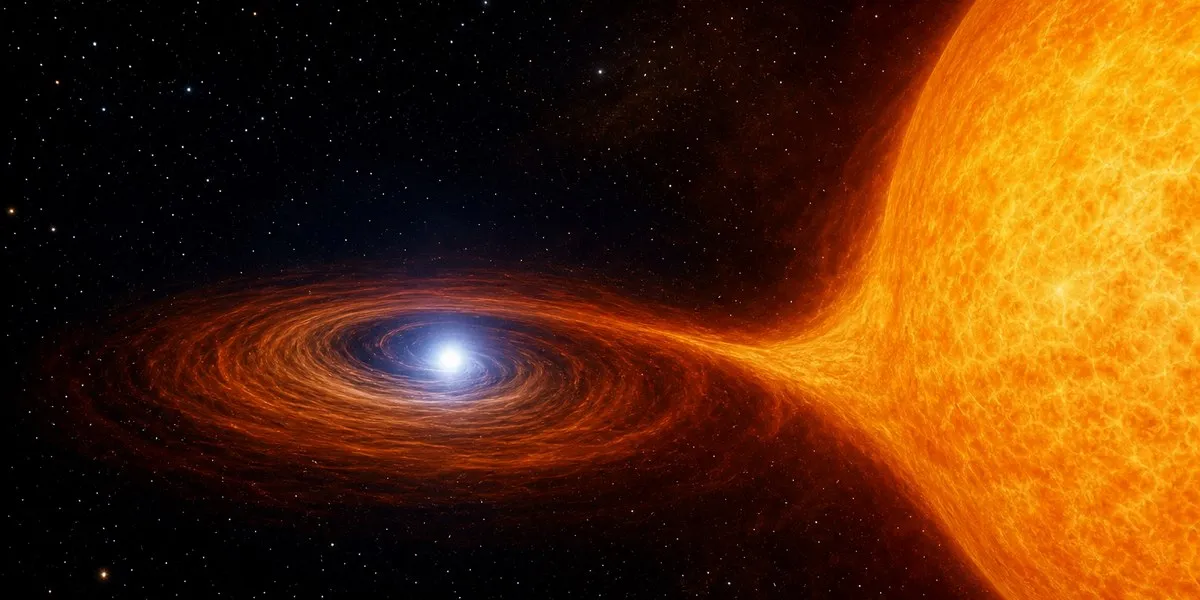
Using three-dimensional simulations, researchers identified the conditions under which a white dwarf in a binary star system can collapse and turn into a neutron star. This mechanism is called accretion-induced collapse: the stellar remnant accumulates matter transferred to it by a companion star, Space.com reports.
Which white dwarfs can collapse
White dwarfs are remnants of stars with masses close to that of the Sun. Most of them consist of carbon and oxygen, but some contain oxygen, neon and magnesium. Such white dwarfs are generally more massive and denser than carbon-oxygen ones, so they require less additional matter to approach the Chandrasekhar limit — approximately 1.4 solar masses.
A carbon-oxygen white dwarf can explode as a Type Ia supernova and be completely destroyed after reaching this limit. In contrast, oxygen-neon-magnesium white dwarfs may avoid such a scenario and become progenitors of neutron stars, but only under appropriate accretion conditions.
A narrow accretion range
Study leader Laurenz Tümmler of ETH Zurich explained that the composition of a white dwarf alone is insufficient. The rate at which matter arrives from the donor star must remain within a relatively narrow range. If the rate is too low, nova outbursts can eject a significant portion of the accumulated matter again. If it is too high, winds, envelope expansion or interactions between the components of the binary system may prevent the white dwarf from reaching the conditions needed for collapse.
More current news is available on the UA.News Telegram channel Telegram.
When the conditions are met, electrons are captured by neon and magnesium nuclei, reducing the pressure supporting the star and triggering collapse. According to the authors' estimate, such events should be rare, although their rate remains highly uncertain.
Observational signatures
The models showed that the most neutron-rich matter is ejected not along the rotation axis, as scientists expected, but at intermediate latitudes. In these regions, magnetically driven matter flows collide with neutrino-heated winds, so the appearance of the event may depend on the viewing angle.
Accretion-induced collapse may appear as a bright ultraviolet and optical event lasting two to three days, possibly with X-ray and longer-lasting radio emission. According to Tümmler, such phenomena could potentially be detected by the Vera Rubin Observatory and other telescopes. The work was published as a preprint on arXiv.


