
Chinese companies develop “world models” for humanoid robots
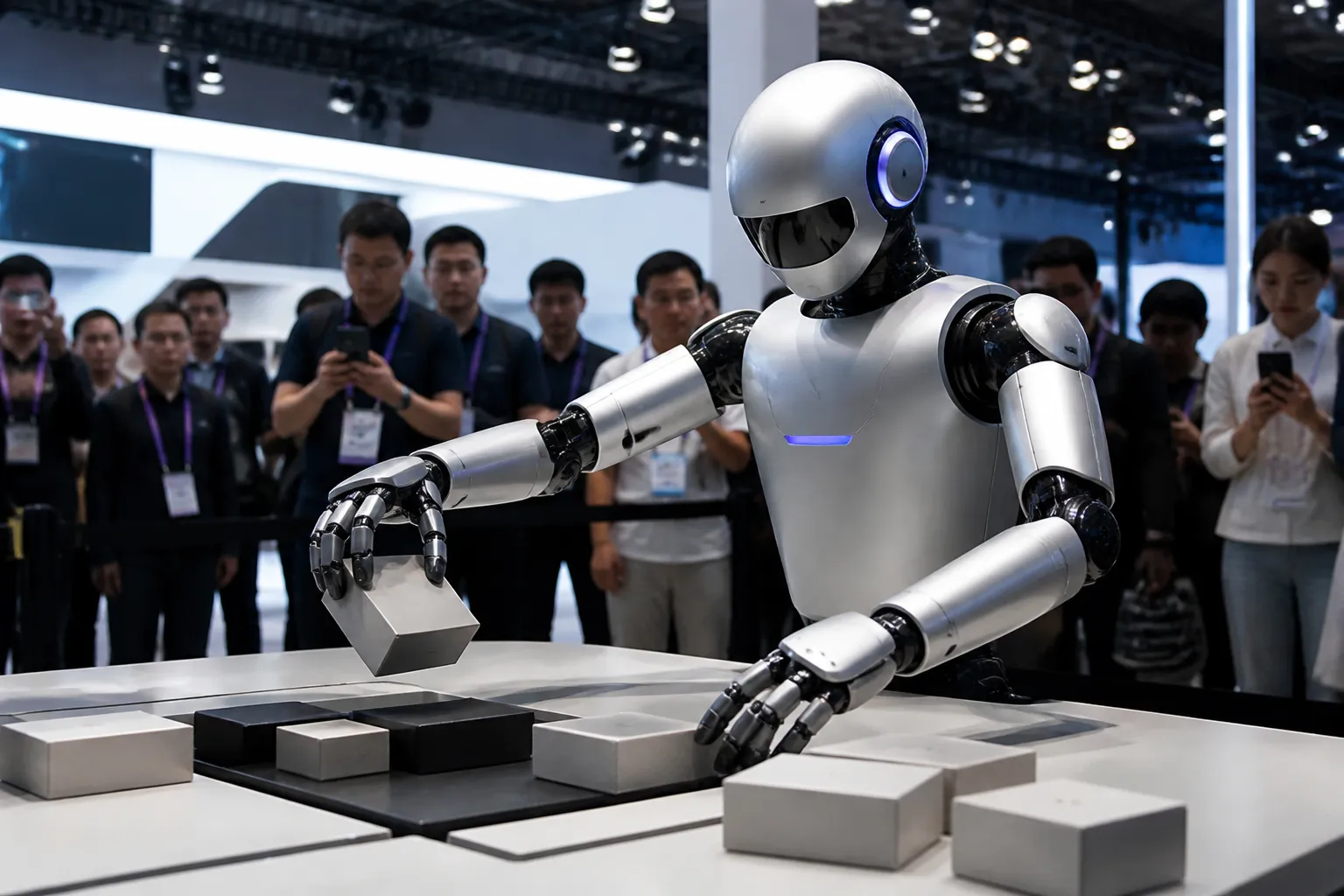
Chinese technology companies are accelerating the development of so-called world models — artificial intelligence systems intended to help humanoid robots understand and interact with the physical environment. At the World Artificial Intelligence Conference in Shanghai, hundreds of robots demonstrated boxing, coffee making, object sorting and other actions, but outside prepared showcases their capabilities remained limited, The Japan Times reports.
From mechanical bodies to software
Bloomberg Opinion columnist Catherine Thorbecke writes that China’s humanoid robot industry has largely solved the task of creating mechanical bodies. At the same time, software capable of giving robots the ability to navigate unpredictable physical environments remains a more difficult challenge.
World models are intended to teach systems to work with objects and changing conditions through observation, action and feedback. At the conference, ACE Robotics, a spinoff of Chinese multimodal AI developer SenseTime, presented Kairos World Model 3.0. The company said the system delivered the best results in several tests, including long-term task planning and reasoning about physical interaction.
Tencent Holdings also presented its comprehensive approach to embodied intelligence. The company’s chief scientist, Zhengyou Zhang, said that genuine intelligence emerges through the joint work of language, visual, spatial and physical systems, as well as feedback from the environment.
More current news is available on the UA.News Telegram channel Telegram.
Open weights and a manufacturing base
Alibaba Group and ByteDance are also working on world models. ByteDance has reportedly identified this direction as one of its AI priorities this year. Earlier this year, Tencent released its flagship HY-World 2.0 model with open weights to attract developers and accelerate further work on the technology.
Such systems are important for manufacturers such as Unitree Robotics. Its humanoids gained international attention through dance performances and kung fu demonstrations, but the company, in the author’s assessment, is still seeking practical applications for its products. China’s broad base of robotics manufacturers creates many hardware platforms for training and improving world models.
A McKinsey report mentioned in the article states that China holds a significant share of the market for robot components, including because supply chains overlap with electric vehicle manufacturing. Canadian scientist and Turing Award laureate Richard Sutton, speaking in Shanghai, cautioned that a breakthrough would require machines not only to understand physics but also to work with abstractions, rewards and experience. He estimated the probability of a deeper breakthrough in this field at one chance in four by 2030 and one in two by 2040.


