
Laser beam moved against the flow in an optical analogue of a quantum fluid — Phys.org
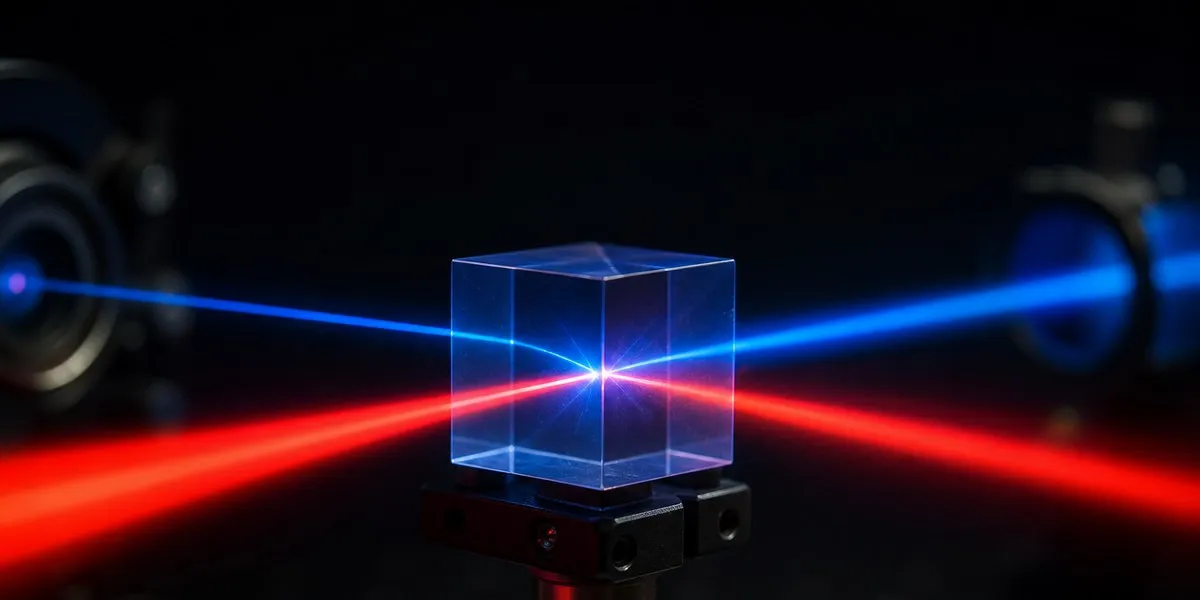
Physicists demonstrated the movement of a narrow laser beam against the current of a broader light flow in a nonlinear crystal. The effect was observed in an optical analogue of a quantum fluid: the beam, which acted as a “swimmer,” shifted in the direction opposite to the flow of the light-created fluid.
Phys.org reports on the results of the study, published in the journal Physical Review A. The authors combined a theoretical analysis of scattering, computer simulations and laboratory experiments.
Two beams in a nonlinear crystal
In the experiment, two laser beams were directed through a nonlinear crystal. The broader beam modeled the flow of an optical fluid, while the narrow one represented an object moving within it. By tilting the “fluid” beam, scientists controlled the direction and speed of its transverse flow.
More current news is available on the UA.News Telegram channel Telegram.
In an ordinary system with mutual, or reciprocal, influence, the narrow beam would move with the flow. Instead, in the configuration set up by the researchers, it moved against it. The most pronounced upstream movement was recorded at intermediate values of the optical fluid’s speed and density, rather than at the highest or lowest values.
The role of nonreciprocal interactions
The researchers explain the effect through nonreciprocal interactions, in which one object’s influence on another differs from the reverse influence. The narrow beam asymmetrically altered the distribution of the surrounding light flow: the intensity was greater on one side than on the other. This uneven distribution created a force directed against the flow.
The authors note that this concerns not material quantum fluids such as ultracold atoms or liquid helium, but their optical analogue. In their view, this system may serve as a platform for studying active-like behavior under nonreciprocal interactions and for developing quantum devices with active functions.




