
The Curiosity rover has discovered a unique sea of polygons on Mars

NASA's Curiosity rover has transmitted new images from Mars that have impressed scientists with their unusual geological structures. While exploring the Valle Grande valley, the rover documented the largest known cluster of polygonal faults, which had not previously been observed on the Red Planet on such a scale.
The images show honeycomb-like patterns known as polygonal fractures.
The diameter of each geometric structure ranges from approximately 4 to 8 centimeters.
Although similar formations have been encountered by the Curiosity mission before, this new discovery significantly surpasses all previous ones in terms of area.
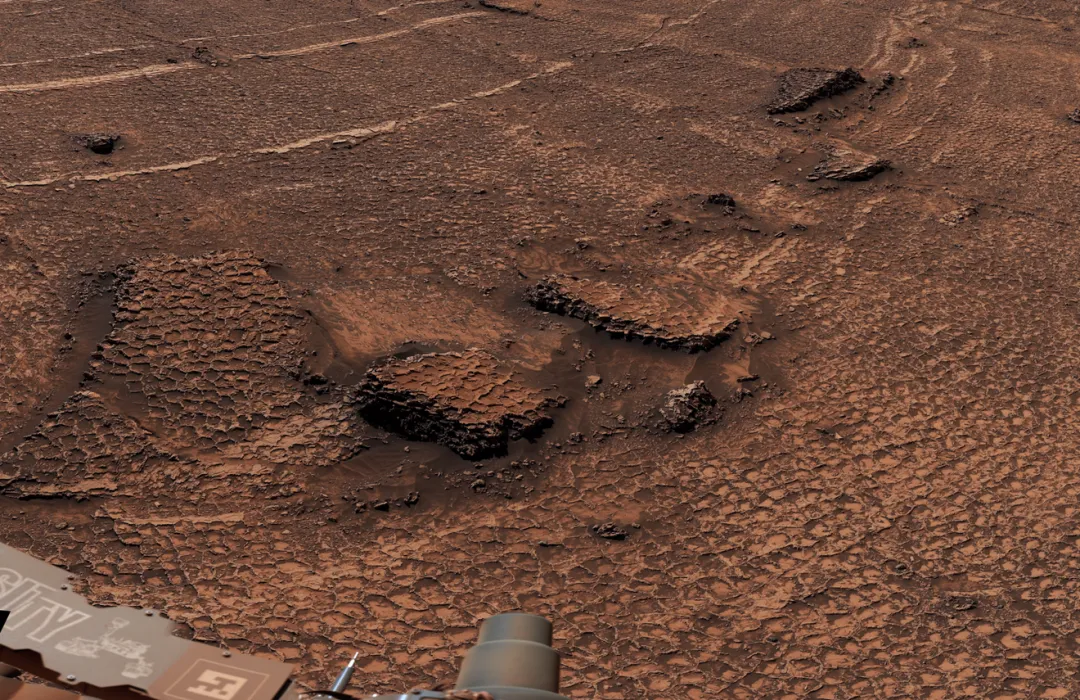
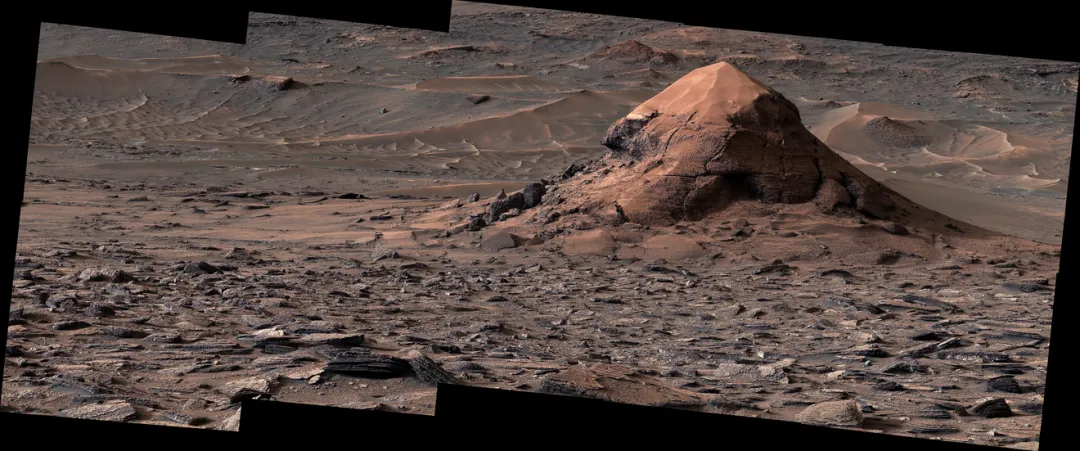
The rover captured a panoramic view of the area on June 19 and 20, during the mission’s 4,930th and 4,931st Martian days. The polygonal shapes extend as far as the eye can see and even cover the slopes of the six-meter-high “Miraflores” hill, whose summit is covered by a thick layer of sand.
Scientists have already begun a detailed study of the shape and chemical composition of these unusual structures.
“We’ve seen many fascinating landscapes through Curiosity’s eyes, but this sea of polyhedrons took our breath away,” said Ashwin Vasavada, the mission’s science lead at NASA’s Jet Propulsion Laboratory.
According to him, researchers hope that the data collected will help them understand the mechanism behind the formation of these geological features.
One theory suggests that the polygonal fractures may have formed as a result of silt drying out, although scientists are also considering other scenarios, including:
- cyclical temperature fluctuations;
- rock compression with water displacement;
- other geological processes.
Over the course of 14 years on Mars, Curiosity has made a number of important discoveries. Previously, it discovered sulfur crystals, meteorites, organic compounds, and traces of ancient bodies of water, which indicate that billions of years ago, Mars had water, the necessary chemical elements, and nutrients for the possible existence of microbial life.
The rover also found carbon molecules considered to be precursors to RNA and DNA. Although scientists cannot yet determine whether they are of biological or geological origin, the discovery reaffirms that ancient Mars may have been habitable.
This was reported by NASA’s Jet Propulsion Laboratory (JPL).
Earlier, the European Space Agency’s (ESA) Mars Express orbiter sent back new photographs of the Martian surface showing “metallic” waves inside the massive Kaiser Crater.
Scientists have previously noted that our planet differs from others in the Solar System. This applies not only to the gas giants but also to our rocky neighbors. For example, just like on Earth, solar eclipses occur on Mars.
And a group of scientists from the University of Warwick, in collaboration with the European Space Agency (ESA), the Georgia Institute of Technology, and the Microgravity Center in Germany, has achieved a breakthrough in the creation of light-driven energy, which could be the key to the future colonization of Mars.
By the end of the decade, NASA plans to establish a lunar outpost on Mars. This must be accomplished before humans begin exploring the planet.


