

We turn chaos into a manageable system: Corefy co-founder and CEO Denis Kirichenko explains how the payment orchestration platform works
23 June 2026 10:40For international businesses that operate in dozens of markets simultaneously and integrate various financial services, having their own scalable payment infrastructure is becoming essential.
“The payments landscape is fragmented, and the more a company grows, the more this complexity costs it,” explains Denis Kirichenko, co-founder and CEO of Corefy. He knows almost everything there is to know about how payment systems work and has many years of experience with successful fintech projects: from developing and launching e-wallets to large payment aggregators.
In an exclusive interview with UA.News, Denis Kirichenko discussed the idea behind Corefy and the platform’s value for large businesses, as well as the opportunities opened up by robust engineering of global financial platforms.
What Is a Modern Payment Orchestration Platform
“Orchestration” sounds complicated, but it’s actually quite simple. Imagine a business that sells in several countries. In one country, people pay by card and bank transfer; in another, via a local digital wallet; and in yet another, using QR codes. To meet these expectations, the company needs to integrate not just one payment provider, but several. Plus, it needs backup providers—just in case one of them goes down. This adds up to a dozen integrations, and each one operates separately: its own dashboard, its own reporting, its own rules. Managing this manually is a constant headache.
Orchestration brings it all together. One solution, one interface, one set of rules—instead of switching between a dozen systems. This is usually why companies come to us—to bring order and cover all the necessary markets. And once everything is consolidated in one place, payments can be managed and optimized. That’s why we call Corefy an operating system for payments. Just as an operating system on a computer is the foundation on which everything else runs, we are the foundation on which businesses consolidate, organize, and scale their payments.
In addition, you can launch your own payment business on our infrastructure. At one point, I thought: why create yet another payment provider when we could build a platform where others can launch their own? At the same time, we don’t become a provider ourselves and don’t handle customers’ money—it goes directly through the providers chosen by the customer. We provide the tool that lets them manage all of this.
Technologically, the main challenge lies in normalization. Each of our 650+ ready-made integrations has its own logic, its own formats, and its own behavior during outages. Our task is to bring this diversity under a single, predictable standard that works in real time and can handle heavy loads. This is the engineering work that underpins everything else.
Geographic Reach
Our platform is global—we have clients from all over the world, from Canada to Japan. We have the largest number of clients in European countries, including Ukraine.
Almost all of our clients are international businesses. The more markets a company operates in, the more complex its payment stack becomes, and the greater the need for a unified level of control.
Corefy’s Key Value for Businesses Around the World
Control. The payments industry has largely solved the problem of accessing providers—it’s easy to get connected today. What remains unresolved for most is managing what’s already connected. Our State of Payment Maturity study showed that 58.5% of companies still operate with fragmented payments: transactions are scattered across unrelated providers and tools, without a unified logic or visibility.
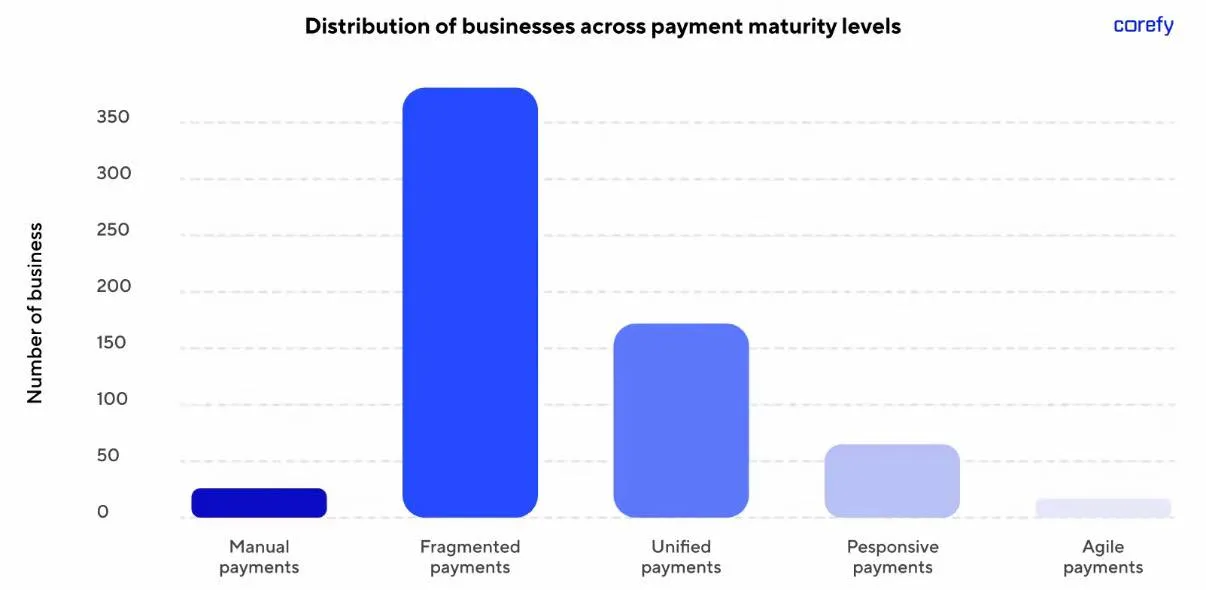
Corefy’s value lies in the fact that we transform this chaos into a manageable system. For the payment teams at large companies, this means higher conversion rates, lower costs, and the ability to change routing quickly and seamlessly. For entrepreneurs launching their own payment businesses, it’s a ready-to-use engine: instead of spending years building infrastructure, they can launch on ours and enter the market in a matter of days. With Corefy, payments stop being an expense and become a driver of growth.
On the Idea Behind Corefy’s Founding and Growth
Corefy grew out of two decades of experience in payments. I’ve been in the industry since 2006, having started back when i was a student. And I’ve basically spent my whole life building payment products: first I worked on a payment system, then on an e-wallet, and later became the CTO and co-owner of a company where I built a payment aggregator from scratch.
I’ve been running the company since 2017 alongside my co-founder and CTO, Dmytro Dzyubenko. I think the key factor without which the project wouldn’t have succeeded is a deep understanding of payments themselves: how providers actually operate, where things break down, and what pitfalls exist in each region. And, of course, strong engineering: the ability to build an architecture that scales and doesn’t falter under load.
What We Outsource
We keep everything that forms the core of the product in-house. Integrations with providers, the platform’s architecture, its reliability, and security—these are our main assets, and they cannot be outsourced, because this is where value is created for the client. The engineering, product, and integration teams work in-house.
My principle is simple: keep your unique expertise in-house, and don’t necessarily build things yourself that aren’t your specialty. In today’s world, time is often more valuable than money, so where there are high-quality, off-the-shelf solutions that don’t define our differentiation, we don’t reinvent the wheel.
The Role of AI in Corefy’s Workflows
We use AI wherever it saves time and eliminates routine tasks—and for me, that’s one of the top priorities right now. We apply it most extensively in our internal operations: we automate daily processes so the team spends less time on manual tasks—from data processing and technical support to transcribing work calls and writing code. To be honest—we’re still a work in progress, but the direction is clear to me.
What We’re Not Ready to Entrust to AI
Anything related to the movement of funds, sensitive data, and security remains under human control. In our field, the cost of a mistake is high, so the ultimate responsibility for decisions always lies with a human.
Demand for Payment Services
Demand is growing in areas where payments quickly become complex. These are primarily high-volume and highly regulated niches. Such businesses almost immediately run into dozens of providers, local payment methods, and varying regulations in each country. They need to do more than just accept payments; they need to take control of this entire stack and manage it flexibly.
Separately, demand is growing from platforms and marketplaces that are not payment-focused by nature but want to integrate payments into their own products so that their users can pay and receive payments directly within the service.

New Competition in the Fintech Market and Corefy’s Strengths
When we launched, I conducted market research and couldn’t find any solutions similar to ours—there were no direct equivalents. Over time, they began to appear, and their numbers kept growing. This is the main change: the category has matured, and access to providers has effectively become a commodity. It’s no longer possible to win simply by saying, “We connect providers.”
That’s why competition has shifted toward the depth of control—how comprehensively and flexibly the platform allows clients to manage their payments and build their own businesses on it. This is where our strengths lie. Over 650 pre-built integrations worldwide mean connections in a matter of days instead of months of development, and independence from any single provider.
Routing and cascading based on over 100 attributes, plus full visibility into all payments—this means centralized control, higher conversion rates, and lower operating costs. And the ability to launch and scale your own payment product on our infrastructure. This is operating system-level capability, not just another orchestrator.

In addition, our pricing model is success-based: we earn revenue only from our clients’ successful transactions, so our interests are directly aligned with theirs.
Our Strategy for Future Growth and Its Flexibility
Strategically, we’re moving in one direction—deepening the platform as an operating system for business and expanding connectivity with providers and markets. We serve two types of clients: those who want to optimize and control complex payment operations, and those who are building their own payment business from scratch. Europe remains our key focus, but the model is global by design.
As for flexibility—for me, the ability to adapt quickly to a changing world is a personal and team value. Payments is an industry where regulations, markets, and technologies are constantly changing, so we adjust our tactics without hesitation. But I have a second principle: seeing things through to the end. I’ve been building payment products my whole life, and I won’t stray from this path until I’ve created the best one. That’s why we change the “how,” but not the “why.”


