
LHC finds signs of primordial plasma in oxygen-nucleus collisions — ScienceDaily
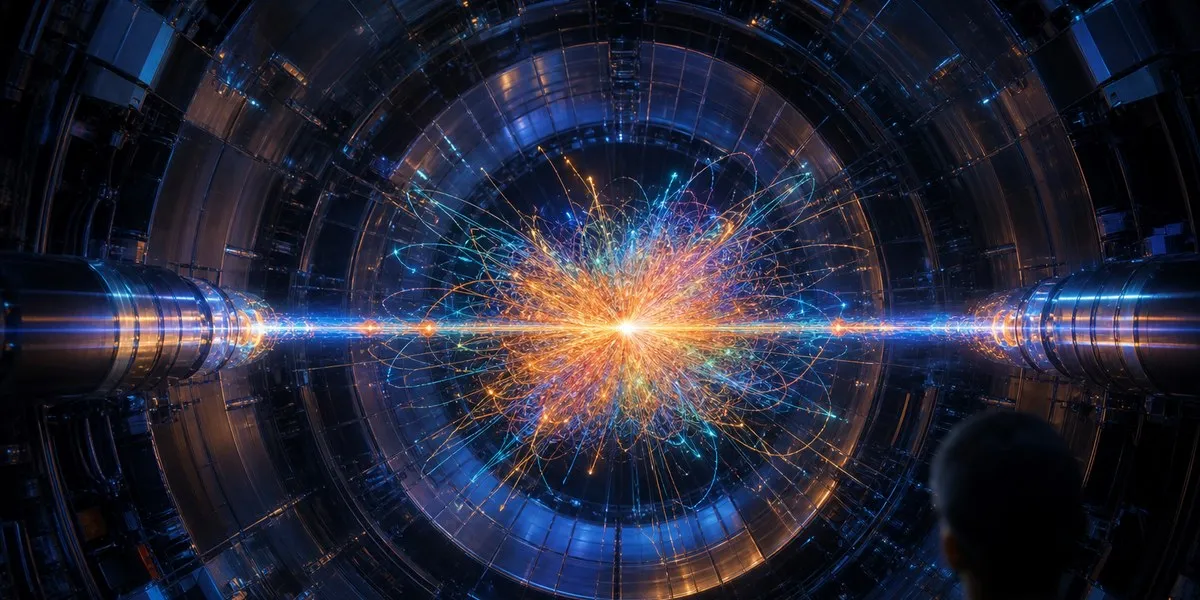
All four main experimental collaborations at the Large Hadron Collider — ALICE, ATLAS, CMS and LHCb — have reported signs of quark-gluon plasma formation during collisions of oxygen and neon nuclei. As ScienceDaily reports, the results indicate that this state of matter, which physicists believe existed in the first microseconds after the Big Bang, may arise not only in collisions of heavy nuclei, including lead.
Particle energy loss
Quark-gluon plasma forms at extremely high temperatures and pressures: under such conditions, protons and neutrons lose their usual structure, while quarks and gluons exist in a freer state. One of the key indicators of plasma is the energy loss of quarks and gluons as they pass through a hot and dense medium.
The ATLAS collaboration recorded such an effect while studying pairs of particle jets in oxygen-oxygen and neon-neon collisions. Differences were found in the energies of jet pairs that are consistent with particles losing energy in the matter produced after the collision. The effect was stronger in central, that is, the most head-on, nuclear collisions.
More current news is available on the UA.News Telegram channel Telegram.
Additional signals from ALICE, CMS and LHCb
CMS detected a suppression in the production of charged particles in collisions of oxygen and neon nuclei compared with proton-proton collisions. LHCb reported that the suppression of particles containing a charm quark was more noticeable in collisions involving the heavier neon nuclei, which is consistent with the expectation of a larger volume of plasma.
At the same time, a reduction in the number of particles alone does not prove energy loss. ALICE compared the production of neutral pions in oxygen-oxygen and proton-oxygen collisions and obtained unambiguous evidence of parton energy loss in oxygen collisions. CMS and LHCb also reported signs of different suppression of bound states of heavy quarks, while ALICE reported differences in the anisotropic flow of baryons and mesons.
Researchers continue to analyze data from collisions of lighter nuclei. CERN is simultaneously upgrading the accelerator to the High-Luminosity LHC, which is expected to increase the volume of data for studying the properties of quark-gluon plasma.




