
NASA has unveiled plans to establish the first permanent base on the Moon — Associated Press
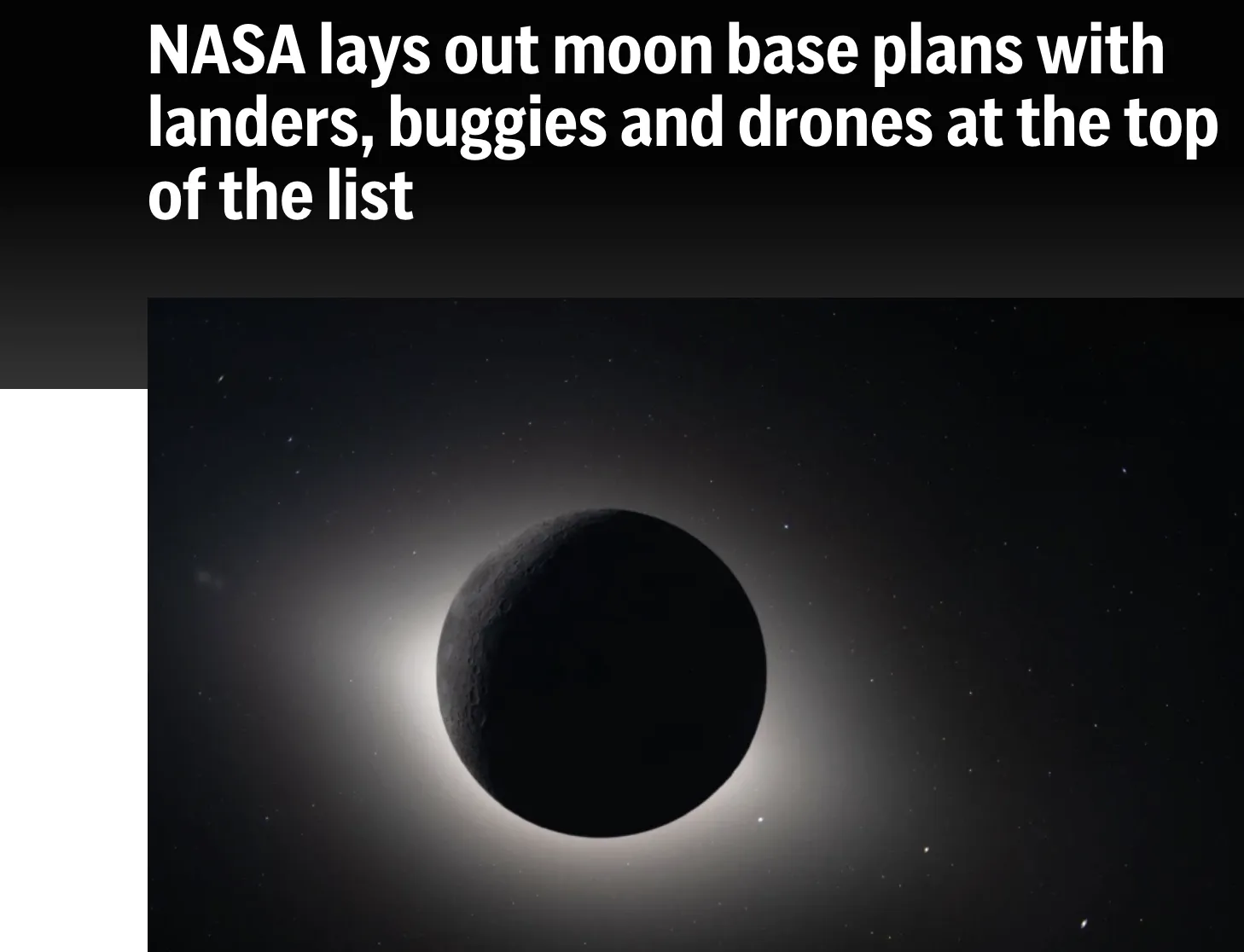
The agency has already ordered the first landing modules, rovers, and drones, which are intended to prepare the infrastructure for a future astronaut landing at the Moon’s south pole.
This was reported by the Associated Press.
NASA has signed contracts worth hundreds of millions of dollars, and four American companies will develop equipment designed to operate in harsh conditions. For example, Jeff Bezos’s company Blue Origin will build two landing modules. They will deliver special rovers to the surface, while the rovers themselves are being developed by Astrolab and Lunar Outpost.
Firefly Aerospace, which already proved its reliability last year, will send the first drones to the Moon. All the equipment is expected to arrive at the destination before the humans. NASA plans the first landing for 2028.
The Artemis program is proceeding according to a clear plan. Preparations for Artemis III will begin next year. Astronauts will train to dock the Orion capsule in Earth orbit. Landing modules from Blue Origin and Elon Musk’s SpaceX will be used for this purpose.
Key milestones in the moon’s exploration:
- Mid-2027 – launch of the Artemis III mission.
- 2028 – landing of two astronauts on the surface.
- 2029 – start of construction of a permanent power system.
- 2030s – creation of habitation modules for long-term stays.
The main goal of the project is to stimulate the lunar economy. NASA wants to conduct unique scientific research, and the Moon will serve as a testing ground before a flight to Mars.
“For those who have been patiently waiting, a grand return is near, and we won’t be slowing down. We’re really just getting started,” NASA says.
Previously, the Japanese probe Hayabusa-2 delivered organic compounds from the asteroid Ryugu. And NASA researchers have detected organic compounds, including sugar molecules, in samples brought back from the asteroid Bennu.
The Curiosity rover has identified more than 20 types of organic molecules, including a nitrogen-containing compound structurally similar to the building blocks of DNA.


