
Scientists have discovered a planet-forming region beyond Jupiter's orbit
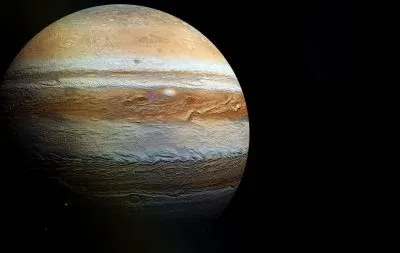
Researchers at the Max Planck Institute for Solar System Research (MPS) have reported the discovery of a unique region where planetary bodies may have formed. According to the scientists, approximately 4.6 billion years ago, the Sun was surrounded by a gas-and-dust disk in which particles clumped together to form planetesimals—the building blocks of planets and asteroids. The discovered zone beyond Jupiter’s orbit may be one of the key regions of this process, a sort of “planet factory” in the early Solar System.
According to a new study published in The Astrophysical Journal, the ring-shaped region immediately beyond Jupiter’s orbit served as an efficient and versatile site for the formation of planetesimals. Using computer simulations, the team found that celestial bodies with very different compositions formed in this region over a period of about two million years.
The study covered the period from two to four million years after the birth of the Solar System. By that time, Jupiter had already gathered most of the surrounding material, creating a gap in the gas-dust disk. This process formed a ring of elevated gas pressure immediately behind the giant planet. The resulting “trap” captured a vast amount of dust and small rocky clumps, allowing them to accumulate and rapidly coalesce into large objects.
New simulation results have shown that such structures are capable of continuously producing bodies of completely different types over millions of years. Scientists were able to link the simulated objects to real groups of meteorites found on Earth, specifically carbonaceous chondrites. Laboratory analyses show that these carbon-rich space rocks formed precisely behind Jupiter during the period under study.
The models developed by German astrophysicists tracked both microscopic collisions of particles ranging in size from millimeters to meters and large-scale movements of material across the entire giant disk over distances of millions of kilometers. Particles shattered, clumped together, drifted toward the Sun, or were captured by Jupiter’s gravity. It turned out that Jupiter acted as a more powerful barrier for large and sturdy fragments, while smaller dust particles penetrated more easily.
Over the first 500,000 years, the amount of loose material in the trap decreased, and then increased again over the next million years. This led to the emergence of two distinct populations of planetesimals: one consisting mainly of fragile material, the other of more stable compounds formed earlier in hot zones closer to the star. The authors of the study emphasize that dust traps were the primary and most effective site for the formation of solid worlds in our Solar System.
Previously, the Japanese probe Hayabusa-2 delivered organic compounds from the asteroid Ryugu. And NASA researchers detected organic compounds, including sugar molecules, in samples brought back from the asteroid Bennu.
The Curiosity rover has identified more than 20 types of organic molecules, including a nitrogen-containing compound structurally similar to the building blocks of DNA.


