
Five Eyes intelligence agencies have warned of the imminent emergence of AI for large-scale cyberattacks — The Guardian
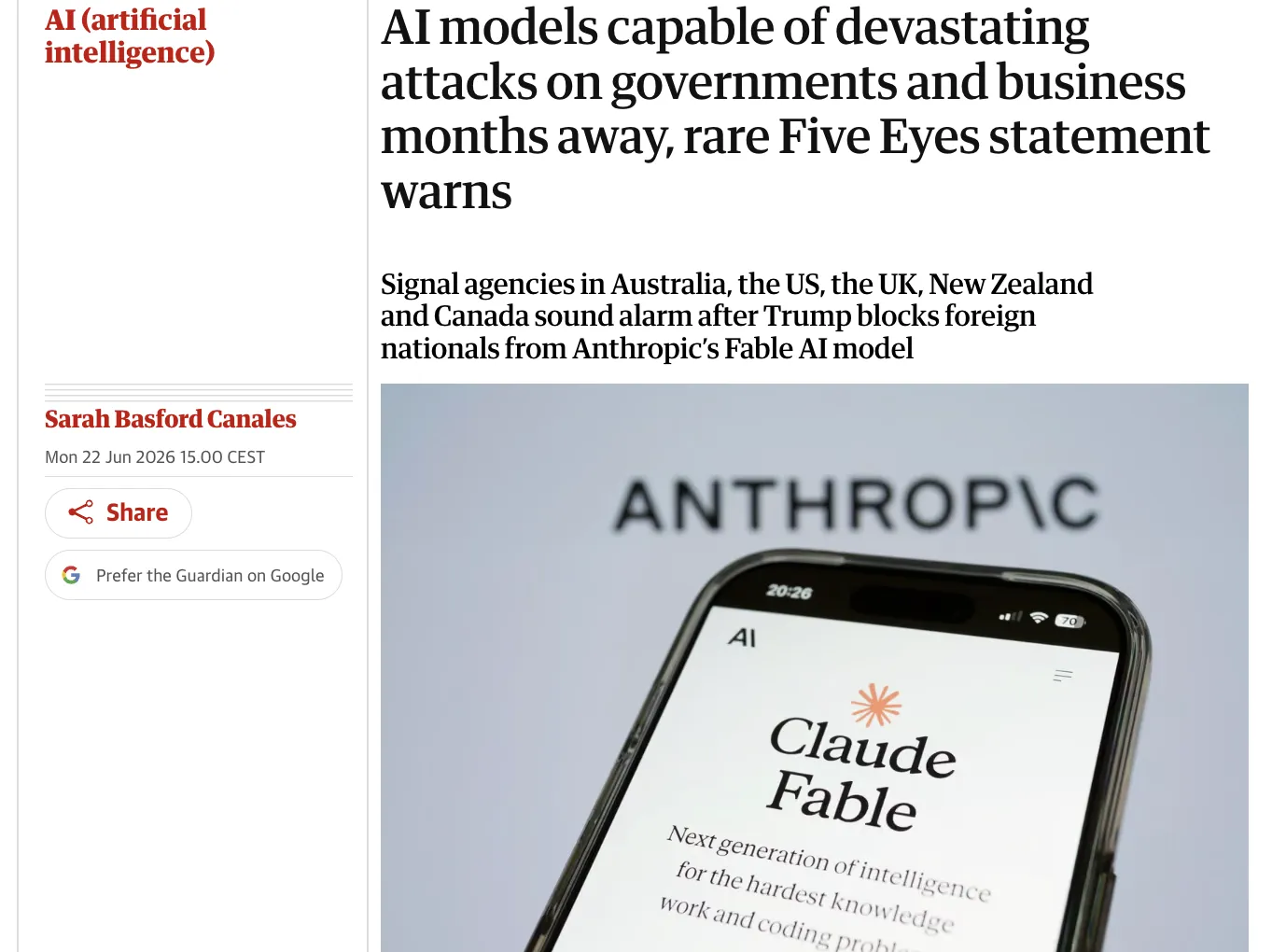
On June 22, the intelligence agencies of the Five Eyes alliance stated that advanced artificial intelligence models capable of amplifying cyberattacks could emerge in just a few months. In a joint warning, they urged governments and businesses to take immediate action, emphasizing that cyber risks are becoming a key security challenge.
Powerful artificial intelligence models capable of launching devastating new cyberattacks against governments and businesses will emerge in just a few months, warn the intelligence agencies of the Five Eyes alliance in a rare joint statement, urging leaders to “act now.”
This unexpected public intervention by the intelligence agencies of Australia, the United States, the United Kingdom, New Zealand, and Canada comes after the Trump administration decided earlier this month to ban “foreign nationals” from using a highly publicized artificial intelligence model developed by the technology company Anthropic, called Fable.
The statement notes that while artificial intelligence “will help us improve cybersecurity over time, it also accelerates the speed, scale, and complexity of cyber threats.”
Cutting-edge AI models are expected to exceed current industry expectations, fundamentally transforming both offensive and defensive cyber capabilities. We’re talking months, not years.
This is according to a warning from the Five Eyes agencies.
“In this environment, cyber resilience is an integral part of advancing business continuity, market confidence, and long-term value,” the statement said.
Cybersecurity agencies stated that breakthroughs in artificial intelligence models have shown that this technology will lower barriers for attackers and increase the speed and complexity of attacks.
“A response from the entire organization and society as a whole is needed,” the statement continued. Five Eyes is an intelligence alliance formed by five countries after World War II.
“Cyber risk can no longer be viewed as a purely technical issue. It is a core business risk and a leadership responsibility,” the statement notes.
Generative AI models are powerful new tools capable of identifying vulnerabilities in cybersecurity systems, and they can help both exploit and remediate those vulnerabilities.
“What sets these [AI models] apart from previous ones is that they are very good at generating exploits,” said Olivia Shen, an expert on national security and artificial intelligence at the United States Studies Centre (United States Studies Centre) at the University of Sydney.
Although the Five Eyes statement does not mention any specific AI models or companies, many around the world have taken a closer look at Anthropic’s cutting-edge tools.
One of the tech giant’s latest innovations is called Fable 5, reportedly a more community-friendly version of Mythos — a powerful AI model released earlier this year capable of detecting vulnerabilities in cyber systems, which is available only to vetted organizations and companies due to concerns about its potential misuse.
Both of Anthropic’s models were suspended for use by “foreign nationals” in June by the U.S. government, which cited recommendations from national security agencies.
Shen said that much of the world is focused on what will happen next with Anthropic, but many more powerful AI models may be just around the corner.
“I think we have to anticipate that the next Mythos or the next Fable is just around the corner,” Shen said.
“We can only see what has been released, but there may be other models being developed by equally advanced countries like China, or by other states, entities, and companies,” she added, according to The Guardian.
Read also:
Germany Reveals That an AI Was Working in Place of the Minister of Digitalization
OpenAI fired an employee over suspicions of using confidential information to place bets on the prediction market regarding events at the company.
French AI startup Mistral AI raised 385 million euros in a funding round. As a result, the estimated valuation of the startup, which was founded less than a year ago, rose to approximately $2 billion.


