
Samsung released the Fold seven years ago: why Apple, of all companies, might now be the one to bring foldable smartphones to the masses
10 September 2026 17:32Apple has once again entered a market that existed long before it did. On September 9, the company unveiled the iPhone Duo—its first foldable smartphone. By that point, Samsung had been selling the Fold for seven years, Huawei had been releasing not only standard foldable devices but also dual-fold smartphones, and Xiaomi, Honor, Motorola, and other manufacturers had already created their own versions of this form factor.
Apple makes no secret of the fact that it is entering a mature market. The new iPhone Duo costs $1,999, features a 7.6-inch internal display and a 5.4-inch external screen. The company calls it the biggest change to the iPhone since the original model.
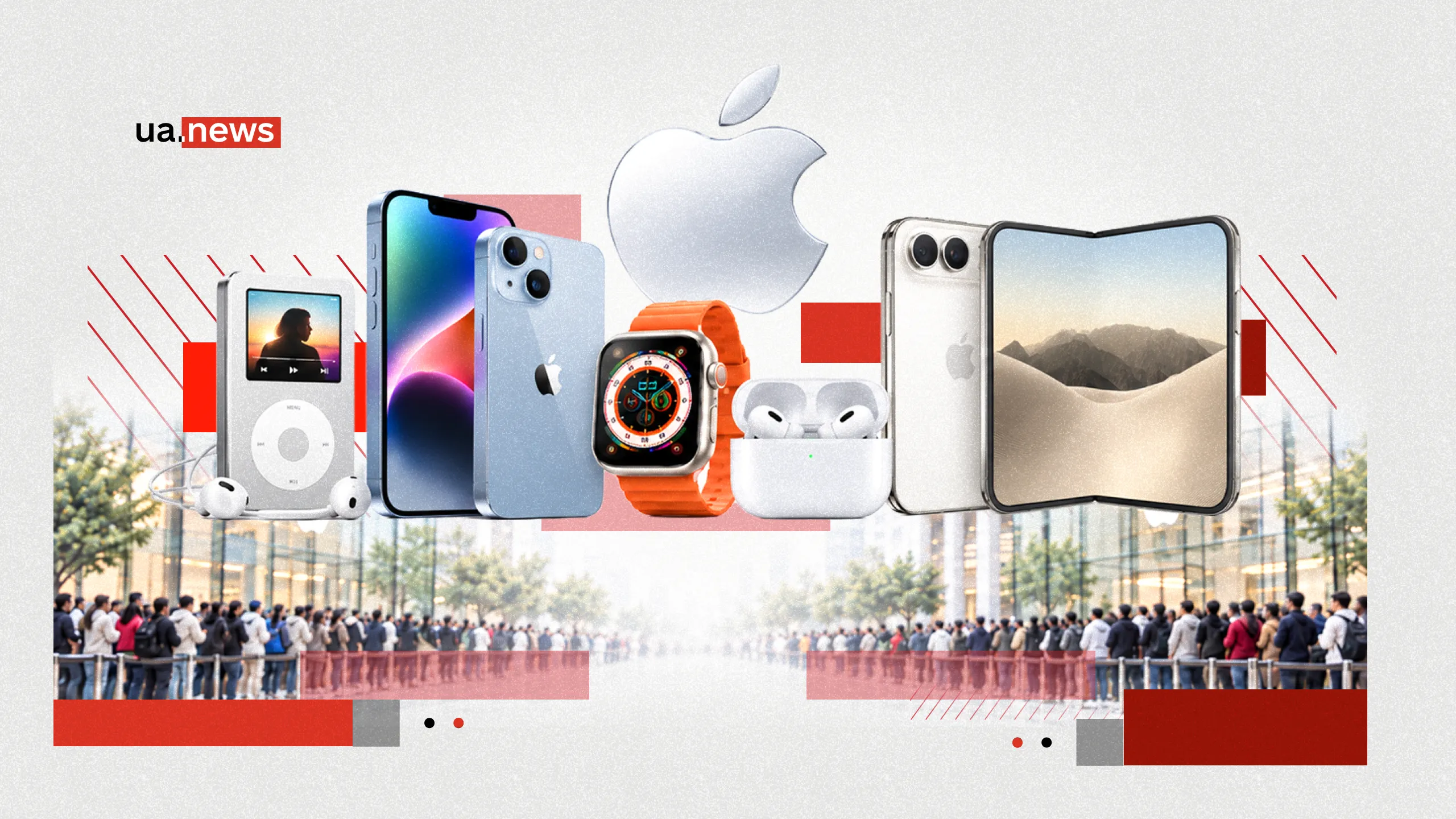
This story, however, is nothing new for Apple. MP3 players existed before the iPod, smartphones before the iPhone, tablets before the iPad, smartwatches before the Apple Watch, and completely wireless earbuds before the AirPods. In many of these categories, Apple didn’t come up with the technological concept itself. Instead, it waited until the technologies were mature enough, identified what was preventing the average person from using the product, simplified the experience, and integrated the device into its own ecosystem.
UA.News explains why Apple so often enters an established market later than its competitors, how the company has managed to turn existing technologies into mass-market products, and whether the same thing could now happen with foldable smartphones.
Apple didn’t invent the MP3 player, but the iPod demonstrated the core principle that would guide the company for decades
When Steve Jobs unveiled the first iPod in the fall of 2001, digital music was no longer a new technology. MP3 players had been on the market for several years. The market already featured the Rio PMP300, Creative Nomad, and other devices. People were already downloading music from computers, storing it in digital format, and listening to it without CDs.
In other words, Apple didn’t invent either the MP3 or the digital player. Its main achievement was something else—the company combined existing technologies into a product that was much easier to use.
The first iPod had 5 GB of storage and could hold about a thousand songs. But Apple wasn’t selling gigabytes. At the presentation, they put it much more simply: “1,000 songs in your pocket.” The player automatically synced with iTunes, had simple navigation, and performed one specific task without requiring users to understand the device’s file system. Even the first generation was far from a mass-market product. It cost $399 and initially worked only with Macs.
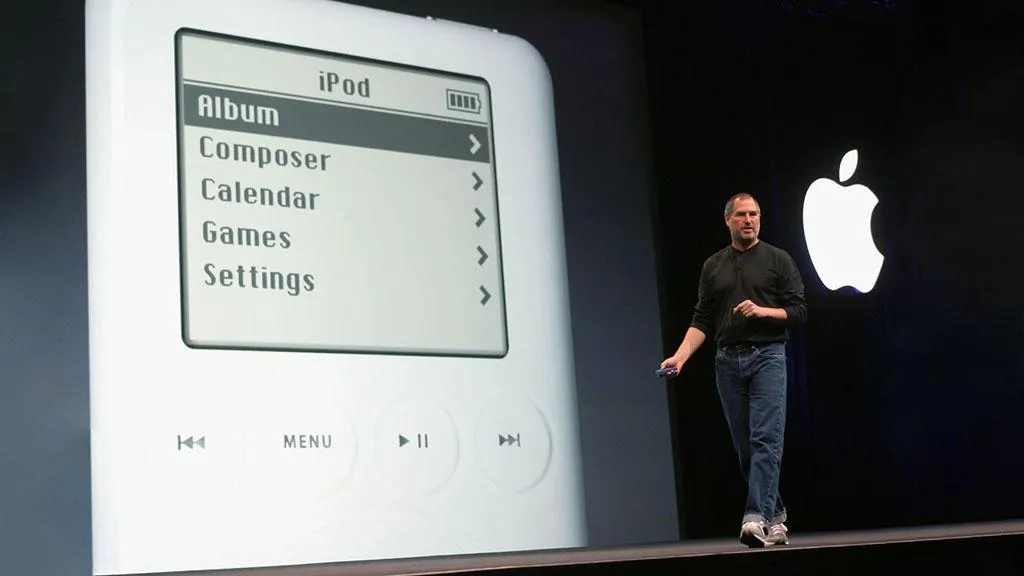
But another element of Apple’s strategy is clearly evident here. The company didn’t just release the device and wait for buyers—it began gradually removing restrictions. In 2002, the iPod gained Windows support. The lineup expanded, cheaper models appeared, iTunes became the central hub for managing the music library, and in 2003, the iTunes Music Store went live.
This model would become one of the most important for the company over the following decades. Apple would rarely try to beat a competitor based solely on a device’s specifications. It would be far more important to ensure that the product worked better within the Apple ecosystem.
By the time the iPod was discontinued in 2022, the player itself had become obsolete—its functions had been absorbed by the iPhone. But the model it created remained. The iPod clearly illustrates the difference between inventing technology and turning technology into a product.
Apple has more often specialized in the latter.
Smartphones and touchscreens existed before the iPhone, but Apple fundamentally changed the very concept of what a phone should be.
The most famous example of this strategy is the iPhone. By 2007, millions of people were already using smartphones. BlackBerry was a symbol of the corporate world. Nokia sold Symbian smartphones. There were Palm devices, Windows Mobile devices, and communicators with touchscreens.

Even the touchscreen wasn’t Apple’s invention. But most of these devices were built around small keyboards, styluses, complex menus, or interfaces that essentially transplanted desktop computer logic onto a small display.
Apple decided to do away with almost everything. On January 9, 2007, Steve Jobs introduced the iPhone as a combination of three devices: a phone, a widescreen iPod, and an Internet-enabled device. Instead of a physical keyboard, most of the front panel was taken up by a screen that could be controlled with your fingers.
The first iPhone, however, had many obvious shortcomings. It didn’t support 3G, didn’t allow third-party apps to be installed via a modern app store, had only one camera, and was expensive. In terms of many technical specifications, competitors could offer more.
But the iPhone changed the criteria by which consumers began to evaluate smartphones. Before it, questions might have been along the lines of “which keyboard is more comfortable” or “how many buttons does the phone have.” After it, the screen, the touchscreen interface, and the apps became the main focus.
The following year, Apple launched the App Store, and the phone effectively became a platform. This is another aspect of Apple’s model: the company often enters a market not when a technology has just been invented, but when it sees an opportunity to build an entire ecosystem around it.
A developer creates an app for iOS. A user purchases it or a subscription through the App Store. Apple controls the hardware, the operating system, the store, and the payment infrastructure.
That’s why a successful Apple product often generates far more value for the company than a one-time device sale. In this sense, the iPhone wasn’t just the most successful smartphone. It created a model that the entire industry subsequently copied.
The Apple Watch and AirPods again entered existing markets—but Apple made the ecosystem, not the device itself, its main selling point
The same pattern repeated itself after the iPhone. In 2014, Apple introduced the Apple Watch. But it certainly wasn’t the first smartwatch.
The Samsung Galaxy Gear had been released a year earlier. Pebble became one of the first major crowdfunding successes back in 2012. Sony had been producing its own SmartWatch, and the idea of a watch that displays notifications from a smartphone had been around for many years.
Apple didn’t even try to hide the fact that it was entering an already established market. Instead, the company focused on integration with the iPhone, design, and health. In the first Apple Watch presentation, the company already positioned it as a communication tool, a fitness device, and a personal accessory all at once.
Over the years, the balance has shifted even further toward health: heart rate monitoring, ECG, fall detection, sleep tracking, and other features gradually transformed the Apple Watch from a “notification screen on your wrist” into one of the ecosystem’s core devices.
This strategy worked even more effectively with the AirPods. Bluetooth headphones had been around long before 2016. There were even completely wireless models on the market with no cable connecting the two earbuds. But early devices suffered from the same problems: unstable Bluetooth connections, complicated pairing, short battery life, and cumbersome switching between devices.

Apple targeted these exact weak points. All the user had to do was open the AirPods case near an iPhone and press a single button. After that, the earbuds automatically linked to the Apple ID and could work with other Apple devices. Sensors detected when an earbud was in the ear, and the charging case solved the battery life issue.
At first, people joked about the AirPods’ design, and the removal of the 3.5-mm jack from the iPhone 7 sparked a wave of criticism. Within a few years, completely wireless earbuds became the standard for nearly the entire market.
Samsung, Google, Sony, Xiaomi, and dozens of other manufacturers have created their own TWS models, while wired earbuds have gradually shifted from being a basic accessory to a much narrower category.
In other words, Apple didn’t invent the technology this time either. The company identified the moment when the technology could be transformed into a simple enough product for hundreds of millions of users.
Apple can afford to wait for years because its main advantage isn’t being first—it’s seeing the mistakes of those who came before
For most tech companies, a seven-year delay would be a disaster. For Apple, it sometimes becomes an advantage. Samsung unveiled the first mass-market Galaxy Fold back in 2019. And its story in particular shows why Apple could afford to take its time.
The first reviewers received devices with display issues. Some of the screens malfunctioned, and the launch had to be postponed. Reuters notes that after a rocky start, it took Samsung several generations to make the folding mechanism thinner, lighter, and more reliable.
Meanwhile, the industry was essentially doing all the legwork for Apple. Samsung tested various hinges and display formats. Motorola brought back the vertical “clamshell” design. Huawei experimented with an outward fold and eventually released devices that fold twice.
Display manufacturers improved protective materials. Suppliers reduced the thickness of components. Android gained increasingly better support for large and variable-size screens. Apple was able to observe which solutions worked and which ones users rejected.
Even Samsung Display—a division of Apple’s main competitor—is now part of the display supply chain for the new foldable iPhone. Reuters explicitly calls this a second-mover advantage: Apple is leveraging the infrastructure and technologies that the industry has been developing for years.
There’s also a second advantage to waiting. Apple doesn’t need to convince hundreds of millions of people that they should try an unknown brand. The company already has a massive base of iPhone users, stores around the world, carrier contracts, the App Store, iCloud, Apple Watch, AirPods, Mac, and other devices.
When Apple adds a new product category, it automatically gains access to this ecosystem. This is precisely what allows the company to enter the market later while still scaling up very quickly.
A telling forecast from IDC. In 2026, the entire global smartphone market could shrink by 16.7%—which would be the worst annual decline in the industry’s history. Foldable smartphones, on the other hand, are expected to grow by approximately 12.6%.
IDC directly attributes this to Apple’s entry into the market. Analysts expect that as early as 2027, the company could sell over 17 million foldable iPhones, capture about 40% of the global foldable market, and generate more than half of its total revenue.
In other words, the company doesn’t even need to become the largest manufacturer by unit volume right away. It’s enough to capture the most lucrative segment of the market. This is also a strategy very characteristic of Apple.
The foldable iPhone will be a new test of Apple’s old strategy
The iPhone Duo clearly demonstrates how far Apple is willing to go with its traditional model. The company is entering the foldable market roughly seven years after Samsung. During that time, Samsung has released eight generations of foldable smartphones, Huawei has become one of the largest manufacturers of such devices in China, and the form factor itself has seen dozens of different implementations.
However, it has yet to go mainstream. Foldable smartphones remain a small fraction of the global market. They’re expensive, thicker than regular phones, have a more complex mechanism, and the display may still have a noticeable crease. It’s also not always clear to buyers why they should pay significantly more just for the ability to unfold the smartphone into a small tablet.
This is exactly what Apple now needs to change. The company has opted for a passport-like design: when closed, the Duo functions as a compact smartphone with a 5.4-inch display, and when opened, the user gets a 7.6-inch screen.
Apple has specifically adapted iOS 27 for dual displays, multitasking, and moving content between screens. The company has also opted for its own A20 Pro chip, a dual-battery system, and a redesigned cooling system. The starting price is $1,999.
The price speaks for itself. Apple isn’t trying to make the foldable smartphone accessible to everyone right away. It’s starting at the high end of the market, where buyers are willing to pay for the new form factor, and the high price tag helps offset the higher production costs.
This is roughly how the company has approached other new product categories for decades: first, it creates an expensive, desirable product, then the technology is gradually rolled out across a broader lineup.
Samsung has already responded to the arrival of a competitor with its “Welcome to Foldables” ad campaign, reminding consumers that it has been making such phones since 2019. According to Counterpoint’s estimates, Samsung could control about 38% of the global foldable market this year, but Apple is capable of quickly capturing about 25%.

This creates a somewhat paradoxical situation. Companies that took risks for years, invested in hinge development, weathered the breakdowns of early models, and effectively created the market may now face their biggest competitor just as the technology has finally matured.
But Apple’s success isn’t guaranteed this time around. The iPod solved an obvious problem—it let you carry all your music with you. The iPhone combined a phone, the internet, and a media player into a single device. AirPods did away with cables and made Bluetooth headphones simpler.
With the foldable smartphone, the main question is more complicated for now: what problem with a regular iPhone does it solve so well that people would be willing to pay nearly $2,000? The answer to this question will determine whether Apple’s old strategy will work again.
The company has almost never needed to be first. It was enough for it to wait until others proved that a new category could even exist, identify its weaknesses, and offer its own version once the technology was ready for a much larger audience.
With the iPod, it took a few years. With smartphones, it took nearly a decade of development by predecessors. With smartwatches and wireless earbuds, history repeated itself once again.
Now Apple is making the same bet on the foldable smartphone. And if tens of millions of iPhone owners decide that their next phone should fold in half, Apple’s greatest achievement will once again not be the invention of a new technology.
It will be the moment when the technology ceased to seem like a niche product.




