
Space.com has named the ZWO ASI174MM suitable for photographing the Sun and the Moon
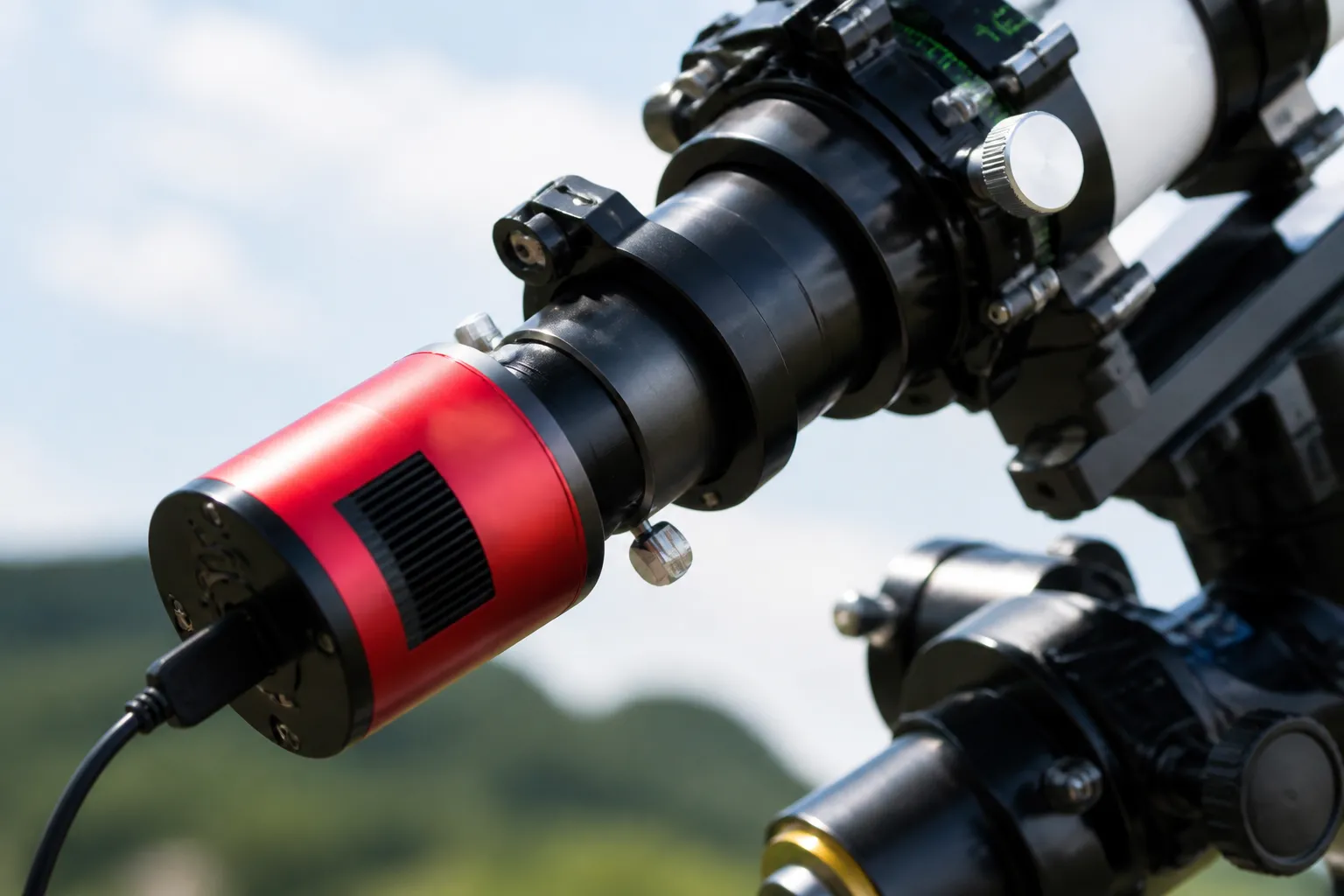
The ZWO ASI174MM astronomical camera is best suited for high-speed imaging of the Sun, Moon, and planets, rather than for traditional astrophotography of deep-sky objects. Space.com reached this conclusion after two weeks of testing the device in combination with a Sky-Watcher HelioStar 76Ha solar telescope and a Solar Quest mount.
The camera is equipped with a 1/1.2-inch Sony IMX174 monochrome CMOS sensor with a resolution of 2.3 MP—1936×1216 pixels. The pixel size is 5.86 µm. The device features a global shutter, a USB 3.0 interface, and can record up to 164.5 frames per second at full resolution in 10-bit mode. In 12-bit mode, the maximum frame rate reaches 128.2 frames per second.
According to the publication’s assessment, the combination of a relatively large sensor, large pixels, and a high frame rate allows for a wider field of view than many planetary cameras with smaller sensors. This is useful for capturing active regions on the Sun, prominences, filaments, and sunspots, as well as for photographing the Moon’s surface.
For more breaking news, follow the UA.News Telegram channel.
The global shutter exposes the entire sensor simultaneously. This helps preserve the shape of details on the Sun and the Moon more accurately in conditions of atmospheric turbulence. The camera is also designed for the “lucky imaging” approach: the user captures thousands of short exposures, and the software selects, aligns, and merges the sharpest ones.
To work with the ASI174MM, you can use SharpCap and FireCapture, as well as the ASIStudio suite from ZWO, available for Windows and macOS. Specifically, ASICap is designed to control the camera and record video in SER or AVI formats, while ASIVideoStack is used for evaluating, aligning, and merging frames. At the same time, the publication noted that uncompressed high-speed video requires a fast computer, a USB 3.0 connection, and significant free storage space.
The model is less suitable for photographing nebulae, galaxies, and other faint objects in deep space: during longer exposures, noticeable backlighting may appear on one side of the frame, and the sensor lacks thermoelectric cooling. Dark frames can partially correct these effects, but they are no substitute for a cooled camera designed for deep-sky astrophotography.


