
Space.com explained how beginners can observe the night sky with a handheld telescope
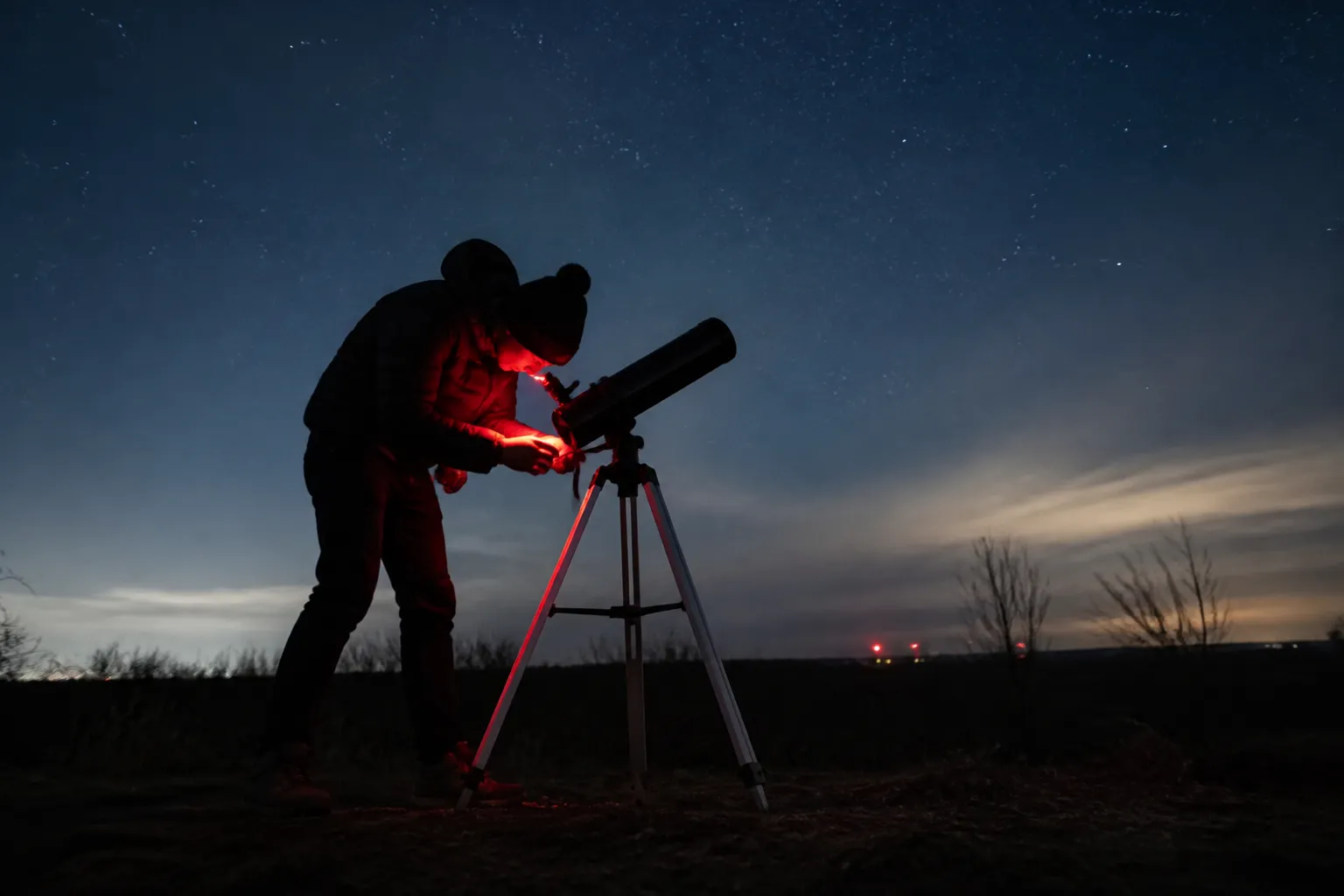
Space.com has published tips for beginners on observing the night sky with a handheld telescope. Such a device does not automatically locate celestial objects, so observers must learn on their own how to navigate among the stars, constellations, planets, and other targets.
Stars appear to move across the sky from east to west due to the Earth’s rotation, so objects gradually exit the telescope’s field of view. Two coordinate systems are used for navigation: altitude and azimuth, which describe an object’s position relative to a specific observation site, as well as right ascension and declination—coordinates similar to Earth’s longitude and latitude.
Before your first nighttime observation, the publication recommends assembling the telescope during the day and testing the finder scope or red-dot sight on a distant ground-based object. In the dark, you should start with the eyepiece that provides the lowest magnification, for example, one with a focal length of 25 mm. It provides a wider field of view and makes it easier to locate the target. Once the object is centered, you can switch to an eyepiece with a higher magnification, such as 10 mm.
For more breaking news, follow the UA.News Telegram channel.
For beginners, alt-azimuth mounts are the simplest; they allow you to move the telescope up and down and left and right. To keep the object in the field of view, you need to adjust the mount slightly every few minutes. Equatorial mounts are more complex; they usually have a counterweight and require rough alignment: in the Northern Hemisphere, they are pointed north, the declination is set according to the local latitude, and the North Star is used as a reference point. After that, the object can be tracked using a single fine-tuning mechanism.
Space.com also recommends giving your eyes about 20 minutes to adjust to the darkness, using a red flashlight, and avoiding bright smartphone screens. For faint objects, it’s recommended to start from bright reference points—such as the Moon, the planets, Vega, Sirius, Orion’s Belt, or the Big Dipper—using a star chart or an astronomy app in night mode. For faint objects, indirect vision—where the observer looks slightly off to the side of the object—can be helpful.


