
China tests oil refining method that could cut energy use by 91%
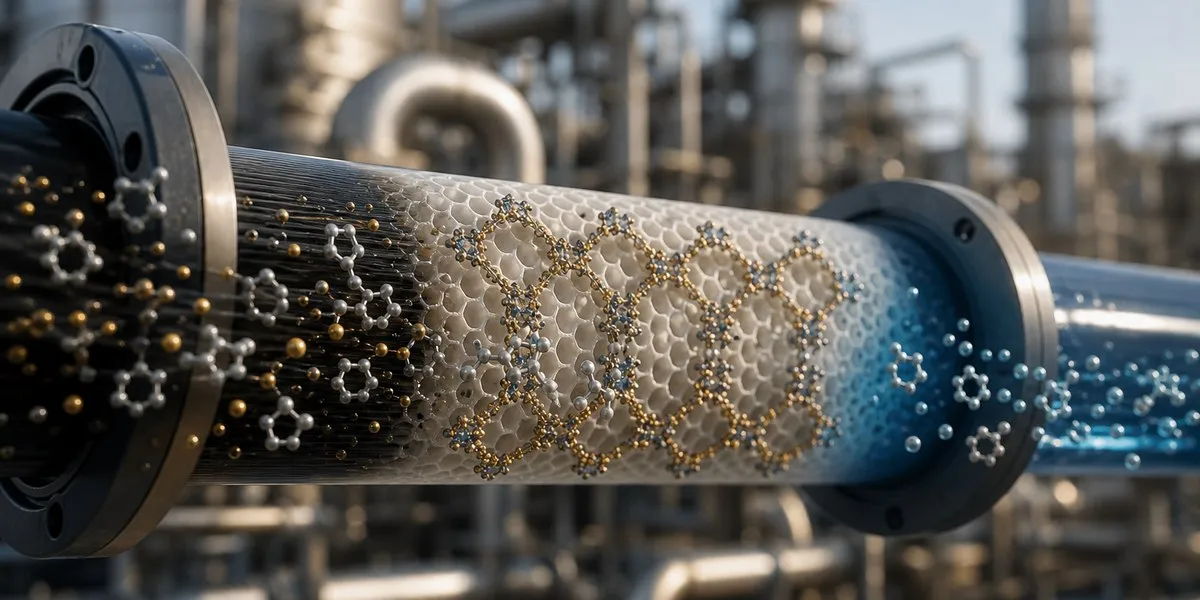
Scientists at the Dalian Institute of Chemical Physics in China tested an oil refining method that, under laboratory conditions, used about 91% less energy than traditional distillation. The technology was called “molecular refining”: it involves separating oil components using membranes based on metal-organic frameworks, South China Morning Post reports.
The research was conducted in a laboratory. If scaled up industrially, the technology could reduce production costs and emissions, improve process precision and increase the value of the products obtained.
Separating molecules without repeated heating
Crude oil cannot be directly turned into gasoline or plastics: it must first be separated into individual components. Usually, distillation is used for this, with the mixture repeatedly heated, evaporated and condensed, relying on small differences in the boiling points of substances.
The proposed approach works at the molecular level. The membranes act as molecular sieves: their pores and surface properties are tuned to separate different compounds and direct them to the relevant production lines.
More current news is available on the UA.News Telegram channel Telegram.
Two stages of membrane sorting
At the first stage of cascade membrane separation, molecules are sorted by size. The difference between them is about 0.1 nanometres. The membrane separates smaller linear and monobranched alkanes, which are used to produce ethylene.
The second stage is intended for molecules whose size difference is less than 0.01 nanometres. Another membrane uses its surface properties to identify and separate aromatic compounds — important intermediates for producing plastics, resins and fibres — from highly branched alkanes and cycloalkanes, which are used to produce gasoline.
The researchers used micro-etching with tannic acid to alter the pore size and surface chemical properties of the membranes. During a laboratory test, a model mixture of a light oil fraction containing 15 components was separated into three groups of high-value products. The recovery rate ranged from 85% to 90%. The study results were published last month in the journal National Science Review.


