
"Dark stars" may have been the precursors to supermassive black holes
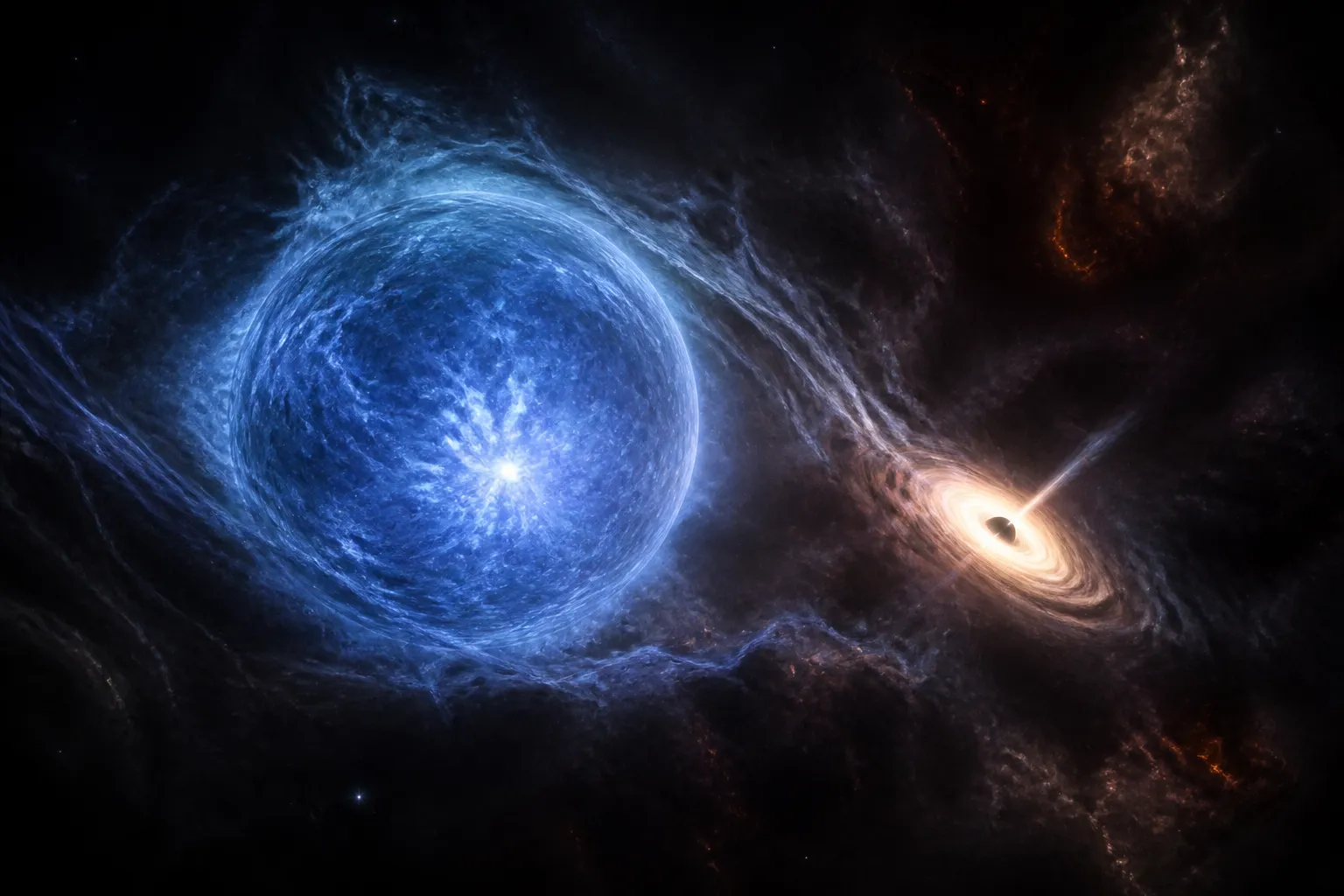
Hypothetical “dark stars” that existed in the early universe may have formed massive precursors to supermassive black holes after their collapse. This is the conclusion reached by Kosmin Ilie and Sohan Godla of Colgate University, who investigated the possible connection between these objects and the low-frequency gravitational wave background, according to Space.com.
This gravitational-wave background was detected in 2023 using pulsar timing arrays. Pulsars are neutron stars that rotate rapidly and regularly and emit narrow beams of radiation. As gravitational waves travel through space, they slightly stretch and compress it, causing microscopic delays in the arrival of pulsar signals on Earth.
A common explanation for this background radiation links it to binary supermassive black holes that orbit each other and eventually merge. However, this does not explain how supermassive black holes could have formed so quickly when the universe was less than one billion years old. The James Webb Space Telescope is already detecting such objects during this early period, even though the proposed models for their growth through accretion and mergers require more than a billion years.
Read more breaking news on the UA.News Telegram channel.
“Dark stars” are hypothetical primordial stars whose energy would be supplied not by nuclear fusion but by the self-annihilation of dark matter in their cores. According to the researchers’ model, this would cause such objects to remain relatively cool and allow them to accrete matter until they reached a mass of millions of solar masses. After gravitational collapse, they could transform into massive black holes, which would subsequently merge with one another.
Ilie and Godla modeled the environment in which these proto-black holes could exist and merge, and calculated the frequency of their mergers and their impact on the gravitational-wave background. According to their calculations, the remnants of supermassive “dark stars” could make a significant—and possibly dominant—contribution to the signal detected by pulsar timing arrays. This hypothesis can be tested through more precise measurements of the gravitational-wave background and a better understanding of black hole populations in the early Universe. The study was published in the journal Physical Review D.


