
NASA selects 18 futuristic space concepts
NASA has selected 18 technology projects for the first phase of its Innovative Advanced Concepts (NIAC) program, which supports research into promising solutions for future space missions. A total of $3.2 million has been allocated for their development, Space.com reports.
Each winner may receive up to $175,000 for a nine-month study. During this period, teams must assess the feasibility of their ideas and identify further steps for developing the technologies. The selected proposals are not approved NASA missions but are at an early stage of development.
Studying Saturn’s rings
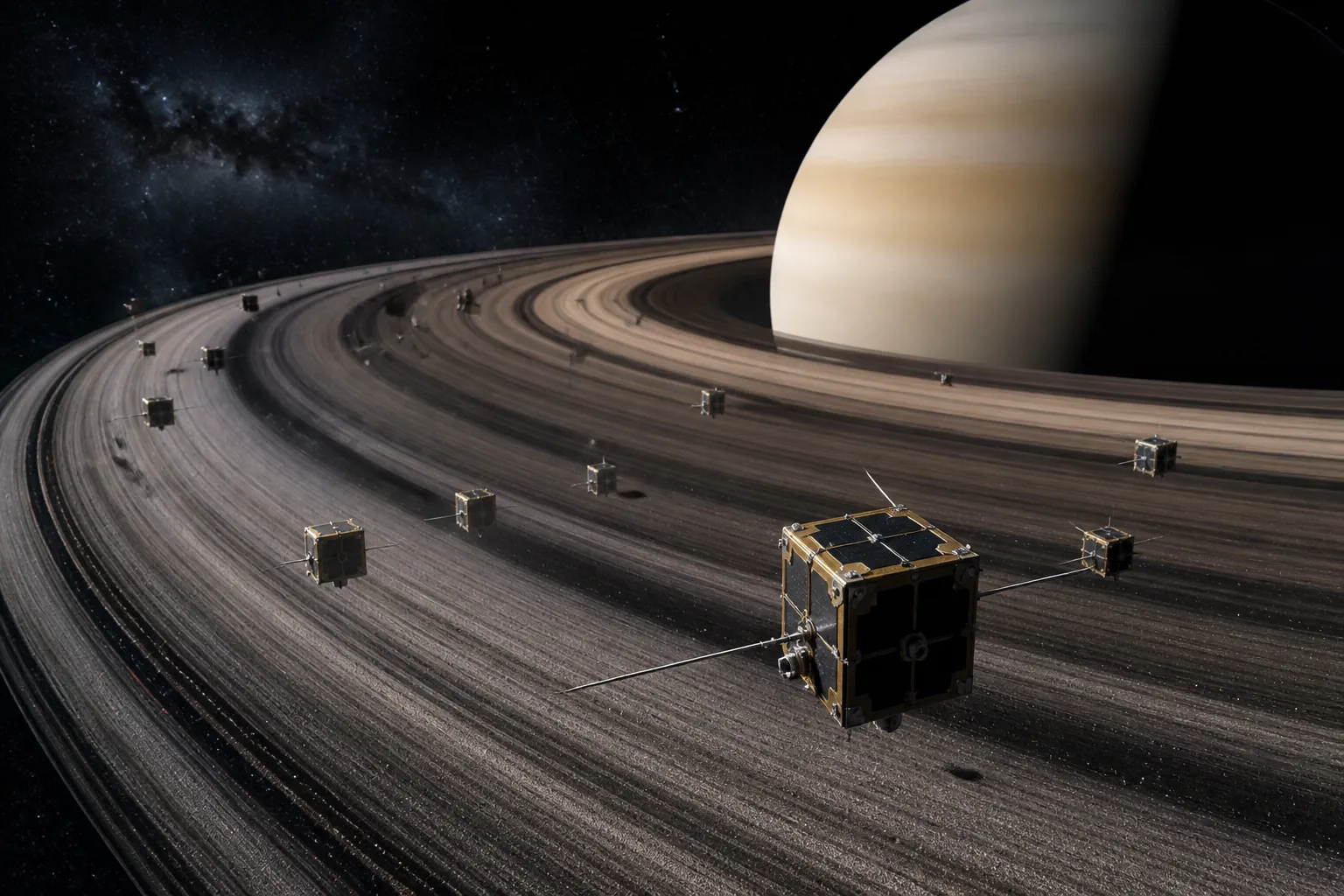
Among the projects is a concept by Michael Rubinstein of Northwestern University to study Saturn’s rings using 10,000 femtosatellites. These are small spacecraft weighing less than 100 grams. They are proposed to be sent into the planet’s rings, allowing for the loss of a significant portion of the spacecraft due to collisions with particles.
According to the authors’ concept, a distributed mission could be more resilient to such losses than research conducted by a single large spacecraft such as Cassini. Even the destruction of many femtosatellites would not necessarily make it impossible to collect data directly within Saturn’s rings.
More current news is available on the UA.News Telegram channel Telegram.
Lunar tunnels and exoplanets
Another selected development is the Lunar Underground eXplorer, or LUX, from Texas-based company Stone Aerospace. The concept involves using hovering-capable robots to map potentially multi-kilometer lava tunnels beneath the Sea of Tranquility on the Moon. They are planned to be connected to a lander or rover on the surface by an ultralight fiber-optic cable for power and communications.
NASA also supported a proposal by Paul Stancus of Brookhaven Science Associates for a new type of nulling interferometer. It is intended to combine data from two space telescopes located about 100 kilometers apart to suppress starlight. This approach could potentially help detect the contrast of surface objects on Earth-like exoplanets near the closest stars.
Other supported ideas include spacecraft protection technologies for operating in Venus’s harsh conditions, lunar spacesuits with radioisotope heating, and the use of space dust to partially reduce solar radiation.




