
Astronomers document a green white dwarf for the first time — Cyprus Mail
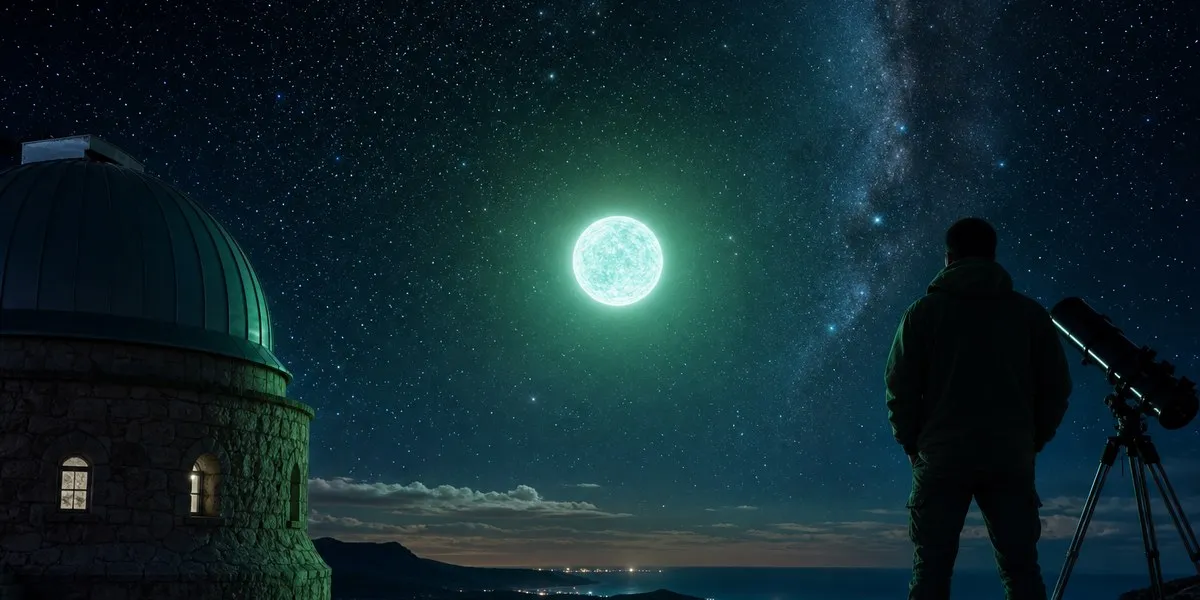
Astronomers have documented the green white dwarf WD J1330+6435 in the Milky Way for the first time. The object is located about 280 light-years from Earth in the constellation Draco. Its unusual chartreuse hue is associated with sodium that entered the star’s outer layers along with debris from former rocky planets, Cyprus Mail reports.
How the white dwarf became green
A white dwarf is the dense core of a low- or medium-mass star that has exhausted its nuclear fuel and shed its outer layers. Usually, the color of stars depends on their temperature: cooler ones appear orange, Sun-like ones white, and the hottest ones blue. For white dwarfs, the chemical composition of the atmosphere also has a significant effect on color.
Astrophysicist Mark Hollands of the University of Warwick, the lead author of the study published in the journal RAS Techniques and Instruments, explained that the surface layers of WD J1330+6435 were enriched with calcium, lithium and especially sodium. In ordinary stars, sodium absorbs a narrow band of orange light. However, the extreme density of a white dwarf changes this process: sodium atoms constantly interact with helium atoms, causing them to absorb yellow, orange and part of the red wavelengths. As a result, the star acquires a green glow.
More current news is available on the UA.News Telegram channel Telegram.
Other unusual colors
The researchers analyzed the colors of 151 white dwarfs located within about 65 light-years of Earth, using spectral data from the Sloan Digital Sky Survey and spectrum models they created. The typical color of such objects is white.
The scientists also identified WD J1011+2845, a white dwarf located 48 light-years from Earth in the constellation Leo Minor, which has a salmon-pink hue. Its color is associated with carbon rising from the star’s depths. According to the researchers, carbon-rich white dwarfs are more often pink or purple, objects with debris from planetary systems are yellowish, and cooler stars with mixed hydrogen-helium atmospheres are blue or cyan.




