
17 spacecraft detect an asymmetric plasma ejection from the Sun
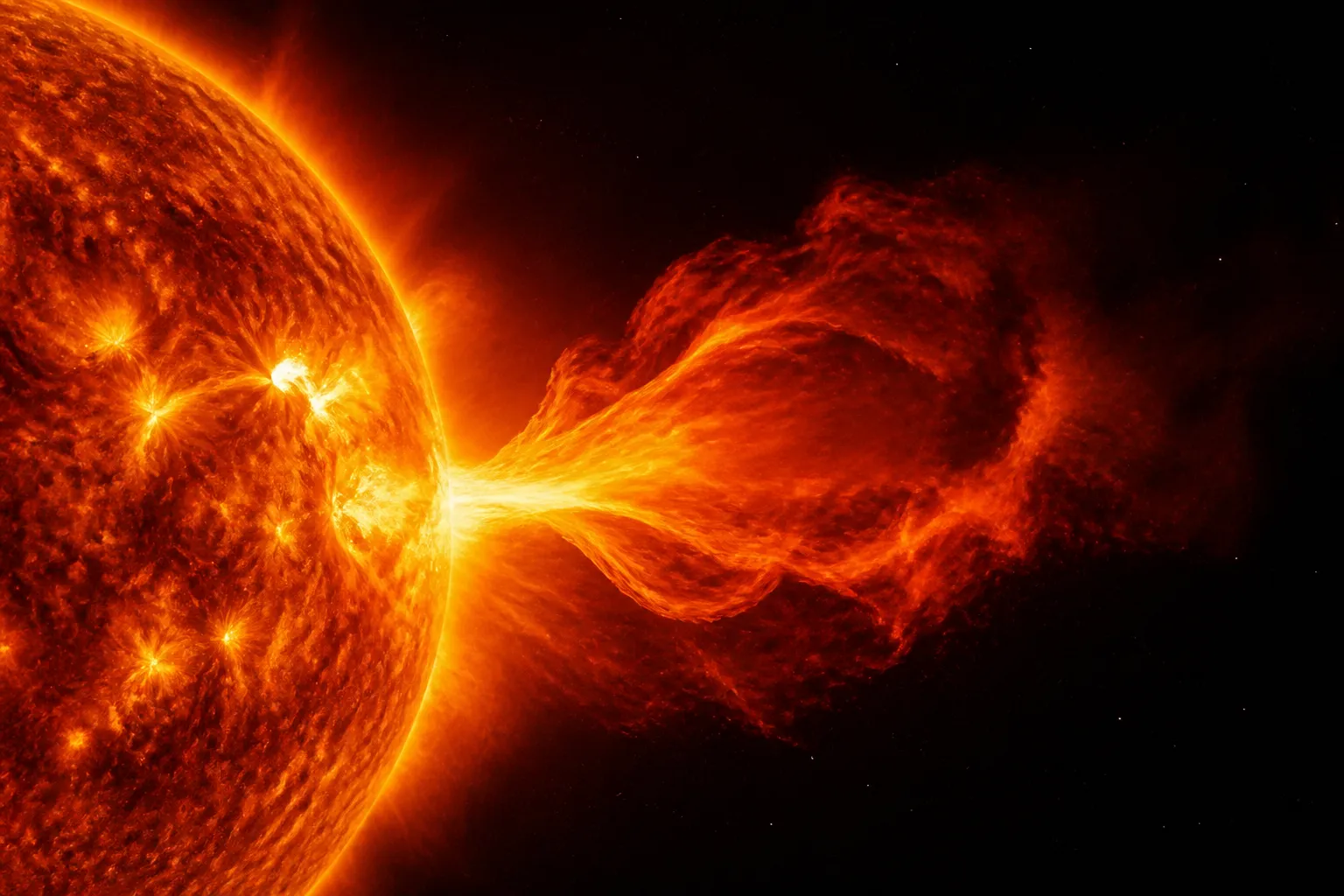
Seventeen spacecraft tracked a coronal mass ejection that occurred on the Sun on December 15, 2024, and revealed its unusual asymmetric structure. Observations showed that the ejection had two parts: a faster one moved through the Earth-Mars sector, while a slower one traveled toward the STEREO-A spacecraft. Space.com reports.
Two asymmetric parts
Coronal mass ejections are large clouds of magnetized plasma expelled from the Sun's hot outer atmosphere, the corona. The event began at 00:48 Universal Time on December 15, 2024. According to study lead Adrienne Luspay-Kuti of the Johns Hopkins University Applied Physics Laboratory, this is a record number of spacecraft involved in tracking and characterizing a single such ejection.
The previous record was 10 spacecraft, but most of them were located roughly along the Sun-Earth line. In this case, the missions were positioned at different distances from the Sun and at different angles to that line. This made it possible to determine the shape of the plasma cloud in at least two dimensions.
Hidden fast component
The SOHO observatory recorded the beginning of the ejection, but saw only the larger and slower part moving at an angle to Earth. The faster component, directed toward our planet, was obscured by the slower cloud. It was detected near Earth on December 17, and later by the Europa Clipper mission at a distance of 1.19 astronomical units from the Sun and by the MAVEN mission near Mars.
More current news is available on the UA.News Telegram channel Telegram.
Solar Orbiter, which at the time was 0.94 astronomical units from the Sun and only 10 degrees from the Sun-Earth line, did not detect the ejection. According to the researchers, this lack of detection was also important for refining its shape.
The part of the ejection that reached Earth traveled at an average speed of 840 km/s. The other had an average speed of 534 km/s and slowed to about 400 km/s near STEREO-A. The event did not cause significant auroras. Researchers are still determining the reasons for the ejection's asymmetric structure.
Scientists noted that observations from multiple directions are important for space weather forecasting. Fast coronal mass ejections can create shock waves that accelerate high-energy particles dangerous to astronauts outside the protection of Earth's magnetic field. The study results were published on August 19 in the journal Science Advances.


