
Star stream beyond the Milky Way found in Hubble archival data
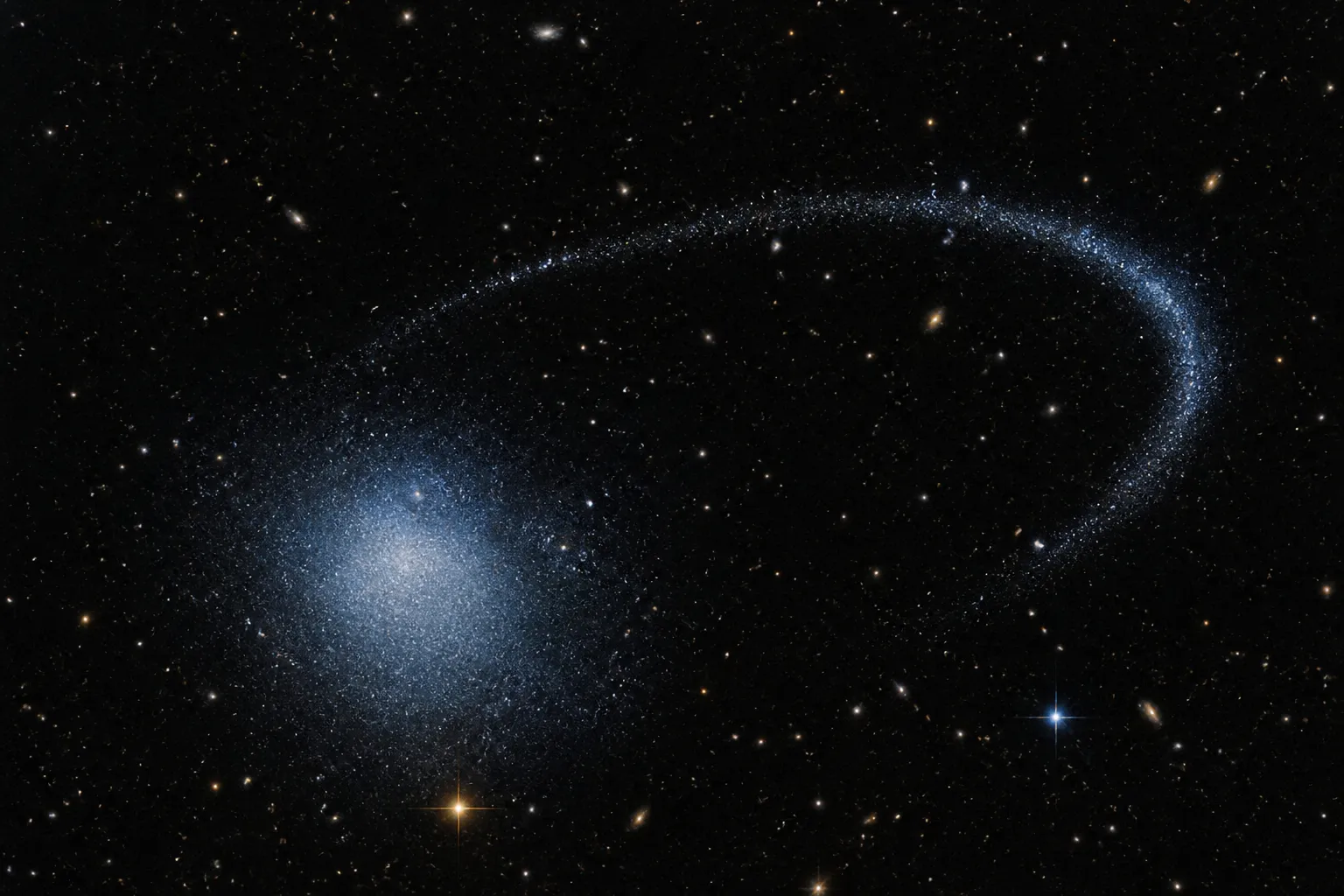
Researchers discovered a thin stellar stream in archival images from the Hubble telescope near the ultra-diffuse dwarf galaxy UGC 9050-Dw1, located about 115 million light-years from Earth. The object was named Oyasio; it may be the first known stellar stream from a globular cluster found beyond the Milky Way, Space.com reports.
Former astronomer David Handel noticed the faint arc-shaped structure in June 2023 while reading a scientific paper on his phone on a train commuting to work in New York. He observed that the stars in the band had similar colors and lay along a curved trajectory leading to a small bright object. According to the researchers’ estimate, these signs are consistent with a stream of stars formed during the gravitational disruption of a globular cluster by a galaxy.
Checking archival data
Handel sent an image with the marked arc to astrophysicist Sarah Pearson of DTU Space at the Technical University of Denmark. Further work was led by Pearson and Julie Kiehl Holm, a graduate student at the Niels Bohr Institute of the University of Copenhagen.
The team independently detected Oyasio in archival data from Hubble and the Canada-France-Hawaii Telescope. This made it possible to reject the assumption that the structure was an artifact of telescope imaging or subsequent data processing. The researchers also conducted thousands of simulations to determine which properties of the globular cluster and dark matter distribution could reproduce the observed shape and brightness of the stream.
More current news is available on the UA.News Telegram channel Telegram.
The best models produced new estimates of the total mass of UGC 9050-Dw1 and its distribution within the galaxy. According to the authors’ conclusions, the galaxy contains significantly more dark matter than might be assumed given its sparse stellar population. This is consistent with ideas about ultra-diffuse galaxies.
Possible traces of dark matter
Stellar streams from globular clusters can preserve information about the gravitational forces that acted on them over billions of years. Theoretically, small clumps of dark matter, too small to form their own stars, can deflect stars from their trajectories and create gaps in such streams.
Unlike the Milky Way, UGC 9050-Dw1 has no central stellar bar or nearby dwarf galaxies such as the Magellanic Clouds that could cause similar disturbances. At the same time, the team emphasizes that it cannot conclusively rule out all alternative explanations for Oyasio, including a chance arrangement of stars. The researchers’ paper was published in the journal Nature on August 12.


