
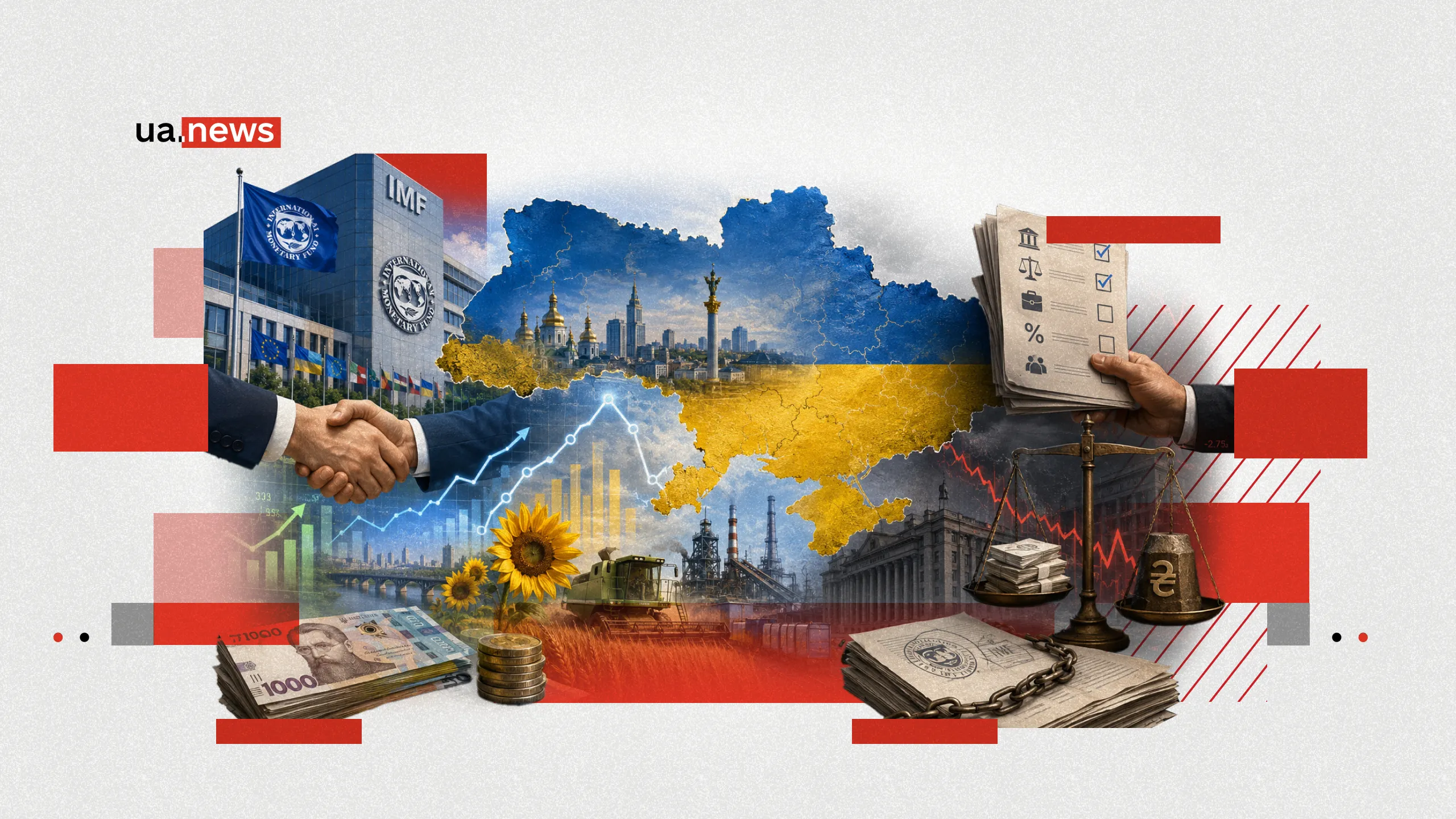
On May 27, 2026, a mission from the International Monetary Fund arrived in Kyiv for the next review of Ukraine’s Extended Fund Facility program. On the agenda were issues that have become traditional for such negotiations: tax reform, the possible introduction of VAT for some sole proprietors, taxation of international parcels, a review of budget parameters, increased defense spending, the search for resources to cover the budget deficit, and so on.
For most Ukrainians, the very fact of the IMF mission’s arrival has long ceased to be news. It has become a distinct political ritual of Ukrainian statehood. Almost every major financial or political crisis in Ukraine—from the hyperinflation of the 1990s to the major war after 2022—has, in one way or another, led Kyiv to negotiations with the Fund.
Over the years of independence, Ukraine has received over $50 billion from the IMF under various programs. But it has never been just about the money. For Ukraine, the IMF is simultaneously a creditor, an instrument of external control, a source of international trust, and a mechanism for enforcing reforms that the Ukrainian political system often is unwilling or unable to implement on its own.
The history of Ukraine’s cooperation with the IMF is, to a large extent, a history of the struggle between economic reality and political populism. It is the story of a state that has regularly tried to live beyond the means of its own economy and has therefore constantly returned to external financing.
So who is the IMF for Ukraine, and how have Kyiv’s relations with this institution evolved over the decades? UA.News political analyst Mykyta Trachuk explores the issue.
The 1990s: The IMF as a lifeline from economic collapse
Ukraine joined the IMF in 1992—a year after declaring independence. At that time, the country inherited from the USSR not only a vast industrial base but also a deep systemic crisis: broken production chains, a budget deficit, uncontrolled money issuance, and a virtual absence of gold and foreign exchange reserves. In 1993, Ukraine experienced one of the most severe episodes of hyperinflation in modern world history—over 10,000% (!) per year. The economy rapidly deteriorated, and the state effectively lost control of the financial system.
It was under these conditions that the IMF became one of Ukraine’s key external partners. The first major program was the 1994–1995 Systemic Transformation Facility, worth approximately $763 million. Later came the stand-by and Extended Fund Facility (EFF) programs. Between 1995 and 1998, Ukraine received nearly $1.9 billion, and the 1998–2002 EFF program was intended to provide an additional $2.6 billion, although approximately $1.6 billion was actually disbursed.
The Fund’s requirements were frankly stringent, but generally logical for a country emerging from a planned economy: ending deficit financing through currency issuance, price liberalization, establishing an independent National Bank, privatization, tight monetary policy, and so on. Interesting fact: it was with IMF support that Ukraine carried out monetary reform and introduced the hryvnia in 1996.
At the same time, a characteristic pattern of Ukraine’s relations with the IMF had already taken shape: Kyiv promised sweeping reforms, fulfilled some of the conditions, received a tranche, and then the political system began to sabotage the unpopular changes. As a result, many programs were frozen or terminated early. This cycle would repeat itself time and again over the decades.
For the public, the IMF gradually became a symbol of painful reforms. Budget cuts, delays in salaries and pensions, privatization, and rising utility rates created the image of a foreign creditor imposing “shock therapy” on Ukraine. But the reality was more complex: without external resources, the Ukrainian state of the mid-1990s could have faced total financial collapse, as happened in Russia in 1998.

The 2000s: Economic Growth Without Deep Modernization
The early 2000s marked a period of relative economic recovery for Ukraine. Against the backdrop of high global prices for metals and agricultural products, Ukraine’s GDP grew by an average of 7% annually between 2000 and 2007. It seemed that the country was gradually emerging from the transformation crisis of the 1990s and no longer needed constant support from the IMF.
But it was precisely then that the main weakness of the Ukrainian development model became apparent: economic growth was taking place without systematic modernization of state institutions, without political development, and without genuine democratization. This was the so-called “middle-income trap”: when, due to the “low-base effect,” a very poor country begins to grow rapidly on the back of its resources and favorable global conditions, but sooner or later this growth hits a ceiling. To continue growing, deep modernization and democratization are needed: political reforms, real alternation of power, independent courts, de-oligarchization, a free market economy, and so on. However, the political system (in the broad sense) begins to resist this.
The IMF has consistently demanded a reduction in the budget deficit, pension reform, market-based gas tariffs, and a decrease in political interference in the economy. The energy issue was particularly acute. Relatively cheap gas for the population remained for years one of the main sources of hidden deficits and corruption schemes by oligarchs surrounding Naftogaz. However, riding the wave of economic growth, the Ukrainian government increasingly relied on social populism. Budget spending rose, social benefits increased—all of which is, without irony, wonderful—yet structural problems continued to accumulate.
As long as the international economic climate remained favorable, this did not seem like a disaster. The global financial crisis of 2008 radically changed the situation. Ukraine became one of the hardest-hit economies in Europe: in 2009, the country’s GDP fell by more than 15%, the hryvnia sharply devalued, and the banking system found itself on the brink of collapse.
In November 2008, the IMF approved a $16.4 billion stand-by program for Ukraine—at the time, one of the largest in the world. In reality, Ukraine received about $10.6 billion. But along with the money, the Fund demanded strict budget discipline, reform of the banking system, and higher utility rates. The Ukrainian political system, however, proved, as usual, incapable of implementing a unified anti-crisis policy. The conflict between President Yushchenko, the Tymoshenko government, and parliament effectively paralyzed the fulfillment of a significant portion of the country’s obligations to its creditors.
It was then that the popular political myth of “external governance” finally took root in Ukraine. Like any conspiracy theory, it contains some entirely true and rational elements, since the IMF’s demands and cooperation with it generally invariably lead to a certain degree of desovereignization and a loss of autonomy in decision-making. However, if a state cannot provide for itself and turns to international creditors for help—who is its doctor? The one who gives the money sets the conditions; that is how it has always been and always will be. Yet the government increasingly explained absolutely any unpopular decision by citing IMF demands, even though a significant portion of these decisions were necessary in principle, regardless of the Fund’s position.
After 2014: The IMF as the Architect of Reforms
Following the events on Maidan and the onset of Russian aggression in 2014, Ukraine’s cooperation with the Fund entered a fundamentally new phase. The country found itself simultaneously in a military, currency, banking, and fiscal crisis—a sort of “perfect storm.” As usual, there was no money, and when a country has no money, it is usually sent to the three-letter agency—and those three letters are IMF.
In 2014, the Fund approved a $17 billion stand-by program for Ukraine, of which approximately $4.6 billion was received. As early as 2015, it was replaced by a four-year EFF program worth $17.5 billion. In reality, Ukraine received approximately $8.7 billion—the remaining tranches were frozen due to, once again, failure to meet the conditions. However, it was precisely after 2014 that the IMF began to play the role not only of a creditor but of the de facto architect of Ukraine’s new macroeconomic model.
With the Fund’s support, the banking sector was cleaned up: over 80 banks left the market, a move that still sparks heated debates among economists over whether it was necessary or not. In 2016, the state nationalized PrivatBank—the country’s largest bank. New anti-corruption bodies were established, the public procurement system was reformed, and corporate governance reforms for state-owned companies began, among other measures. However, all these reforms were half-hearted, did not yield immediate results, and were received very, very ambiguously by the public and the expert community.
One of the IMF’s most contentious demands was “bringing tariffs to market levels.” Simply put, from 2014 to the present, utility rates have risen at least 8–12 times, which is not the case for wages and the general standard of living. For many Ukrainians, this became the very symbol of the “IMF’s diktat.”
After 2014, cooperation with the IMF also took on a clear geopolitical significance. The Fund’s programs served as a signal to other international partners—the EU, the World Bank, the U.S. government, and private investors. In fact, the IMF tranche was not just money, but a kind of “certificate of confidence” in the Ukrainian economy. At the same time, nearly every Ukrainian government—from Yatsenyuk and Groysman to Honcharuk and Shmyhal—simultaneously criticized the IMF in public rhetoric while being forced to negotiate new programs with it.
After 2022: The IMF as a Pillar of Ukraine’s War Survival
Russia’s full-scale invasion in 2022 posed an unprecedented challenge not only for Ukraine but also for the IMF itself. Traditionally, the Fund has avoided long-term programs with countries embroiled in large-scale war. Ukraine became an exception.
After February 24, 2022, the Ukrainian economy lost a significant portion of its industrial capacity, millions of people fled their homes and became refugees, and the budget deficit reached over 20% of GDP. A significant portion of government spending goes toward defense and some form of social support for the population.
Initially, Ukraine received emergency RFI financing of approximately $2.7 billion. And in 2023, the IMF approved a four-year EFF program worth $15.6 billion—the largest in the history of cooperation between Ukraine and the Fund. New programs for the future are also under discussion.
Today, the IMF’s requirements extend far beyond the scope of traditional monetary policy. They include tax system reform, de-shadowing the economy, customs reform, fiscal discipline, and preparing the country for post-war recovery. It is in this context that discussions are currently emerging regarding the taxation of sole proprietorships, international parcels, or a review of the social spending system.
For the government, this creates a difficult balancing act: without external financing, the state cannot function fully in wartime conditions, but any new taxes or restrictions create serious political risks within the country. This is a classic Ukrainian catch-22: money is needed, but there is no desire to make systemic changes to obtain it. This is exactly how Ukraine has been cooperating with the IMF for four decades now, and this is most likely how this work will continue.

In summary, the question arises: has Ukraine become dependent on the IMF? Partially—yes, certainly. But this dependence did not arise because the Fund came here uninvited and began forcing its loans on Kyiv. It happened because the Ukrainian state has been living beyond the means of its own economy for decades and is chronically incapable of self-sufficiency.
Over the past thirty years, Ukraine has repeatedly tried to “kick the habit” of the IMF. But every major crisis—in 1998, 2008, 2014, and 2022—has brought it back to the need for direct external support.
The IMF, as an institution, did not create Ukraine’s problems. It merely stepped in when these problems became critical and when Ukraine turned to it for money. Just as a bank or microcredit organization that issued a loan is not the source of a person’s financial problems.
A person creates the problem for themselves—just as they come of their own accord, on their own two feet, to ask for a loan. No one is forcibly dragged into a debt trap. And this applies both to the average citizen and to the state.


