
Parents identified the main shortcomings of school meals and shared their suggestions for the menu
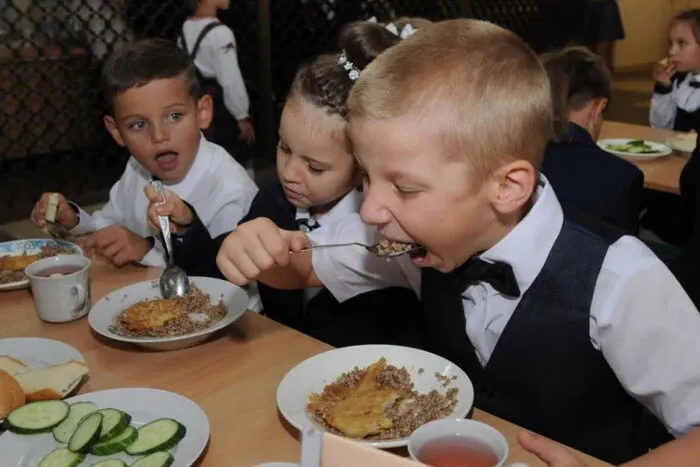
Most parents who participated in the survey view the organization of school meals positively. At the same time, among the most common requests are a more varied menu and improved taste of the meals.
Nearly 37% of the parents surveyed said they would like to see a more varied menu in schools. They also emphasize the need for clearer guidelines regarding children’s meals during prolonged air raid alerts.
According to the initial survey results, 80.8% of parents reported that their children regularly eat at school, while another 14.9% said they do so occasionally.
96% of respondents noted that their children receive meals completely free of charge.
More than 80% of parents rated all seven aspects of school meals covered in the survey positively. These include dining hall conditions, meal service organization, portion sizes, menu variety, quality, taste, and food temperature.
The conditions in the cafeterias received the highest positive rating—90.7%. Meal organization was rated positively by 87.7% of parents, portion sizes by 87.4%, menu variety by 85.8%, and the quality of the meals by 85.7%. The taste of the dishes was rated positively by 83.6%, and the temperature by 80.1%.
At the same time, some parents pointed out areas where the meal service could be improved. 37% would like a more varied menu, and 36.5% would like the taste of the meals to be improved. Another 22.4% cited the quality of the meals as an area for improvement, while 19.8% mentioned their temperature. Nearly one-third of survey participants noted that nothing needed to be changed.
The survey also examined meal arrangements during air raid alerts. Among parents whose children found themselves in a situation where mealtime coincided with their stay in a shelter, 53.2% reported that meals were provided. Another 13.5% indicated that meals were provided only partially or not always. At the same time, 21.1% of parents do not know how their child’s meals are organized in such situations.
The survey is being conducted by the State Service for Education Quality on behalf of the Prime Minister. So far, 2,162 questionnaires from parents of children attending in-person classes have been analyzed.
The Ministry of Education and Science noted that the survey results will be used to identify issues and further improve school meals. Regions and the State Service for Food Safety and Consumer Protection are involved in this effort.
“The reform is ongoing, and such surveys are necessary precisely to see the situation through the eyes of families and children and to respond promptly where the system needs improvement. This includes the quality and taste of meals, the operation of school cafeterias, meal provision during emergencies, and communication with parents,” the Ministry of Education and Science stated.
The survey will run until October 16. Participation is voluntary, so the interim results presented reflect the opinions of the parents who participated in the survey and are not representative of the entire school meal system.
This was reported with reference to the Ministry of Education and Science.
The expansion of free school meals has caused problems for Ukrainian communities.
As a reminder, the Verkhovna Rada amended the law “On the State Budget of Ukraine for 2025” regarding financial support for the security and defense sector and addressing priority issues. Funds were allocated, in particular, for meals for students in grades 1–4 in all regions and for students in grades 5–11 in frontline areas.
Meanwhile, the government plans to expand the free school meal program to include all students in grades 1 through 11 nationwide starting in 2026.




