
Magnetic storms in June 2026: space weather forecast for the coming days
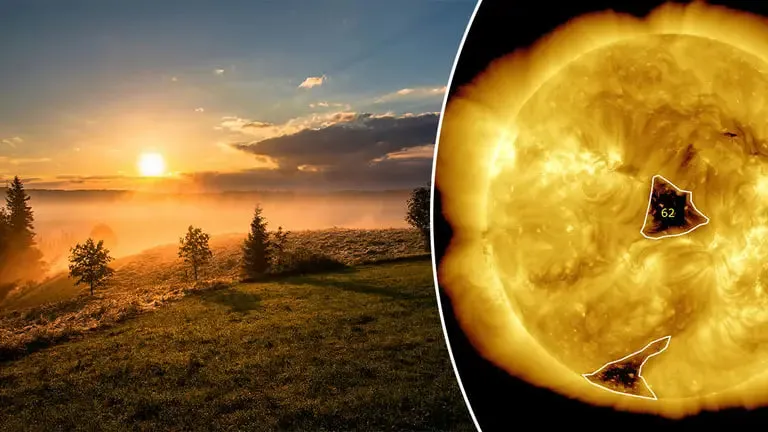
The last days of spring have been relatively calm in terms of solar activity, but the situation may change at the start of summer. Experts have noted the appearance of a new coronal hole, which has already turned toward Earth. This could lead to an increase in solar wind and fluctuations in the magnetic field in the coming days, so space weather is currently being monitored very closely.
This is reported by SolarHam, a specialized space weather monitoring resource.
What was happening on the Sun at the end of May, and what should Earth’s inhabitants expect in June?
The lull observed at the end of May is gradually giving way to a period of increased activity. Between May 29 and 31, scientists did not record any coronal mass ejections directed directly at Earth. This allowed our planet’s magnetosphere to remain in a relatively stable state. However, the Sun was not completely inactive: during this period, researchers observed several flares, among which an M1.1-class flare recorded on May 29 stood out.
In addition to isolated flares, experts counted at least seven numbered sunspot groups on the visible part of the solar disk, as shown by data from solen.info. The regions AR4452 and AR4455 attract the most attention, as they have the greatest potential for generating isolated M-class flares. Although these events have not yet led to significant geomagnetic effects, they indicate that internal processes within our star are becoming more intense.
The main news in early June was the appearance of a large coronal hole, designated CH1372. This region with open magnetic field lines has a positive polarity and is currently located directly opposite Earth. Coronal holes are sources of fast solar wind—streams of charged particles moving at significantly higher speeds than ordinary solar wind. When these streams reach the planet’s magnetosphere, they cause disturbances.
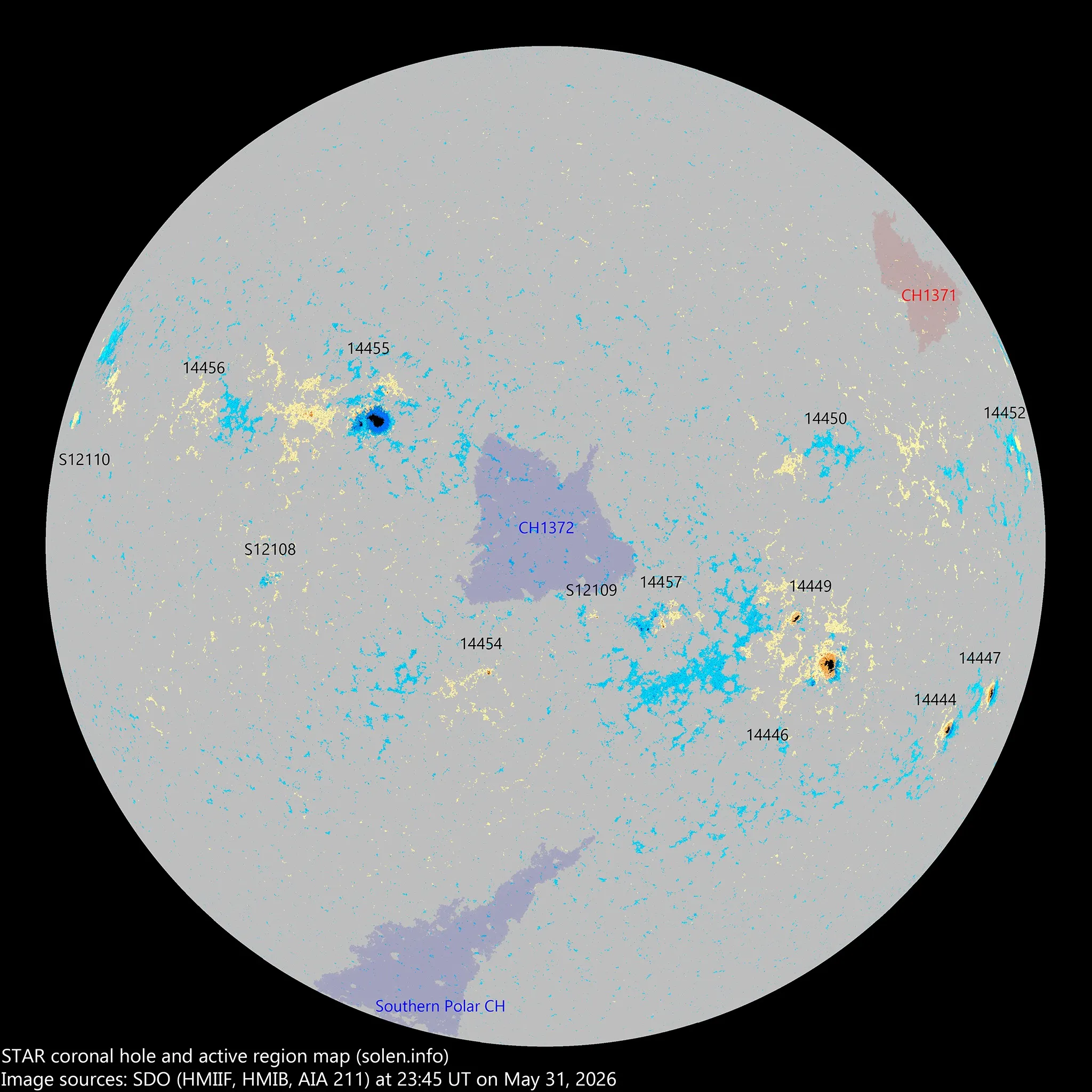
Scientists predict that the solar wind stream from this region will reach our planet as early as June 3 and will continue to affect it on June 4. Thus, although the geomagnetic field will remain calm on June 1–2, the situation will begin to change as early as Wednesday. The geomagnetic activity index is expected to rise to Kp4, corresponding to an active state of the magnetosphere. There is also a high probability of a weak G1-class magnetic storm occurring when the index reaches Kp5.
Although G1-class storms are considered minimal on the space weather scale, they can still affect the operation of power systems in high latitudes and alter the behavior of migrating animals. For the general public, this usually means the opportunity to observe the aurora in regions located closer to the poles.
Experts continue to analyze images obtained using the SDO/AIA observatory to provide timely warnings of possible increases in solar activity. Further forecast updates will depend on the speed of the solar wind and its density at the moment of contact with Earth’s magnetic shield.
Magnetic Storm Calendar for June 2026: How to Prepare for Geomagnetic Disturbances.
Astronomers have discovered a strange planetary system that is changing before our eyes
Meteorologists predict the formation of the El Niño climate phenomenon as early as May, and by the end of 2026, it could become the strongest in the last decade.


