
The Ministry of Education and Science is changing its approach to teaching in grades 10–12
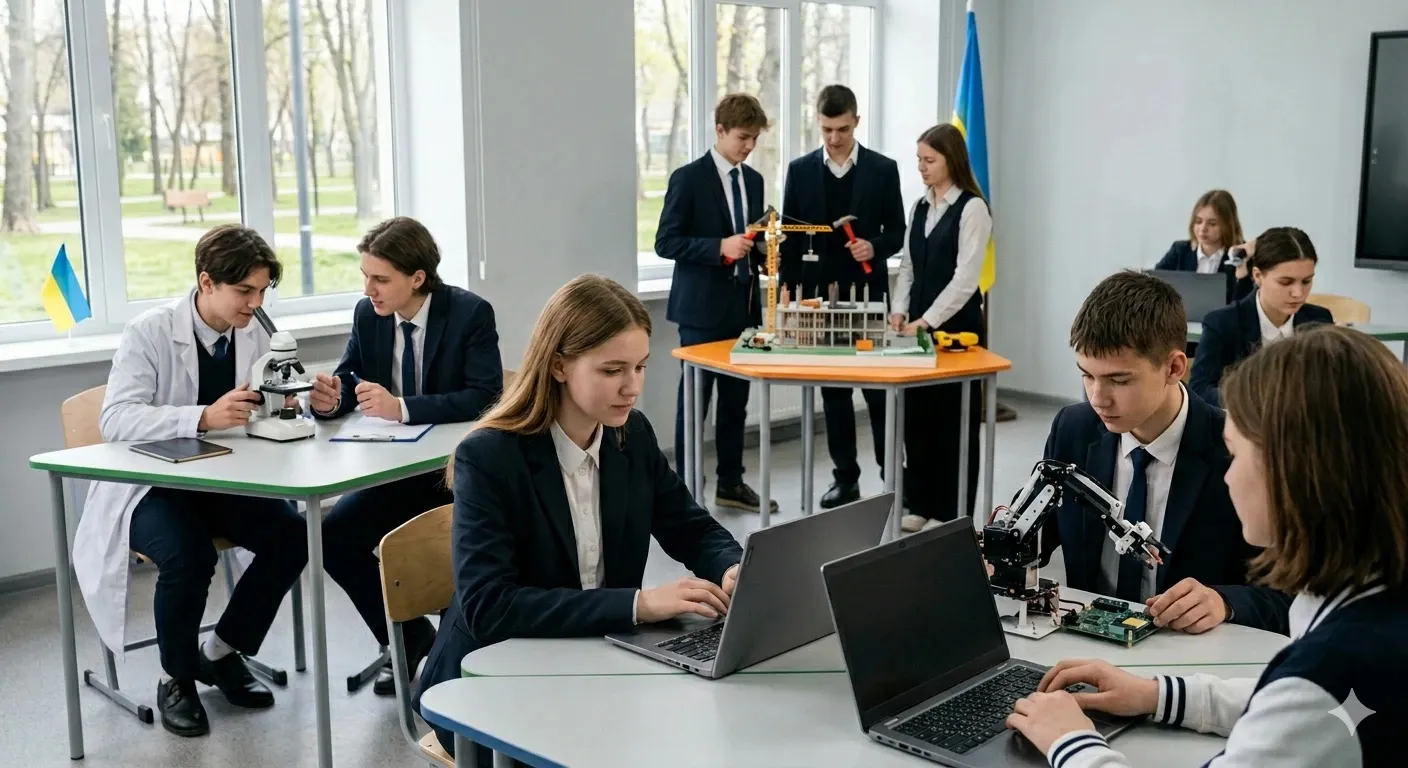
Starting in 2027, Ukrainian high school students will be able to choose not only an academic track but also a vocational one. The Ministry of Education and Science has approved a new program that will allow students to combine a complete secondary education with training in a specific profession and practical skills.
Students will be offered ten specializations—ranging from IT and medicine to construction, agriculture, and the beauty industry. The Ministry of Education and Science says that this model will bring Ukrainian schools closer to European standards and help teenagers decide on their future careers earlier.
The Ministry of Education and Science of Ukraine has approved the Model Educational Program for Vocational Secondary Education. The new approach to high school education will take effect on September 1, 2027, and will apply to students entering 10th grade.
After completing the ninth grade, students will be able to choose one of two paths. The first is the academic track, which is geared toward future admission to higher education institutions. The second is a vocational track, where general education will be combined with the acquisition of practical skills and preparation for a future profession.
The Ministry of Education and Science notes that the new model is intended to help high school students make more informed choices about their career paths and gradually prepare for work in their chosen fields. Ten areas of study will be available to students:
- agricultural;
- construction;
- transport and logistics;
- engineering and technology;
- medical;
- IT;
- business and administration;
- education and humanities;
- hospitality and event management;
- beauty and design services.
The program will last three years—from 10th to 12th grade. The total program load will be 180 ECTS credits. In the first year, students will go through an adaptation phase. Subsequently, the specialized component will gradually increase, and students will be able to delve deeper into their chosen field.
More than a third of class time will be devoted to specialized subjects. Another 11% of the time will be allocated to courses that students can choose independently, based on their own interests and the needs of the job market. The curriculum will vary depending on the chosen field. For example, the IT track will include more mathematics, digital technologies, and computer science. Future medical professionals will focus more on biology and chemistry.
One of the main features of the new curriculum will be the integration of general education subjects with future professions. Students will be able to apply their theoretical knowledge in practice by examining examples related to specific fields of activity. “The new curriculum will allow students to gain not only knowledge but also practical experience and a better understanding of what they want to do in the future,” the Ministry of Education and Science notes.
The ministry also emphasizes that this approach has long been in use in many European countries, where vocational training is an important part of high school. Upon completion of their studies, graduates will receive a certificate of complete general secondary education. In addition, they will be able to confirm their professional qualifications through special qualification centers or continue their education at institutions of vocational, pre-higher, or higher education.
The Ministry of Education and Science is convinced that the new system will provide students with more opportunities and help them better prepare for adult life and the modern labor market.
Earlier, the Ukrainian Center for Educational Quality Assessment commented on the situation in the Odesa region, where participants in the National Multidisciplinary Test spent nearly 13 hours at the testing center due to prolonged air raid alerts. According to the agency, graduates were offered the option to reschedule the exam for an additional session, but they refused and decided to wait until the testing was completed and take the NMT on the same day.
An alternative bill to change the format of the National Multisubject Test (NMT) has been registered in the Verkhovna Rada. The document proposes reducing the number of subjects from four to three. In this case, mathematics would be an elective subject.


