
Europe's largest floodplain forest has grown on the site of the Kakhovka Reservoir
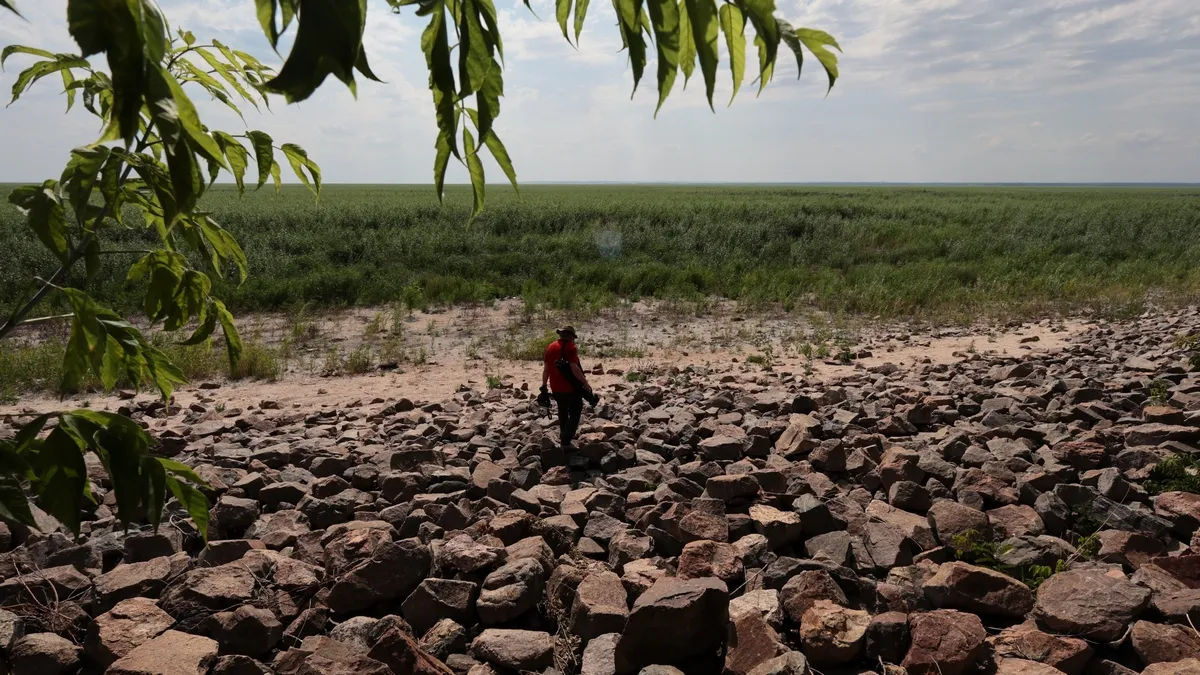
At the site of the former Kakhovka Reservoir, Ukrainian scientists are observing a unique natural process—the formation of a large floodplain forest. According to the researchers’ estimates, this phenomenon is not currently observed anywhere else in the world.
Kateryna Romanenko, a senior research fellow at the M. G. Kholodny Institute of Botany of the National Academy of Sciences of Ukraine and a candidate of biological sciences, spoke about this in an interview with “Suspilne.”
According to her, scientists have already conducted three expeditions to the site of the former reservoir this year and are planning another one in the fall. The research is being conducted as part of a project by the Institute of Botany of the National Academy of Sciences of Ukraine dedicated to assessing biodiversity loss resulting from hostilities and climate change.
Romanenko noted that the willow forest that has formed at the bottom of the reservoir covers about 65,000 hectares. It is currently in its third year of development.
“We are witnessing the formation of the largest floodplain forest of uniform age in Europe,” said the researcher.
According to her, the willows have already grown to an average height of 6.5 meters, with a diameter of 5–6 centimeters. Despite the heat, the trees continue to grow actively and create conditions for other plants and animals.
The researcher also dispelled concerns that the willows might wither or be displaced by invasive species. She noted that a stable ecosystem is forming in the area, one with significant potential for further development.
Ivan Moysienko, Ph.D. in Biology, noted that a distinct stratification has already formed in the new forest. The upper layer consists of willows and poplars, the middle layer of tamarisk shrubs, and the lower layer of reeds and sedges.
Scientists emphasize that this differs significantly from the ecosystem that previously existed within the Kakhovka Reservoir.
“Instead of a monotonous, very simple ecosystem, many different ecosystems are forming. What we see at the bottom of the Kakhovka Reservoir is, in fact, the rapid revival of the Great Meadow,” Moiseenko noted.
Source: Suspilne Kherson.
As a reminder, there are plans to create a modern science park in the Lviv region, with the relocated Donetsk National Technical University (DonNTU) serving as its center. The project envisages the development of an innovative ecosystem, modern laboratories, research centers, and housing for scientists.
A new national nature park has been established in Ukraine.




