
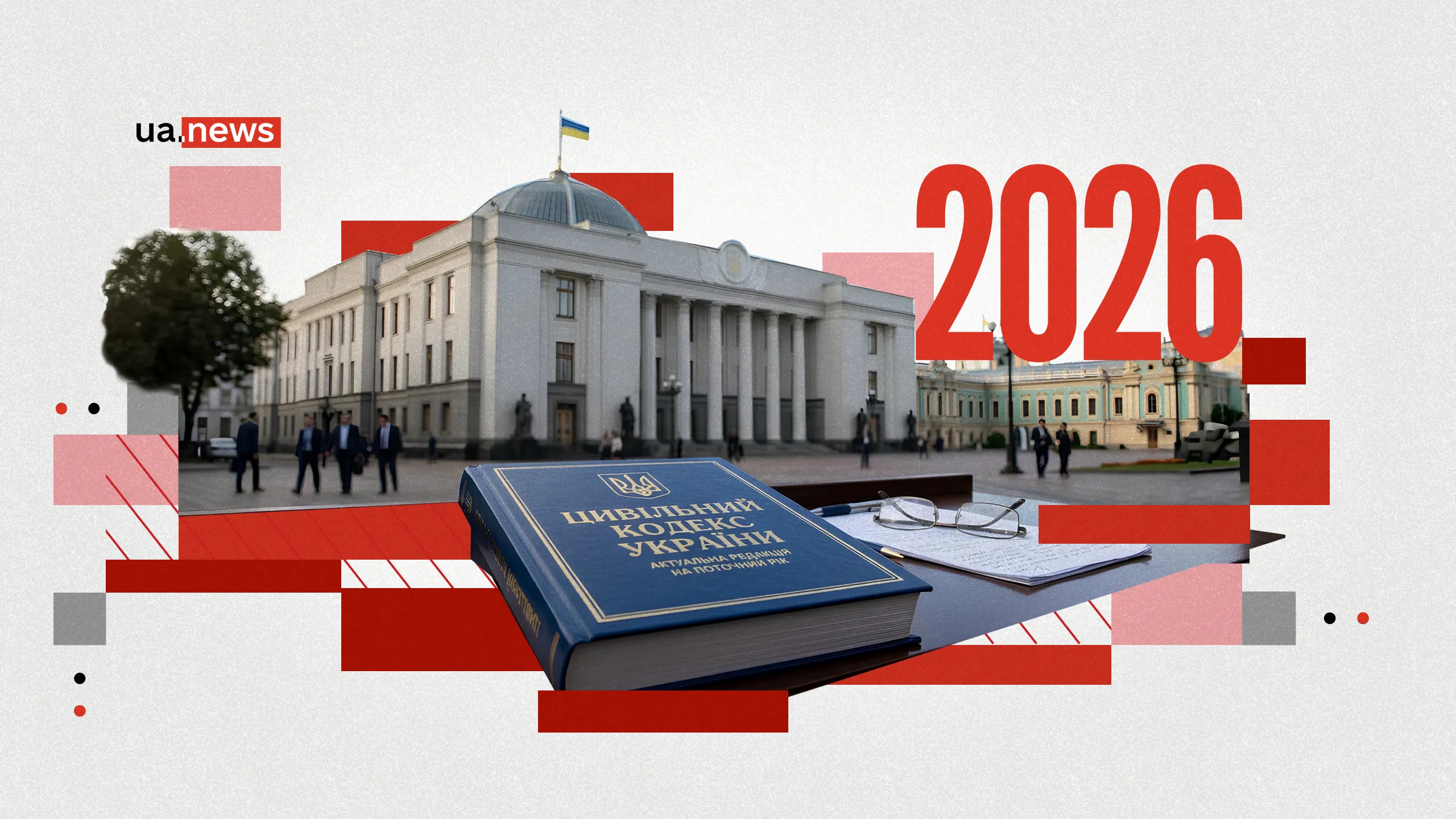
On April 28, the Verkhovna Rada approved the draft of the new Civil Code of Ukraine in its first reading. The Civil Code of Ukraine (CCU) is the primary legislative act governing property and non-property relations between individuals and legal entities. It defines property rights, contractual relationships, intellectual property rights, and inheritance; establishes rules for civil transactions; protects the rights of individuals; and defines the limits of their obligations, among other things.
The new CCU was intended to be a fundamental reform in private law, as the document had not been amended for over 20 years. However, even during the drafting stage and first reading, it sparked a wave of criticism from the public.
Among the controversial issues are the definition of a family as a union between a man and a woman, the religious status of marriage, a provision allowing marriage from the age of 14 under special circumstances (which has already been removed), potential restrictions on investigative journalists, changes in property law and the protection of state property, and more. Additionally, some activists and organizations believe that certain provisions may contradict European human rights standards and Ukraine’s obligations in the process of European integration—particularly regarding issues related to the LGBT community.
Be that as it may, the process of adopting the new Civil Code is ongoing, and the Verkhovna Rada has already adopted the document as a basis. Further discussions and amendments are expected, after which the Code will be adopted in its entirety and sent to the president for signature.
Why was the decision made to amend the Civil Code right now? Was there truly an urgent need for this? What changes await Ukrainians? UA.News posed these questions to experts. Read more in our article.
Let’s hope for modernization: social expert and MP of the 6th and 7th convocations Andriy Pavlovsky
Actually, this idea isn’t new—it’s quite old: to amend all previous codes, and generally the legislation that has been passed down to us from the days of the Ukrainian SSR. Take the Housing Code, for example. This is a form of modernizing legislative practices.
Whether it is timely and necessary right now, or whether it is all just needed by the authors of the new Civil Code—that is a matter of debate, and I won’t venture to make any assertions here. Let’s hope that the most important aspects of the Civil Code for citizens will be modernized—especially since many provisions have been carried over from the now-abolished Commercial Code. It is also difficult for me to say whether this is truly a necessary initiative here and now, or whether it is merely a distraction from something else. Because, to be honest, there is always something distracting us from something else and shifting our attention.
The Civil Code needs to be refined; otherwise, there will be more misunderstandings: political analyst Maksym Honcharenko
The new Civil Code is a purely technical document that was presented as a step toward European integration or a significant change in the rules of the game for ordinary Ukrainians. But in reality, the most controversial provisions were already present in the old legislation. For example, the so-called “reimbursement” of wedding expenses in the event of a breakup after an engagement: this practice dates back to Article 31 of the Family Code. In other words, nothing radically new has been introduced.
Looking at the process of adopting this decision, I get the impression that it was rushed through. This explains the controversies surrounding the wording, the controversy regarding the possibility of marriage from the age of 14, and the absence of key European integration initiatives, such as equal rights for the LGBTQ+ community, as well as the use of such “flexible” legal neologisms as “good morals.” All of this means the bill must be thoroughly revised during the second reading; otherwise, the initiative will generate more confusion than transparency.
From the perspective of the average citizen, the changes in the most media-sensational points are not critical. But in the medium and long term, issues regarding citizens’ property and ownership raise greater concerns.
Questions regarding the mechanisms for acquiring and transferring property rights—specifically, who determines and interprets the rules of the game. Questions regarding the increased role of digital tools in managing agreements, clearer rules for interaction between parties—how well these mechanisms will function. There are questions regarding business and inheritance mechanisms. And here we encounter risks. Even with all the system’s declared progressiveness, legal practice and law enforcement have not yet been fully developed. Even lawyers interpret the new provisions differently, and ordinary citizens simply do not understand what it all means.
There is no disaster in the new Civil Code: MP Oleksiy Kucherenko
I understand the public’s interest in the new Civil Code. It’s a complex issue. I myself looked into the details before supporting it in the first reading. Speaker Stefanchuk and other drafters of the document visited our faction. We asked questions and discussed problematic issues. Overall, the conversation was constructive.
The government’s key argument is that the Commercial Code has been repealed, leaving gaps in the legislation. I would actually start with the Commercial Code. To be honest: I’m not a fan of these changes. But to say that the new Civil Code is some kind of disaster, as the media has reported—I wouldn’t go that far.
But here’s a valid question: is now the right time to do all this? Since we’ve already started—well, what can you do… I believe there are many issues that need to be resolved. But it’s not a given that the second reading will be so straightforward. There are a lot of nuances there, and we could get stuck on them for a long time. But I’ll say again that I don’t see any outright disaster in the new Civil Code, especially against the backdrop of everything else that’s been adopted here. The work is ongoing.
No one really needs the new Civil Code: lawyer Rostislav Kravets
As for the adoption of the new Civil Code in the first reading—in my view, its emergence and such urgent actions regarding its adoption are linked exclusively to one thing: the money that was spent on its development. Especially since the previous code was adopted relatively recently, in 2003–2004, and there are currently no fundamental changes that would require regulation. Moreover, during wartime, introducing such a change and turning civil legislation upside down—personally, I believe there is no need for this.
Of course, there are certain nuances that suggest not only an attempt to legalize the illegal expenditure of funds by scientific institutions on its development and the utter futility of these efforts, but also of attempts to simplify the process of seizing property from Ukrainian citizens and to facilitate the acquisition of ownership rights by foreign entities or their affiliates over both state and private property.
In other words, there was no critical need to change anything. Even the drafters of this code still cannot explain what exactly they find unsatisfactory in the current civil legislation. And if they cannot explain exactly what they want to regulate, this indicates only one thing: in my view, it is an attempt to launder money that was spent on scientific research that was of no use to anyone. All of this is reminiscent of very high-profile cases involving similar situations: when scientific institutions are allocated funds for research—significant amounts at that—and it later turns out that no scientific research actually took place.
I think there are more questions here for these scientific institutions that drafted this code and what they ultimately received. And, of course, I don’t rule out another possibility here—that the developers of this new code, which nobody needs, are people directly connected to the government, currently in power, and they understand that as soon as their time in power ends, it’s unlikely anyone will even remember them. And now they are trying, as strange as it may sound, to “write themselves into history,” even though they are only making things worse.
In the work of the Rada, we see the “Truskavets School of Law”: political scientist Andriy Zolotaryov
The Verkhovna Rada adopted in the first reading a new Civil Code, which succeeded the code that had been in effect since 2004. And that code, in turn, succeeded the Soviet Civil Code of the Ukrainian SSR, which had been in effect since 1963.
Why such changes? Especially since this code was in the works for six years.
Certainly, arguments about modernization are valid—that civil relations must keep pace with the times. But there are key innovations—for example, the introduction of the principle prohibiting contradictory conduct; the approach to liability for damages is also changing (now it will even include preventive costs); the document provides for the expansion of the personal rights of citizens and legal entities; rules regarding civil relations are being updated; new types of property rights are being introduced, and so on.
In other words, there are quite a few innovations. But, for example, the restriction of citizens’ right to informational privacy, the ban on work-related calls during personal time—these are the things that are concerning. It is also concerning what was done to push this bill through—and it certainly didn’t have any kind of universal support. There was a PR campaign that I noticed right away: when they floated the idea of allowing marriage from age 14. Traditionally, when they want to push something through, they first throw out some nonsense that sparks a huge debate—and then they announce that it won’t happen, everyone is happy, and the main bill passes. That is precisely why there are so many controversial issues, such as the definition of family and the status of religious marriage, potential restrictions on journalists and investigators, changes in property rights and the protection of state property, and so on. There may also be problems regarding land privatization. And this, again, is cause for concern.
It is still too early to criticize this document, however, but given that we have the “Truskavets School of Law” at work in the Verkhovna Rada, most draft laws are poorly drafted from a legal standpoint. This raises questions about the Civil Code: what will ultimately become of it, and what hidden pitfalls will still emerge. This will take time, as we are dealing with an overly large document that changes so much in civil relations. Let’s hope that it at least doesn’t turn out to be worse than the previous one.


