
Holiday on September 16, 2026 — the Feast of Saint Cyprian: The History of the Metropolitan of Kyiv
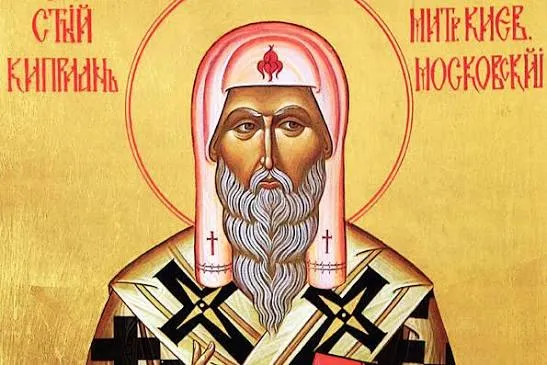
On September 16, Orthodox Christians commemorate Saint Cyprian, Metropolitan of Kyiv and All Rus’, who lived at the turn of the 14th and 15th centuries. He was not only a church leader but also a learned scholar, translator, and author of spiritual works. Cyprian died on September 16, 1406, which is why this date became the day of his commemoration.
The commemoration of Saint Cyprian, Metropolitan of Kyiv and All Rus’, is observed on September 16. It was on this day in 1406 that he died, bringing to a close his many years of service to the Church. In the church calendar, this date is not associated with any specific event or folk holiday, but rather with the veneration of the saint himself and his spiritual legacy. In various church traditions, another date may also be observed—September 29 according to the New Style calendar; in the old Julian calendar, the day of commemoration falls on September 16. This is why there are sometimes discrepancies in the dates listed in calendars. In Ukrainian calendars for 2026, the commemoration of Cyprian is listed for September 16.
On this day, the faithful reflect on the metropolitan’s life, his work for the Church, and his contribution to the development of literary culture. For the Orthodox tradition, the commemoration of the saint is, above all, an occasion to focus on his example of faith, education, prayer, and service to others. Churches may hold services during which the saint is commemorated and invoked in prayer.
Who Was Saint Cyprian?
Cyprian was born around the 14th century in Bulgaria, likely in the region of Tarnovo. He received a good education for his time and was associated with the renowned Tarnovo School of Letters. Later, Cyprian found himself in Constantinople and then continued his monastic life on Mount Athos. It was there that he earned a reputation as a learned and devout church figure.

His education played an important role in his later work. Cyprian was well-versed in ecclesiastical literature, worked with Greek texts, and was involved in translation. He did not limit himself solely to church administration but devoted much attention to books, writing, and the dissemination of spiritual knowledge. That is why he is often remembered in history not only as a metropolitan but also as a writer and scholar.
In 1375, Patriarch Philotheos of Constantinople appointed Cyprian as Metropolitan of Kyiv, Rus’, and Lithuania. His appointment took place during a difficult period, when various principalities were vying for influence, and church life was also far from peaceful. Cyprian was to become one of the figures who sought to preserve the unity of the metropolis.
Why Is He Called the Metropolitan of Kyiv and All Rus’?
Cyprian’s title is linked to the structure of the Orthodox Church at that time and the history of the Kyiv Metropolis. In the 14th century, church lands were divided among various political centers, and a serious struggle was underway for the right to influence the metropolitan see. Cyprian himself faced resistance from individual princes and church leaders at various times. In 1389, the Patriarch of Constantinople confirmed Cyprian as Metropolitan of Kyiv and All Rus’. In 1390, he arrived in Moscow and effectively took charge of the metropolitanate. Historians note that one of Cyprian’s main tasks was to preserve ecclesiastical unity amid political tensions between various lands.

At the same time, his activities should not be viewed solely as a matter of church politics. Cyprian sought to maintain contacts between various Orthodox lands, promoted ecclesiastical education, and engaged in literary work. His tenure coincided with a period of major political upheaval, so the metropolitan had to simultaneously address spiritual, administrative, and diplomatic matters.
Cyprian was a renowned scholar and translator
One of the most important aspects of his work was his engagement with books. Cyprian was considered one of the most educated church figures of his time. He translated individual works from Greek into Church Slavonic, worked on the texts of liturgical books, and oversaw their compilation. Cyprian also edited and transcribed important ecclesiastical texts. He is credited with working on the hagiography of Metropolitan Peter, as well as participating in the creation and dissemination of other historical and ecclesiastical works. His efforts contributed to the continued development of book culture within the Orthodox community.

It is interesting to note that, for the Middle Ages, working with books was an extremely difficult task. Books were copied by hand, and translation required not only knowledge of languages but also an understanding of theological content. Therefore, educated church leaders who could work independently with Greek texts had a significant influence on the development of spiritual culture. Cyprian also supported the work of scribes and copyists. It was precisely through such efforts that his legacy extended far beyond the scope of ordinary church administration. Today, he is remembered as one of the prominent figures of the medieval Orthodox literary tradition.
What role did he play in church life?
Cyprian lived at a time when the Kyiv Metropolis was going through a difficult period. Various political forces sought to strengthen their influence over church life, and the question of who should lead the metropolis often became part of a broader political struggle. That is precisely why the metropolitan’s role required not only spiritual authority but also diplomatic skills. One of his main tasks was to maintain ties between Orthodox lands. Cyprian advocated for the metropolis to remain united, despite political disputes. Sources describe his work as crucial for restoring ecclesiastical unity among different territories.
The metropolitan also took an active interest in spiritual education. He supported the development of scholarship, translations, and the dissemination of ecclesiastical literature. For him, knowledge and faith were closely linked, so the education of the clergy was of great importance. His work continued until his death in 1406. In the last years of his life, Cyprian devoted much of his time to literary work and ecclesiastical affairs. The metropolitan died on September 16, 1406, after which he was buried in the Cathedral of the Dormition in the Moscow Kremlin.
An Interesting Story About the Vladimir Icon
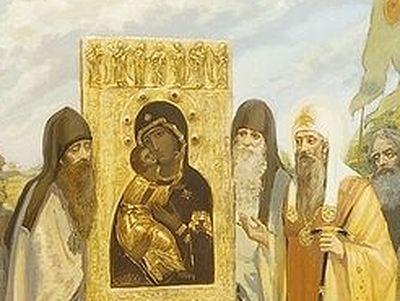
One of the well-known events of the late 14th century is also associated with the name of Cyprian. In 1395, the army of Timur—known in European history as Tamerlane—approached the Rus’ lands. During this period, the Vladimir Icon of the Mother of God was transferred from Vladimir to Moscow. According to church tradition, people viewed this event as a prayer for the protection of the city and the entire land. Afterward, Timur’s army changed course and did not march on Moscow. The event became an important part of the history of veneration of the Vladimir Icon.
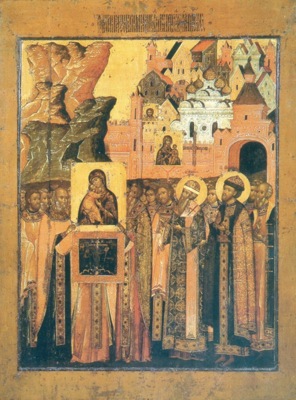
The initiative to transfer the holy icon is attributed specifically to Metropolitan Cyprian. Later, the Sretensky Monastery was founded at the site where the icon was received in Moscow. This story has become one of the most famous in the metropolitan’s hagiography, although it is important for the modern reader to distinguish between historical facts and the Church’s interpretation of events.
When Saint Cyprian Died
Cyprian died on September 16, 1406. Before his death, he was staying in the village of Golenishchevo near Moscow, where he was also engaged in scholarly work. After his death, his body was transferred to Moscow and buried in the Assumption Cathedral in the Kremlin. Later, Cyprian began to be venerated as a saint. His name was included in the church calendars, and the day of his death became one of the main days of his commemoration. In addition to September 16, the church tradition includes other days associated with his veneration, notably the date of the discovery of his relics.
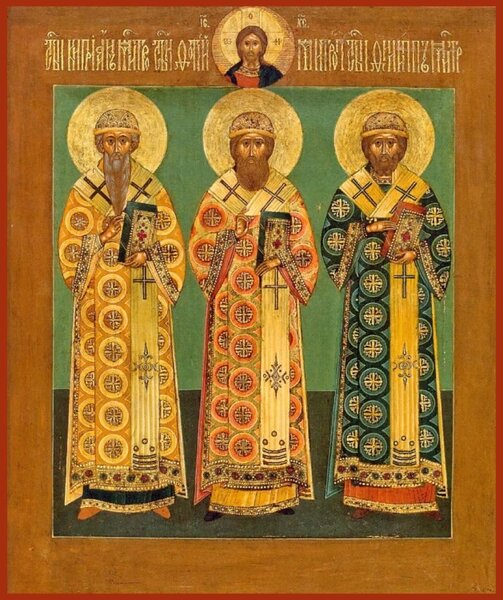
Thus, September 16 holds special significance. It is not a random date on the calendar, but the day on which the metropolitan’s earthly life came to an end. That is why, on this day, his ministry, works, and spiritual legacy are particularly commemorated.
How the Day of Remembrance of Saint Cyprian Is Observed
For believers, this day is first and foremost associated with prayer. Divine services are held in churches, during which Saint Cyprian is commemorated and prayers are read in his honor. People can come to church, light a candle, pray for their loved ones, and ask for spiritual support. It is especially fitting on this day to reflect on the virtues associated with Cyprian: wisdom, self-restraint, a love of knowledge, prayer, and service to others. In the church tradition, a saint’s feast day is not merely a commemoration of a historical figure. It is an opportunity to reflect on his example and try to apply certain values to one’s own life.
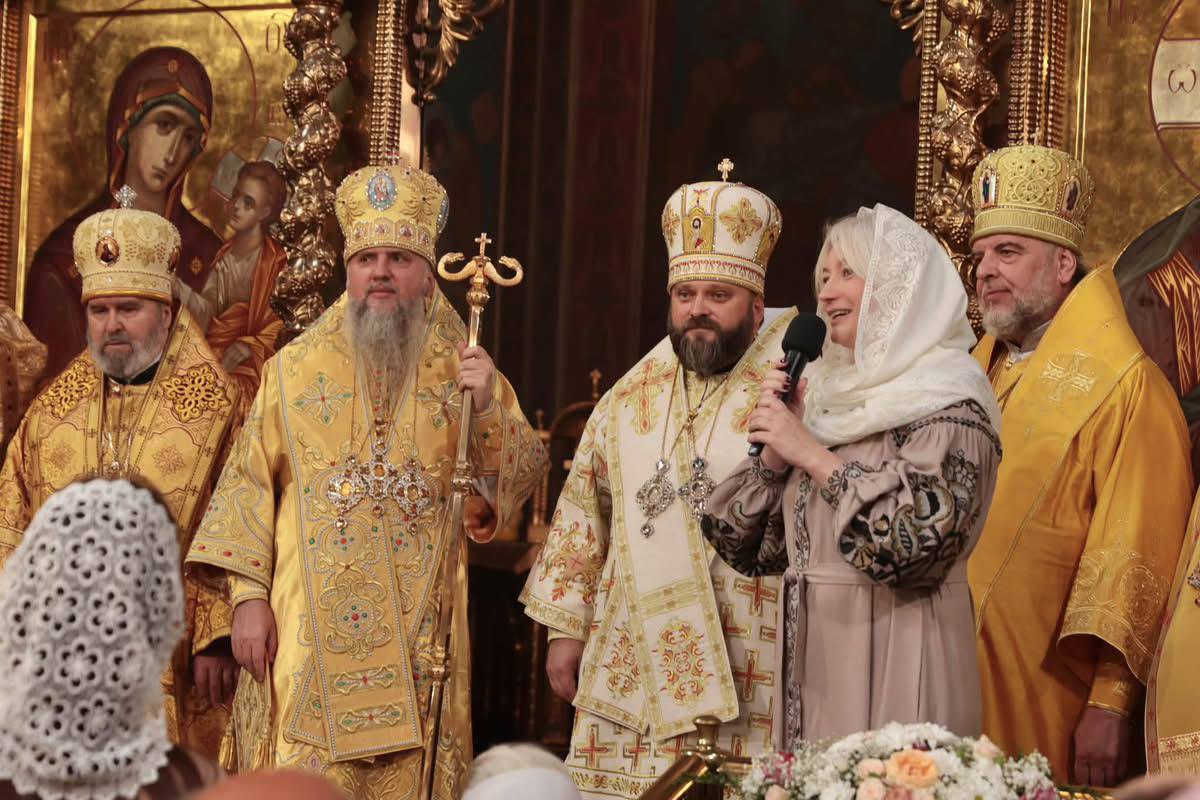
On this day, one can also read the saint’s hagiography and learn about the history of the Church and medieval literary culture. For those interested in the history of Ukraine and Eastern Europe, the figure of Cyprian is particularly fascinating, as he lived during a period when church life was closely intertwined with major political changes. At the same time, there are no specific folk festivities or major secular traditions associated with this day. It is, above all, a day of remembrance for the Church. Therefore, it is usually observed quietly, with prayer and remembrance of the saint.
What You Can and Shouldn’t Do on This Day
The main advice for the saint’s day of remembrance is not to reduce it to a mere list of everyday prohibitions. The Church first and foremost calls on people to focus on prayer, good deeds, charity, and the spiritual life. If possible, you can visit a church on this day and pray for yourself and your loved ones. You shouldn’t view the day of remembrance as a day when any kind of household work is supposedly strictly forbidden. Household chores, work, or necessary responsibilities are not in themselves a reason to give up your normal life. It is far more important not to turn a church holiday into an excuse for quarrels, insults, anger, or indifference toward others.
Nor should one attribute various superstitions to this date if they have no connection to church tradition. Over time, folk beliefs have arisen around many church dates, but they do not form the basis of the day of remembrance itself. The significance of September 16 lies first and foremost in honoring Saint Cyprian and his spiritual example.
Interesting Facts About Saint Cyprian
Saint Cyprian was originally from Bulgaria, but he spent most of his life in various ecclesiastical centers of Eastern Europe. He was associated with Constantinople and Mount Athos, and later became the head of the Kyiv Metropolis. Such a path for a medieval church leader was not easy and required a high level of education and diplomatic skills.
Cyprian was not only a metropolitan but also a translator. He worked with Greek texts and translated ecclesiastical works into the Slavic language. He also edited and transcribed ecclesiastical books, which made him a prominent figure in the history of medieval book culture.
Another interesting fact is that his activities are associated with the transfer of the Vladimir Icon of the Mother of God from Vladimir to Moscow in 1395. This event became one of the most important chapters in the church history of that time. Later, the Sretensky Monastery was founded at the site where the icon was received.
Cyprian died in 1406 and was buried in the Cathedral of the Dormition in the Moscow Kremlin. According to church sources, his relics were discovered in 1472. The memory of the saint has been preserved in the church calendar, and his name remains associated not only with church history but also with the development of medieval literature and translation.
Why This Date Is Important
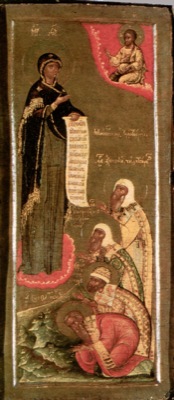
The commemoration of Saint Cyprian is, above all, a reminder of a man who lived during a complex historical era but devoted much attention to education, books, and spiritual ministry. His life shows just how important working with texts and preserving the spiritual heritage was for medieval society. Cyprian left behind not only ecclesiastical decrees but also a significant body of literary works.
For people today, September 16 can be an occasion to reflect on this chapter of history and learn more about the medieval Kyiv Metropolis. It is also a day when believers can turn to prayer and remember the saint as an example of an enlightened spiritual minister. That is precisely why the memory of Cyprian has been preserved in the church calendar for many centuries. The main idea behind this day is not a grand celebration, but remembrance. The commemoration of Saint Cyprian combines church tradition, history, and literary heritage. And his life’s journey reminds us that spiritual ministry in the past often required not only faith but also knowledge, patience, and a great deal of personal responsibility.


