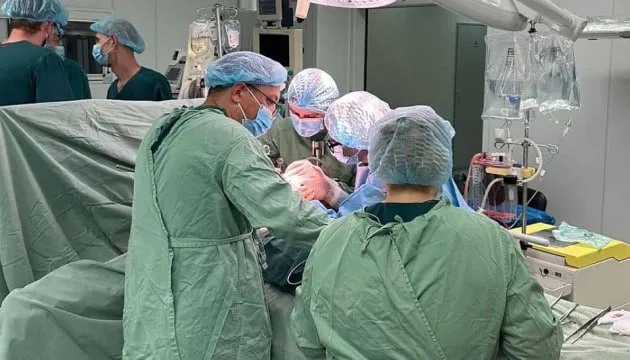
The O. F. Gerbachevsky Zhytomyr Regional Clinical Hospital performed its first high-tech FET cardiac surgery on a patient with an aortic condition. Medical staff note that procedures of this complexity are rare and require specialized equipment and an experienced team. The surgery successfully stabilized the patient’s condition.
“At the Zhytomyr Regional Hospital, a high-tech surgical procedure was performed for the first time in the region, which, without exaggeration, ranks among the most complex in modern cardiac surgery and is currently available only at a limited number of leading cardiac surgery centers in the country,” the statement reads.
It is noted that the patient was admitted to the facility with a history of previous surgery for a dissecting aortic aneurysm. His condition remained stable, but subsequently, progressive aortic dilation occurred distal to (beyond) the site of the previous reconstruction.
After thorough additional examination and multidisciplinary planning, specialists decided to perform a FET (Frozen Elephant Trunk) procedure, which involves prosthetic replacement of the ascending aorta, the aortic arch, and the descending thoracic aorta with complete reimplantation (transplantation) of the brachiocephalic vessels (which supply blood to the head and the entire upper shoulder girdle).
The hospital added that on the morning after the surgery, the patient was breathing on his own, and two days later he was transferred from the intensive care unit to a general ward.
In Lviv, a 12-year-old boy received a heart transplant from a 10-year-old girl who died in a traffic accident.
At Okhmatdyt, an 8-month-old boy was saved after a donor liver was delivered by air.
Earlier at the Okhmatdyt National Children’s Specialized Hospital, doctors and staff honored the memory of 13-year-old Ivan, who became a donor after his death and saved the lives of four patients.
Thanks to the Ukrainian Bone Marrow Donor Registry, a genetic match was found for 34-year-old Zinoviy from Kyiv, who had been battling aplastic anemia for a long time. Unfortunately, there was no match among the donor’s relatives. However, the registry identified a 21-year-old man who donated his hematopoietic cells.