
Ukrainians Name Their Favorites in the Parliamentary Elections — Poll

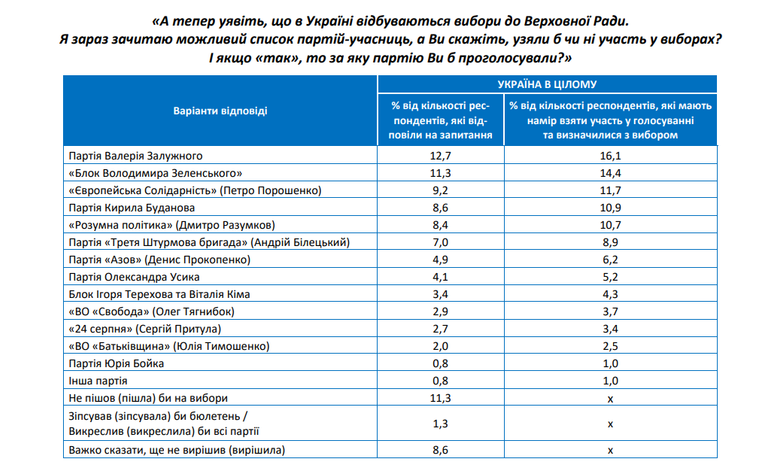
According to the poll results, if elections to the Verkhovna Rada were held in late May 2026, the “European Solidarity” party would receive the most support. Thirty-nine percent of respondents are ready to vote for it. “Servant of the People” ranks second with 29% support. The poll also shows voters’ general preferences regarding political forces in the event of a potential vote.
Thus, 16.1% of those who would participate in the vote and have made up their minds are ready to support Valery Zaluzhny’s potential party.
"Volodymyr Zelenskyy’s Bloc" stands at 14.4%, and the "European Solidarity" party at 11.7%.
The 5% threshold is also cleared by Kirill Budanov’s potential party—10.9%, Dmytro Razumkov’s “Smart Politics”—10.7%, Andriy Biletsky’s “Third Assault Brigade” (8.8%), the “Azov” party (Denys Prokopenko) (6.2%), and Oleksandr Usyk’s Party (5.2%).
Ratings of parties currently represented in the Rada
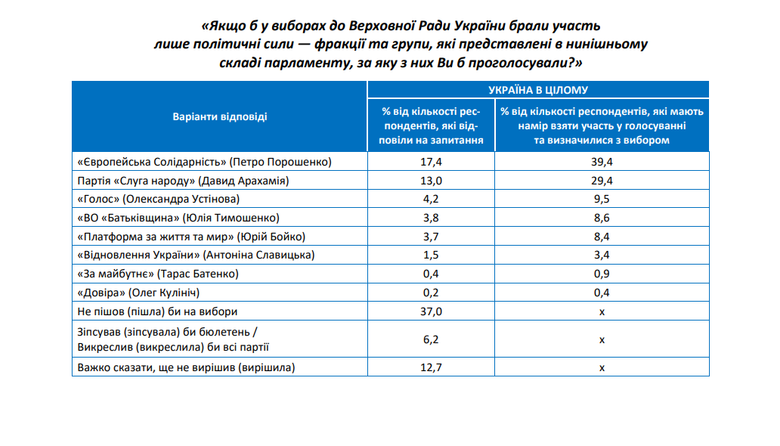
Given that it is currently unknown when exactly the next parliamentary elections might take place and which political forces will participate in them, respondents were also asked to evaluate a hypothetical scenario in which only the political forces—factions and deputy groups—represented in the current parliament would participate in the elections to the Verkhovna Rada of Ukraine.
Under this hypothetical scenario, Petro Poroshenko’s “European Solidarity” party would receive the most support—17.4% of all respondents and 39.4% among those who would vote and have made up their minds. Second place would go to the “Servant of the People” party—13.0% of all respondents and 29.4% among those who would vote and have made up their minds. Other parliamentary political forces have significantly lower levels of support: "Holos" – 4.2% and 9.5%, respectively, "All-Ukrainian Union 'Fatherland'" – 3.8% and 8.6%, respectively, "Platform for Life and Peace" – 3.7% and 8.4%, respectively, "Restoration of Ukraine" – 1.5% and 3.4%, respectively, "For the Future" – 0.4% and 0.9%, respectively, and "Trust" – 0.2% and 0.4%, respectively.
At the same time, 37.0% of respondents would not vote in such a scenario, 6.2% would spoil their ballot, and 12.7% remain undecided.
Methodology
The survey was conducted from May 24 to 29, 2026. A total of 1,002 respondents were interviewed.
The theoretical statistical margin of error for the representativeness of the proportion of a characteristic, with a confidence level of 0.95 and without accounting for the design effect, does not exceed:
3.1% – for data close to 50%;
2.7% – for data close to 25% and 75%;
2.5% – for data close to 20% and 80%;
2.2% – for data close to 15% and 85%;
1.9% – for data close to 10% and 90%;
1.4% – for data close to 5% and 95%.
This is evidenced by the results of a "Sociopolis" poll.
A Parliament in Disarray: What Is Happening to the Supermajority?
Charles III reaffirmed his unwavering support for Ukraine in a speech to Parliament.
The Rada adopted important decisions regarding the EU and funding.


