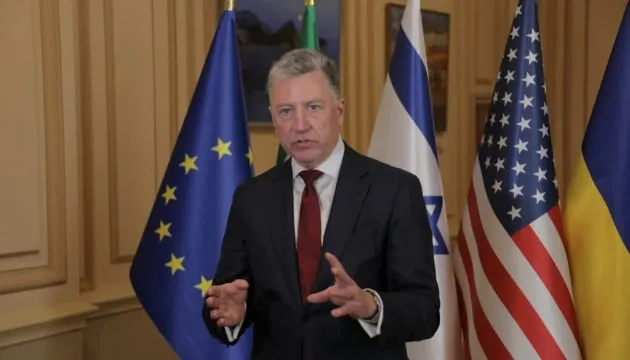
This was stated by Kurt Volker, the U.S. State Department’s Special Representative for Ukraine from 2017 to 2019, in an interview with Ukrainian Radio.
"Russia is not demonstrating a serious interest in reaching a peace agreement. It is making maximalist demands and using negotiations as a tool to pressure Ukraine, as well as a way to encourage the United States to exert this pressure," the diplomat noted.
In addition, he said, the Russians are trying to entice American negotiators with the prospect of business deals following the lifting of sanctions, hoping this will push them to increase pressure on Ukraine.
"So Russia is not taking these negotiations seriously. Ukraine understands this well, but at the same time participates in the negotiations, because it is important for Ukraine not to appear as a party that does not seek peace or is not ready for dialogue. That is precisely why Ukraine conscientiously participates in all negotiation formats, remains open to engagement, and even responds to frankly weak or unacceptable proposals, trying to turn them into more realistic ones. And this is the right strategy. However, I think Ukrainians understand—and have understood from the very beginning—that this process is not serious,” Volker noted.
He acknowledged that the U.S. has now shifted its focus to Iran, so there is currently “virtually no attention” being paid to the negotiation process regarding ending the war in Ukraine.
"In fact, the situation on the battlefield and in the real world is more important than the negotiations themselves. And very telling things are happening there. Russia’s financial situation is deteriorating; its economy is under pressure. It is no longer able to replenish its manpower losses on the same scale, nor can it replace its equipment losses with the same quality. At the same time, Ukraine has developed its own defense industry and today meets 60–70% of its needs through domestic resources. It has gained important advantages," noted the former State Department special representative.
He also noted that Ukraine is capable of striking targets deep inside Russian territory, particularly oil export facilities, which are critical for financing the war.
Therefore, according to him, a situation is emerging that increasingly favors Ukraine.
"And if this trend continues, it could create conditions under which Russia would be forced to agree to a ceasefire. Currently, Russia still prefers to continue its attacks and make demands, using negotiations as a tool to extract additional concessions. But it is entirely possible that we will eventually reach a genuine ceasefire—and that would be a positive outcome," the diplomat noted.
He emphasized that supporting Ukraine is in the U.S. interest: “We must ensure that Ukraine succeeds and emerges from this war as a sovereign, independent European democracy. It is also important to establish a new border in Europe within which Russia will remain, rather than accepting the logic that it can simply invade and seize territories.”
Volker added that he has no doubt about Ukraine’s victory.
"Ukraine has already firmly established itself as a sovereign, independent European democracy, a future member of the European Union, and a state that will not only benefit from security guarantees in Europe but will also contribute to European security itself. The only thing we don’t know yet is when this war will end and exactly where the border, the ceasefire line, will run. Unfortunately, part of Ukraine’s territory will remain occupied for a long time. But we must never recognize this as lawful or legitimate. Ukraine must continue its economic, political, and security development, even despite the temporary occupation of part of its territory,” the diplomat noted.