
Filatov reported a decline in Russian activity in the Zaporizhzhia region and pressure in the Donetsk region
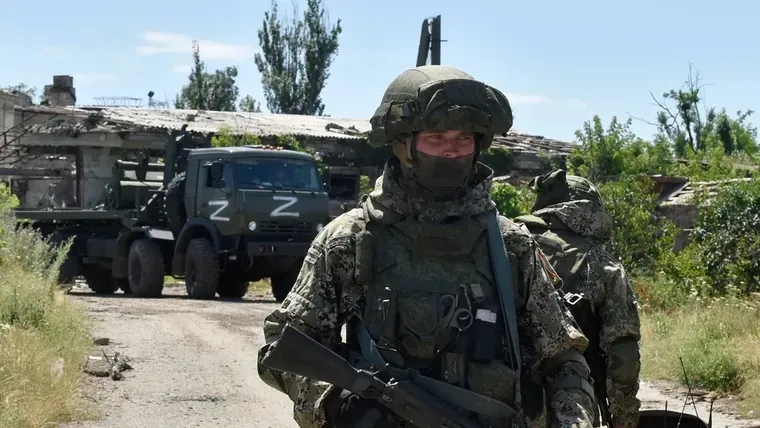
The situation in the Zaporizhzhia sector has stabilized, and the intensity of Russian assaults is gradually decreasing. Dmytro Filatov, commander of the 1st Separate Assault Battalion “Da Vinci,” stated that Russia is shifting its focus to the Donetsk sector, specifically the Dobropillia area.
Dmytro Filatov, commander of the 1st Separate Assault Regiment named after Dmytro Kotsyubailo, spoke about this on “Hromadske Radio.”
According to Filatov, Russian forces continue to use infiltration tactics—attempting to penetrate as deeply as possible into Ukrainian positions using small assault groups.
“Currently, the situation in the Zaporizhzhia sector has fully stabilized. The number and intensity of the enemy’s assault operations are gradually decreasing. The enemy is beginning to refocus its attention on the Donetsk region, specifically on the city of Dobropillia. Their tactics have remained unchanged over the past few years. This involves infiltration—attempts to send isolated assault groups as deep as possible,” Filatov said.
He noted that such groups can operate without direct drone escort. Russian military personnel determine their routes and points of advance in advance.
“Quite often, this happens without UAV support. They simply map out a route and designate waypoints. The commander monitors the situation: if a group is no longer at a given waypoint, he establishes contact. So even if there’s no surveillance, they understand that the group has either been eliminated or taken prisoner. And they plot a route for the next group that bypasses that area,” the commander explained.
Filatov cited the active use of drones by Russian forces as a particular challenge. According to him, Russia has powerful units that specialize in the use of UAVs, notably “Rubicon.”
“Their use of UAVs is quite advanced. They also have very powerful units working in this area, such as ‘Rubicon.’ And they have increased their capabilities to disrupt our logistics. They are now covering a greater depth and targeting these areas more intensively. They are also quite active along the front line. If they detect our positions and troop movements, they focus their UAV resources on them as much as possible,” the military official said.
According to the commander, Russia has achieved significant results in the production of drones and the quality of these systems. He believes that, in terms of the number of UAVs, the two sides are currently roughly on par.
“The enemy has achieved significant success in this regard, both in terms of production volume and product quality. Their drones are in no way inferior to ours in quality, and in some respects, they sometimes even surpass ours. In terms of the number of drones and the scale of production, we are roughly on par. In other words, the enemy has roughly the same number of UAVs as we do,” the commander noted.
Filatov emphasized that supplying the troops is currently one of the most difficult tasks on the front lines. According to him, the stability of the front line directly depends on the effectiveness of logistics.
“Logistics today, in my opinion, is a greater challenge than holding the front line. Because, in fact, the stability of the front line depends directly on the effectiveness of logistics and the resupply of both combat support units This applies equally to the units directly engaged in combat on the front line,” he explained.
The military official added that Ukrainian units may currently be suffering more casualties during logistics operations than during actual combat.
“Statistically speaking, the current situation is such that we suffer more casualties during logistics operations and while supporting those operations than during combat on the contact line,” Filatov said.
Filatov also spoke about the role of Orikhiv in the defense of the Zaporizhzhia sector. According to him, the city is situated on high ground and serves as a key defensive hub.
“From a military standpoint, if we look at the line of contact, this is one of Orikhiv’s flanks. Orikhiv is a high ground that controls the area in front of it. I wouldn’t say it’s exactly the steppe, but this is where the steppe zone of the Zaporizhzhia region begins. Here, the distance between forest strips is twice as long—or even three times as long—as in other areas, where there are very large expanses of open terrain,” he explained.
The commander compared the role of Orikhiv to that of Vuhledar, the loss of which, he said, created opportunities for Russian troops to advance deeper into the operational depth.
“Orikhiv itself is a key defensive node because it is elevated. I can give you the example of Vuhledar. Vuhledar was a very important defensive node, and as long as Vuhledar held, the Kurakhiv direction remained fairly stable. And the enemy was unable to achieve success. As we recall, immediately after the loss of Vuhledar, the enemy was able to build on its successes into operational depth. It wasn’t exactly a rapid advance in a single day, but over the course of four months, the enemy achieved more than in all the previous years in that sector,” Filatov said.
According to him, a similar scenario could also play out on the Zaporizhzhia front.
“Orikhiv is roughly the same kind of case, and if we lose Orikhiv—which is a key defensive node—the enemy’s advances in the Zaporizhzhia sector will be significant. Therefore, the Huliaipole sector is a key flank that ensures Orikhiv’s stability, and it must be held. And in general, we cannot let our guard down on the Zaporizhzhia sector, because there are very many risks there,” the commander emphasized.
Source: Hromadske Radio
Over the past 24 hours, the Special Forces have struck more than 2,300 targets and 558 Russian drones.
As a reminder, partisans destroyed a drone depot in the Sverdlovsk region of the Russian Federation.
Overnight, three regions in Russia came under attack.
Drones also attacked the Iskra plant and the Perm Oil Refinery in Russia.




