
How heavy drones are saving lives on the frontline
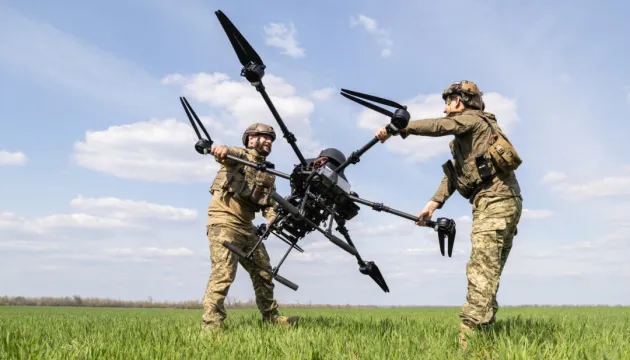
Ukraine is training operators of heavy strike drones, which have become a major threat to Russian armoured vehicles on the battlefield. These large multirotor UAVs, operated remotely, are capable of destroying depots, logistics routes and enemy equipment, helping to save the lives of Ukrainian soldiers. This was reported by the Ministry of Defence of Ukraine.
A heavy bomber drone operator is a specialist who controls high-payload UAVs using advanced control systems.
“On the battlefield, they usually appear at night, and the enemy fearfully calls them ‘Baba Yaga’,” the ministry said.
Operators work with cameras—most often thermal imaging—and carry out precise munition drops in real time.
Their task is to stealthily guide the drone to enemy positions, locate concealed equipment and depots, accurately release munitions, and safely return to base for reloading.
“These specialists inflict maximum damage on the enemy while preserving the most valuable thing — the lives of their comrades,” the ministry emphasised.
Technology and capabilities
Ukraine is among the world leaders in the use of heavy copter drones. The Defence Forces operate domestically produced systems such as Vampire, Kazhan and Nemesis. These are large hexacopters or octocopters capable of carrying payloads ranging from 10 to 40 kilograms, including anti-tank mines and high-explosive fragmentation munitions.
Each crew is equipped with a protected ground control station, Starlink satellite terminals, generators and a vehicle for rapid drone deployment. For personal protection, operators carry standard small arms while securing launch positions.
Training begins with basic military instruction, followed by an intensive specialised piloting course. Future operators learn to control large drones, manoeuvre with payloads, and perform complex ballistic calculations. They also train in optics and night vision, and receive safety and explosives-handling instruction.
“Operating heavy drones is a profession that builds advanced skills. After service, such specialists can work in well-paid civilian sectors, including agriculture and logistics,” the Ministry of Defence added.
On the night of 21 March, Ukraine’s Defence Forces struck facilities at the Saratov oil refinery in Russia’s Saratov region.
Earlier, around ten powerful explosions were reported over the Russian cities of Saratov and Engels.
Powerful explosions were also reported at the Belbek airfield in Crimea.
Drones also targeted the Ilsky oil refinery and Sevastopol.


