
Companies affected by the attacks may be provided with government warehouses
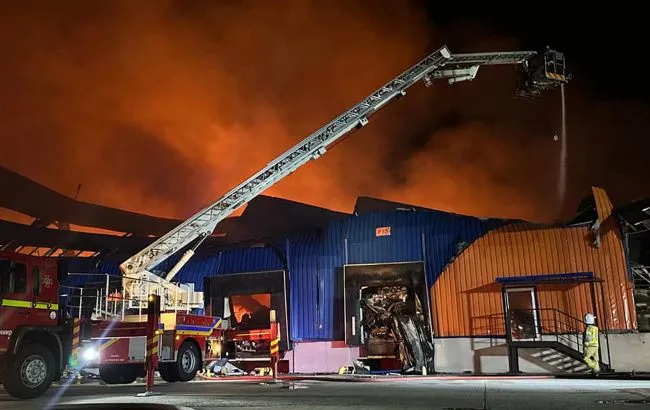
The State Property Fund of Ukraine has begun inspecting the warehouse facilities of state-owned enterprises to identify space for companies that have lost their logistics facilities due to Russian attacks. Preliminary estimates suggest several hundred thousand square meters, but how much of that space can actually be transferred to businesses will become clear after on-site inspections.
The State Property Fund has launched an audit of state-owned enterprises’ warehouse facilities at the government’s request. The goal is to determine which facilities are currently vacant or can be used to meet the needs of private companies affected by Russian shelling.
According to State Property Fund Chairman Dmytro Natalukha, there is a great deal of such space on paper. Preliminary estimates indicate several hundred thousand square meters of warehouse space. For businesses, this could serve as a temporary solution following the loss of their own logistics centers.
However, this figure does not yet mean that all of this space can be immediately filled with goods. Some of the warehouses may be occupied, in poor condition, or subject to other restrictions. Some facilities may exist only on paper, while in reality their size or condition does not match the information in the documents at all. “Formally, there is a great deal of warehouse space that affected businesses could potentially use—several hundred thousand square meters. However, in reality, all of this must be physically inspected to determine the condition and suitability of these spaces, as well as their actual physical accessibility for transfer to businesses. Because what’s on paper is one thing, but the reality can be completely different,” Natalukha explained.
The State Property Fund will inspect warehouses on-site
Next week, representatives of the State Property Fund plan to travel to the regions. There, they will inspect the warehouse facilities, assess their technical condition, verify their actual floor area, and determine whether they can be used for storing goods. Separately, officials will determine which facilities are already leased and how much space might be available for a new user. This is important because even if a state-owned enterprise has a large warehouse on its books, that doesn’t necessarily mean it can be quickly transferred to an affected company.
The Fund is also seeking a legal mechanism that would allow businesses to obtain such facilities. There are several options here, but no final decision has been made yet. One option is to hold auctions for the right to lease. Another is to transfer the facilities to a designated state-owned company, which could then sublease the warehouse space to businesses.
They are even considering the possibility of a nominal rent—for example, one hryvnia per month. This approach would help reduce the financial burden on companies that have already suffered significant losses due to Russian attacks.
At the same time, the State Property Fund emphasizes that the scheme must be transparent. The government does not want to create a situation where certain companies gain access to cheap warehouse space without clear rules. “We considered the possibility of holding auctions to sell lease rights to businesses, as well as the possibility of leasing these assets—for a nominal fee of 1 hryvnia per month—to a designated state-owned company, which could then sublease them to businesses. But it’s important not to create opportunities for corruption here. So we’re working on legal options,” Natalukha said.
Why Businesses Urgently Need New Warehouses
The need for such space arose after a series of Russian attacks on Ukrainian logistics infrastructure. On August 5, Russia launched another massive strike using drones and ballistic missiles, which targeted, among other things, the warehouses and production facilities of large companies. Among those affected were Epicenter, Rozetka, Nova Poshta, and Silpo. The attack also halted operations at the Epicenter Group’s ceramic tile factory.
For large retail chains, the warehouse is essentially the heart of the entire sales system. Goods are stored there, and from there they are distributed to stores and shipped to customers. If such a facility is destroyed, the company loses not only the premises but also vast inventories of products and the ability to operate normally. The situation becomes particularly difficult for companies that handle seasonal merchandise. If inventory is destroyed ahead of the fall season, the business must simultaneously search for new facilities, negotiate with suppliers, reorganize delivery routes, and replenish its inventory.
Russian attacks on logistics have been ongoing for several months now. Back in June, Russia attacked the logistics centers of the “ATB” retail chain. Facilities belonging to other well-known companies were also targeted. These included, in particular, Puma and Intertop. Puma warned that the loss of inventory could lead to shortages of certain products.
Russian strikes are not limited to warehouses
Attacks on logistics centers create problems far beyond the scope of a single company. If a large warehouse is destroyed, the company is forced to find a new location for its goods and effectively rebuild its entire supply chain. This can also affect customers. Certain products may temporarily disappear from stores or become less available. Companies have to find alternative routes, negotiate new warehouse space, and expedite shipments from other countries.
For the state, this also means an additional burden. It’s not just about direct losses to businesses, but also about taxes, jobs, employee wages, and the stability of the domestic market.
That is why the State Property Fund is trying to use state-owned real estate as one way to help companies. If suitable premises can be found quickly and the transfer process made transparent, businesses will be able to at least partially resume operations without having to wait months for new warehouses to be built.
So far, there is no final list of available facilities. First, the State Property Fund must inspect the properties on-site to assess their condition and availability; only then will it become clear exactly how much warehouse space the government can realistically offer to affected businesses. This was reported by the fund’s chairman, Dmytro Natalukha, who made the remarks during a meeting with the media.
Russia dropped seven aerial bombs on Sumy: one person was killed and others were injured.
On the night of July 19, Russian troops launched a ballistic missile strike on Kyiv. One person was killed and eight others were injured as a result of the attack. Damage and fires were reported in five districts of the capital.
Over the course of July 17, Russian forces carried out strikes on Kharkiv and 29 other settlements in the Kharkiv region. Two people were killed and 18 others were injured in the shelling; among the injured were five children.


