
Russia staged a propaganda show in Ukraine's temporarily occupied territories
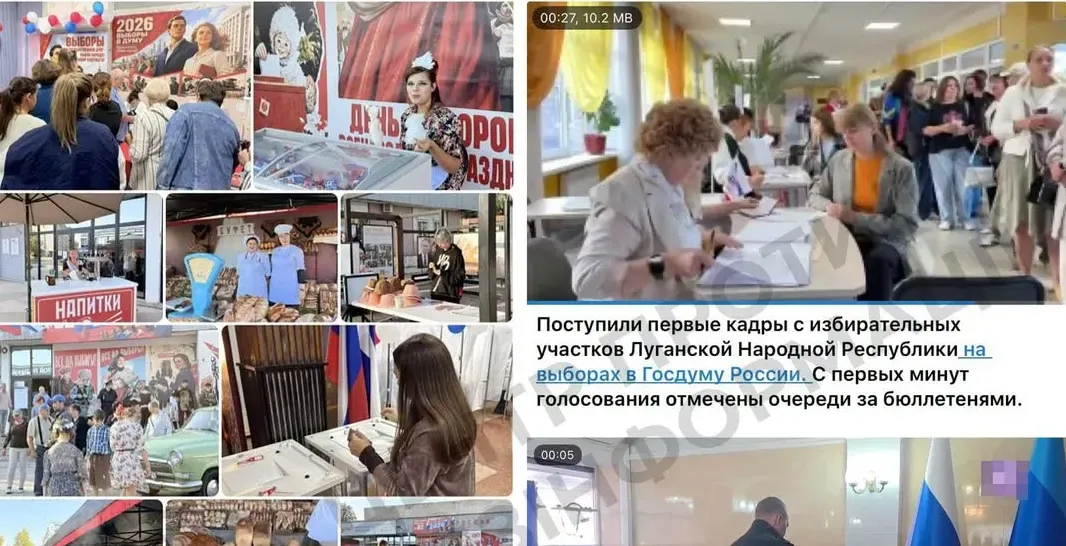
Voting has begun in the temporarily occupied territories of Ukraine for the so-called elections to the Russian State Duma, which Ukraine does not recognize. At the same time, Russian propaganda is spreading stories about alleged high voter turnout at polling stations and attempting to create the impression of “mass support” for the Russian Federation.
In Russia, three days of voting in the State Duma elections began on September 18. It will continue until September 20. This year, Moscow is also holding voting in the temporarily occupied territories of the Donetsk, Luhansk, Zaporizhzhia, and Kherson regions. Ukraine considers such actions illegal. Ukraine’s Central Election Commission stated back in August that the organization of Russian “elections” in the temporarily occupied territories lacks legitimacy. The CEC emphasized that Russia is using electoral procedures in an attempt to legitimize the occupation and extend its jurisdiction over Ukrainian territories.

As voting begins, Russian propaganda outlets are actively publishing reports about allegedly large crowds at polling stations in the occupied cities. The reports show lines of people and crowds supposedly coming out to vote en masse. The decor of these polling stations draws particular attention. In the videos, election commission members are often seen wearing ribbons in the colors of the Russian flag. In this way, the propaganda seeks to portray the voting as a major patriotic event.
At the same time, it is impossible to reliably assess the actual number of people participating in such voting based on propaganda reports. The mere fact that people are present at polling stations does not, in itself, indicate their voluntary support for the Russian authorities.
In Henichesk, they staged an “event evoking nostalgia for the USSR”
The occupiers are using more than just campaigning to attract people to the polling stations. In the occupied cities, they are organizing additional entertainment and trying to turn the voting into a kind of celebration. In particular, in occupied Henichesk, one of the polling stations was decorated in the style of the 1960s. There, they played Soviet songs and set up a refreshment stand with “Duches” lemonade.
In this way, the occupiers are using Soviet symbols and nostalgia to create an atmosphere for people that suggests a supposedly ordinary festive event. Against the backdrop of war and occupation, such a scene is intended to serve Russian propaganda. At the same time, Russian media can present such events as evidence of the population’s supposedly positive attitude toward the elections. However, isolated propaganda footage does not allow one to draw conclusions about the actual sentiments of all residents of the occupied territories.
Voting is taking place even in dangerous areas
Russian authorities have also organized voting in areas near the front lines. The Russian Central Election Commission established specific rules in advance for conducting voting in territories under martial law. As a result, setting up polling stations in frontline areas poses additional risks to the civilian population. People are effectively being drawn into the Russian electoral process even in places where fighting is ongoing and there is a threat of shelling.
At the same time, Russian propaganda uses such footage to create the illusion of “normal life” in the occupied territories. The screen shows people arriving at polling stations, election commission members, and well-decorated premises, but it shows almost nothing of the actual living conditions under occupation.
Why Does Russia Need These “Elections”?
Holding elections in the occupied Ukrainian territories has not only domestic but also political significance for the Kremlin. Moscow is trying to show that the seized territories have supposedly become part of the Russian political sphere. That is precisely why the occupied regions of the Donetsk, Luhansk, Zaporizhzhia, and Kherson oblasts are included in the Russian electoral process.
Ukraine and its government bodies do not recognize these actions as legitimate. On September 18, the Ukrainian Ministry of Foreign Affairs called on the international community not to recognize the Russian elections, which are being held both on the territory of the Russian Federation and in the occupied regions of Ukraine. At the same time, the Russian authorities are attempting to use the very fact that voting is taking place, along with media coverage of it, as evidence of alleged support for their policies. This is precisely the purpose of reports featuring “lines of voters,” festive decorations at polling stations, entertainment, and other staged footage.
Russia is holding its first parliamentary elections since the start of the full-scale war
These State Duma elections are the first parliamentary elections in Russia since the start of the full-scale invasion of Ukraine in 2022. Voting takes place September 18–20, and 450 deputies are to be elected to the State Duma. A distinctive feature of this year’s elections is that Russia has included Ukrainian territories occupied after 2022 in its electoral process. Ukrainian authorities emphasize that such actions do not create any legal basis for changing the status of these territories.
Against this backdrop, Russian propaganda continues to portray the voting as a routine political process. However, Ukraine views the holding of Russian “elections” in the occupied Ukrainian territories as an illegal attempt to extend the Russian system of governance to the seized lands.
Throughout the day, Russian invaders attacked five districts in the Dnipropetrovsk region more than 40 times, using drones, artillery, and aerial bombs. As a result of the enemy strikes, three people were killed and five others were wounded.
On the morning of September 17, Russian troops struck the “Epicenter” shopping center in Kharkiv. As a result of the attack, the building sustained significant damage and caught fire.
The enemy attacked a passenger bus in the Kosmichnyi district of Zaporizhzhia using an FPV drone. At the time of the attack, there were people inside the bus who were traveling on their daily errands.


