
Russian troops are advancing toward Izyum again — NYT
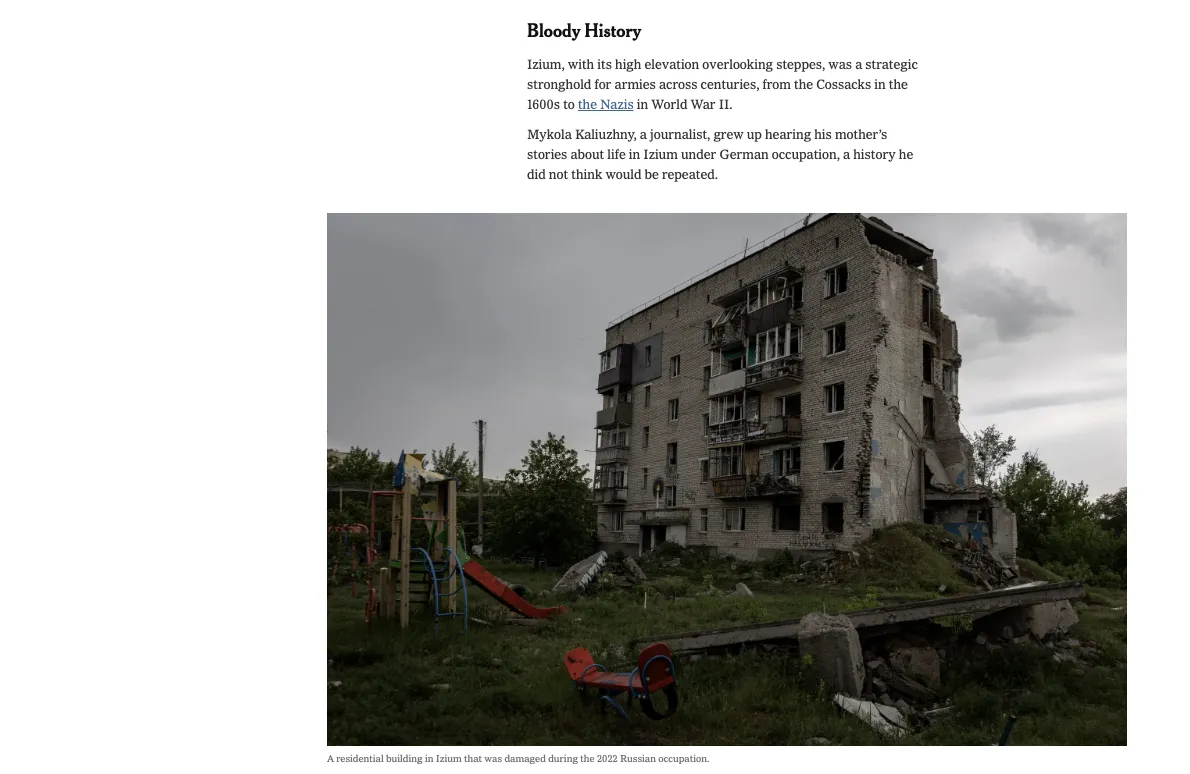
On September 12, The New York Times reported on a new threat to Izyum in the Kharkiv region, which is still recovering from the Russian occupation of 2022. Russian troops are approaching the city, and local residents are preparing for the worst-case scenario.
According to the journalists, a number of graves in the city serve as a chilling reminder of the horrors of the Russian occupation four years ago. Among them are inscriptions on the crosses reading “Unknown Woman” and “Bone Fragments.” Russian troops left behind destroyed buildings and a mass grave. All 447 bodies from the grave were exhumed and reburied on a hill, including remains that have not yet been identified.
Residents have no illusions: they say that another battle for the city will be far worse than the last. Therefore, although Izyum is not currently under immediate threat of capture or destruction, people are preparing for the worst, while hoping that Ukrainian forces will continue to hold the line of defense.
Meanwhile, the authors write, the Ukrainian military has set up new fortifications around the city and has been rehearsing operations to repel a large-scale assault. According to one of the local commanders, whose call sign is “Coach,” they are planning for “every possible scenario.”
Mykola Kalyuzhny, a 70-year-old journalist and local resident, says that as a child he listened to his mother’s stories about life in Izyum during the German occupation. He never thought that history could repeat itself. He vividly remembers the first Russian planes in the sky, the first bombs that struck the city center, and the mangled body of a man lying beneath the monument to the poet Taras Shevchenko.
“It was like Stalingrad in 1942. Everything was on fire,” he recalls.
The city’s historical museum is hosting an exhibition on life under Russian occupation. There, visitors can see packs of Russian cigarettes, propaganda newspapers, Russian helmets shattered by shrapnel, and the occupiers’ boots.
According to Deputy Mayor Volodymyr Matsokin, Izyum does not want to remain known only as a site of mass graves or torture; it wants to move forward and rebuild. However, he said, the approaching front line has led to the suspension of major investments, including some plans to build underground schools.
As the article states, about 28,000 people currently live in Izyum—compared to 45,000 before the full-scale invasion began. The city’s movie theater, city council building, and a school have been destroyed. An anti-drone net has been strung over the sidewalk in the city center.
Izyum is an important staging ground and logistics hub for the Ukrainian military. To reach the city, Russian forces would have to break through several rings of defensive structures: minefields, triple layers of barbed wire, trenches, and concrete pyramids—known as “dragon’s teeth”—that stretch for many kilometers, journalists report.
Freshly dug trenches and anti-tank barriers are appearing along the highway leading to the city. Beyond the checkpoint, an anti-drone net forms a tunnel over the road. According to the authors, Izyum became the first city in Ukraine where such nets were installed as a preventive measure—long before drones began terrorizing the city.
Many of the city’s defensive structures were built by the 96th Separate Support Battalion of the 3rd Army Corps. It is commanded by 40-year-old Trainer, who arrived in Izyum in April 2024 after fighting in the Zaporizhzhia region, Bakhmut, and Avdiivka. At that time, he explained, Izyum was considered one of the most likely targets for a new Russian offensive.
Now, Moscow’s troops are slowly advancing through the Donetsk region east of the city. As the two fortress cities—Sloviansk and Kramatorsk—come under fire, Izyum, which serves as the gateway to the Donetsk region, has become even more important as a supply hub, the article states.
The coach predicted that Russia would intensify its efforts to block the movement of troops and equipment toward Sloviansk and Kramatorsk. However, he categorically rejected the suggestion that Izyum faces a new occupation. According to the military expert, the fresh trenches and other defensive structures are preparatory measures, not a sign that Russian troops will inevitably reach Izyum again.
“Just because they’re getting closer doesn’t mean they’ll make it here. You can’t go far with your legs blown off,” he said.
However, many residents of Izyum have a different opinion. Eгор Bratychev, 18, and Klym Velychko, 20, said that the risk of a new occupation exists.
“The likelihood is high. Have you seen our front line? It’s getting closer to us every day,” Bratishchev said.
According to him, Russia has far more people, guided bombs, and drones than Ukraine does.
“The defenses here are very strong, but it’s only a matter of time,” he added.
Natalia Rudenko, the owner of a vegetable and flower kiosk, admitted that she is afraid: staying in the city could become too dangerous.
“Russian troops are now destroying entire cities. It’s terrifying. We’re living with our suitcases packed,” she said.
Yuriy Kuznetsov, a surgeon at Izyum’s main hospital, told reporters that before the 2022 occupation, residents were like “little children”—unaware of the horrors that awaited them.
“Now I’m more afraid; we’re all more afraid because we understand the danger,” he said.
According to him, almost all of his patients now have injuries related to drone attacks. A full-scale assault, in his opinion, will be worse than in 2022.
“This time, it will be total destruction,” the doctor said.
Deputy Mayor Matsokin acknowledged that people are worried, but noted that they “talk more about hope.” He wondered where they find the strength. Perhaps it’s a defense mechanism, he suggested, or perhaps people have simply grown accustomed to war, the NYT reports.
Earlier, the Russians struck a passenger train at the Lutsk train station.
As a reminder, overnight, the Russians fired Kalibr missiles at a high-rise building in Odesa.
In the Black Sea near Odesa, two Azerbaijani sailors were killed on September 9 when the Somali-flagged tugboat TEDY was struck by a drone attack.
In Odesa, a Russian attack on September 10 damaged warehouse buildings belonging to a volunteer organization where humanitarian aid and essential supplies were stored.


