
In July, the SBS struck more than 53,000 targets and carried out 230,000 combat missions

Robert Brovdi (“Madyar”), Commander of the Ukrainian Armed Forces’ Unmanned Systems Forces, summarized the units’ performance for July 2026, emphasizing that the main activities of the Unmanned Systems Forces are focused directly on the front lines, rather than on strikes against targets deep within Russian territory.
According to the commander, the public often associates the Unmanned Systems Forces primarily with strikes on oil refineries, ports, energy infrastructure, or targets in Crimea; however, the actual structure of combat operations looks quite different.
“I’ll quickly dispel that public misconception about the priority use of the Unmanned Systems Force with some numbers,” said Robert Brovdi.
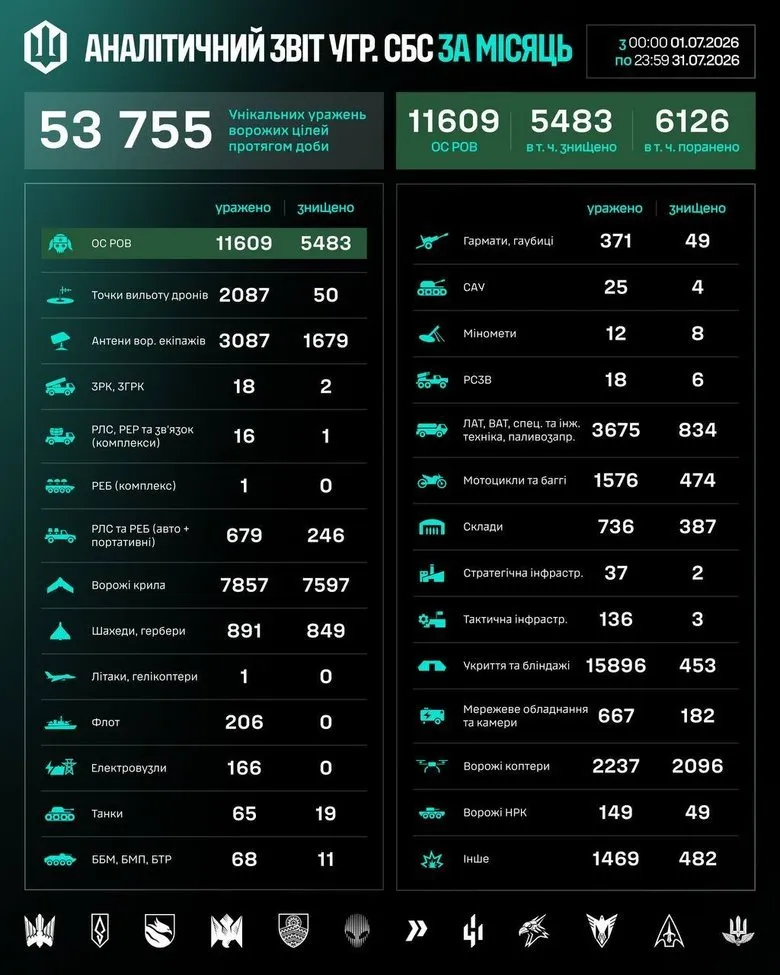
In July, UAS units destroyed or struck 53,755 enemy targets, of which:
- 95.1% (51,147 targets) were in tactical depth at an average distance of 3.73 km from the line of engagement;
- 4.4% (2,415 targets) were in operational depth, specifically in the temporarily occupied territories and in Crimea;
- about 0.5%—in Russia’s strategic territory.
Within the operational depth, according to the commander, the following were struck:
- 51 facilities—factories, oil refineries, and ports;
- 206 tankers of the shadow fleet;
- 166 energy facilities as part of Operation “Crimean Circuit Breaker Off”;
- 35 air defense system components;
- 2,008 other targets related to the blockade of occupied Crimea.
As of the end of July, the Unmanned Systems Forces had carried out:
- 230,843 combat missions;
- 128,000 strike operations;
- over 102,000 reconnaissance missions.
On average per day, Ukrainian operators:
- hit or destroyed 1,734 enemy targets;
- eliminated 374 Russian soldiers.
In total, according to the commander, 11,609 occupiers were eliminated over the course of the month.
Robert Brovdi emphasized that the main task of the Special Forces on the front lines remains to deter the enemy’s advance by destroying its manpower and equipment, while strikes deep behind enemy lines are aimed at destroying military logistics, weapons production, energy infrastructure, and air defense systems.
“The mission in the rear: to contain and prevent the enemy’s advance by destroying enemy personnel and equipment. The objective deep in the rear: to deprive the enemy of sources of war funding and weapons production facilities, to cut off logistics to the front, to neutralize air defense systems, and to prevent the enemy from using the peninsula as a military bridgehead. The main work of the SBS pilots—yesterday, today, and in the future—is being carried out right on the front line, directly under our feet—the results are on the scoreboard,” the commander emphasized.
He also stated that the workload on Ukrainian troops may increase this fall.
“An autumn bunker mobilization lies ahead—plus up to 500,000 stewed meat rations from October 2026 to March 2027; we’ll be operating in at least four directions,” Madyar wrote.
In closing, the commander added: “We will stand firm. Moscow will fall. We will rebuild Crimea and bring it back to its former glory.”
He reported this on his Telegram channel.
On the night of August 1, the Ukrainian Defense Forces carried out a series of strikes on key military facilities of the Russian occupation forces in the temporarily occupied Crimea and in southern Ukraine. The strikes targeted warehouses, railway bridges, a repair base, a radio-electronic reconnaissance unit of the Russian Black Sea Fleet, and other military logistics facilities.
On the night of August 1, drones attacked several temporarily occupied cities in Ukraine. According to reports from monitoring Telegram channels, fires broke out in Zuhres, Berdyansk, Luhansk, Dolzhansk, and Sevastopol following the strikes.
As a reminder, the Russian online marketplace Ozon evacuated employees from its logistics center in Zelenodolsk (Tatarstan) due to the threat of attacks by Ukrainian drones. After the alert ended, the warehouse resumed normal operations.
On the morning of July 31, drones attacked a warehouse complex in Zelenodolsk (Tatarstan, Russian Federation), where the logistics facilities of the Ozon and Wildberries marketplaces are located. Following this, a number of Ukrainian sources reported that strikes on Ozon warehouses might continue.


